شناسایی عوامل مؤثر بر نوآوری سازمانی در شرکتهای دارویی با تمرکز بر رویکرد جهش اقتصادی
کلمات کلیدی:
نوآوری سازمانی, صنعت دارو, جهش اقتصادی, ظرفیت جذب دانش, سرمایه انسانی, فرهنگ سازمانی, تحقیقوتوسعه, تحول دیجیتالچکیده
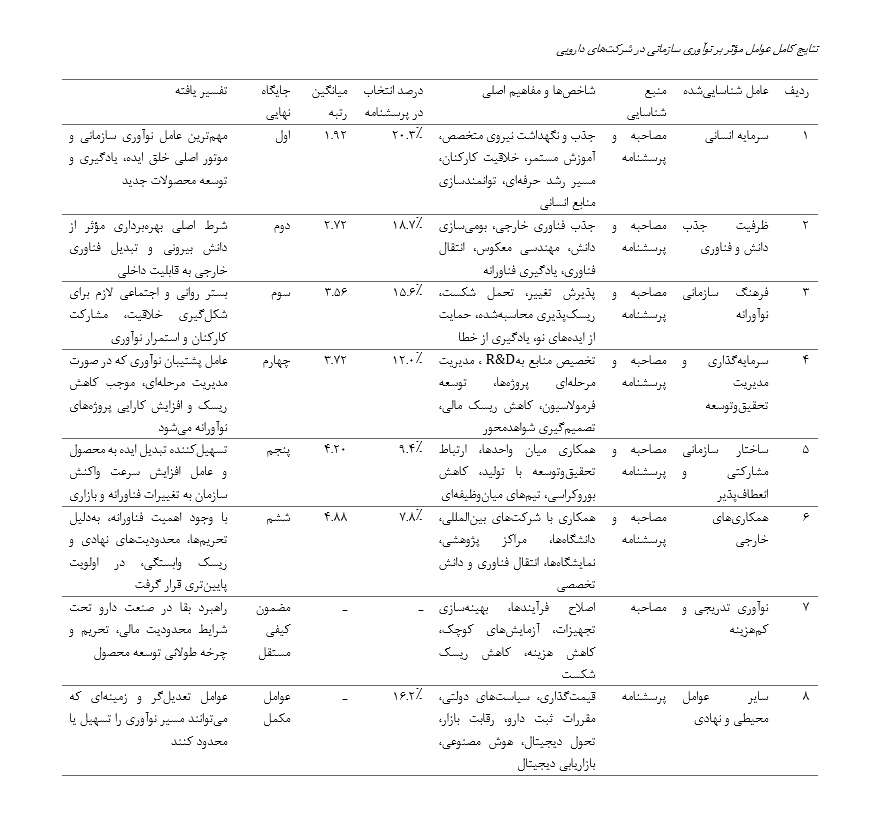
هدف این پژوهش شناسایی و تبیین عوامل مؤثر بر نوآوری سازمانی در شرکتهای دارویی پذیرفتهشده در بورس اوراق بهادار تهران با تمرکز بر رویکرد جهش اقتصادی بود. پژوهش حاضر از نظر هدف کاربردی و از نظر روش، کیفی با رویکرد تحلیل مضمون بود که در مرحله تکمیلی از دادههای پرسشنامهای نیز استفاده شد. جامعه پژوهش شامل مدیران ارشد، مدیران عامل و مدیران تحقیقوتوسعه شرکتهای دارویی پذیرفتهشده در بورس اوراق بهادار تهران بود. دادههای کیفی از طریق ۱۰ مصاحبه نیمهساختاریافته گردآوری شد و برای اعتبارسنجی و اولویتبندی یافتهها، پرسشنامه الکترونیکی پرسلاین در اختیار ۲۵ نفر از مدیران صنعت دارو قرار گرفت. تحلیل دادهها از طریق کدگذاری باز، محوری و انتخابی و همچنین تحلیل مضمون انجام شد و دادههای پرسشنامه با استفاده از آمار توصیفی و رتبهبندی عوامل تحلیل شدند. یافتههای پژوهش نشان داد که نوآوری سازمانی در صنعت داروی ایران تحت تأثیر هفت عامل اصلی شامل سرمایه انسانی، ظرفیت جذب دانش و فناوری، فرهنگ سازمانی نوآورانه، سرمایهگذاری در تحقیقوتوسعه، ساختار سازمانی انعطافپذیر، همکاریهای خارجی و نوآوری تدریجی و کمهزینه قرار دارد. در میان این عوامل، سرمایه انسانی بالاترین اولویت را به خود اختصاص داد و بهعنوان مهمترین محرک نوآوری سازمانی شناسایی شد. همچنین نتایج نشان داد که ظرفیت جذب دانش و فناوری نقش کلیدی در بهرهبرداری از فرصتهای فناورانه و بومیسازی دانش خارجی دارد. فرهنگ سازمانی مبتنی بر یادگیری، پذیرش تغییر و تحمل شکست نیز بهعنوان بستری مؤثر برای توسعه نوآوری مطرح شد. یافتهها همچنین نشان داد که شرکتهای دارویی ایران بیشتر به سمت نوآوریهای تدریجی و کمهزینه گرایش دارند و در استفاده از همکاریهای خارجی بهدلیل محدودیتهای نهادی و اقتصادی، رویکردی محتاطانه اتخاذ میکنند. نتایج پژوهش نشان داد که نوآوری سازمانی در شرکتهای دارویی ایران حاصل تعامل همزمان عوامل انسانی، فناورانه، ساختاری و محیطی است و موفقیت در این حوزه مستلزم تقویت سرمایه انسانی، توسعه ظرفیت جذب دانش، ایجاد فرهنگ سازمانی نوآورانه و بهرهگیری هوشمندانه از فرصتهای فناورانه و همکاریهای بیرونی است.
دانلودها
مراجع
Ajike, E. O., Adeleke, A. A., Bamidele, A. G., Olubiyi, T. O., Adesuyi, O. O., Ilori, G. E., Ariguzo, V. A., & Binuyo, B. O. (2024). The Moderating Role of Supply Chain Agility on the Relationship Between Strategic Flexibility and Organizational Market Performance in Nigerian Pharmaceutical Industry. PaperASIA, 40(5b), 337-349. https://doi.org/10.59953/paperasia.v40i5b.259
Ajike, E. O., Nwankwere, I. A., & Adeleke, A. A. (2023). The Moderating Effect of Marketing Competence on the Relationship Between Strategic Flexibility Organizational Performances of Quoted Pharmaceutical Companies in Nigeria. International Journal of Research in Finance and Management, 6(1), 353-363. https://doi.org/10.33545/26175754.2023.v6.i1d.225
Almeman, A. (2024). The Digital Transformation in Pharmacy: Embracing Online Platforms and the Cosmeceutical Paradigm Shift. Journal of Health Population and Nutrition, 43(1). https://doi.org/10.1186/s41043-024-00550-2
Asrif, M. I., Handayani, P. W., & Harahap, N. C. (2026). Indonesian organization digital innovation: the influence of business process management capabilities. Business Process Management Journal, 1-26.
Benavides, A. F. C., Ehrenhard, M., Visser, M. d., & Weerd-Nederhof, P. C. d. (2022). Interfirm Cooperatives Enabling Organizational Ambidexterity, a Case Study of the Printing Industry in Colombia. Thunderbird International Business Review, 64(5), 477-491. https://doi.org/10.1002/tie.22283
Carmine, B. (2022). The Evolution of High Tech Companies Over the Years: Some Definitions and Difference Between Market-Oriented Companies and Innovation-Oriented Companies. International Journal of Economics Business and Management Research, 06(12), 30-41. https://doi.org/10.51505/ijebmr.2022.61203
Christofi, M., Stylianou, I., Hadjielias, Ε., Massis, A. D., & Kastanakis, M. N. (2023). Tackling Pandemic‐related Health Grand Challenges: The Role of Organizational Ambidexterity, Social Equality, and Innovation Performance. Journal of Product Innovation Management, 41(2), 347-378. https://doi.org/10.1111/jpim.12662
Collington, R., & Lazonick, W. (2022). Pricing for Medicine Innovation: A Regulatory Approach to Support Drug Development and Patient Access. https://doi.org/10.36687/inetwp176
Damle, M., & Krishnamoorthy, B. (2022). Identifying Critical Drivers of Innovation in Pharmaceutical Industry Using TOPSIS Method. MethodsX, 9, 101677. https://doi.org/10.1016/j.mex.2022.101677
Gaitho, N. M., Kilika, J. M., & Muriuki, N. (2024). Investing in the Social Innovation for Sustainability: Identifying the Casual Effects in Pharmaceutical Distributors Targeting Informal Settlement Areas in Nairobi City, Kenya. International Journal of Research in Business and Social Science (2147-4478), 13(6), 52-66. https://doi.org/10.20525/ijrbs.v13i6.3418
Ibikunle, T. D., Akpa, V. O., & Nwankwere, I. (2023). Entrepreneurial Orientation and Financial Growth of Quoted Pharmaceutical Companies in Nigeria. Journal of Economics Finance and Management Studies, 06(05). https://doi.org/10.47191/jefms/v6-i5-60
Kim, E., In-Gyu, L., Kim, H., & Shin, K. (2021). Factors Affecting Outbound Open Innovation Performance in Bio-Pharmaceutical Industry-Focus on Out-Licensing Deals. Sustainability, 13(8), 4122. https://doi.org/10.3390/su13084122
Kim, S. J., Koo, I., Park, S., & Wang, Z. (2024). Schumpeterian Implications of Government-Led Local Innovation: Evidence From China. Science Technology and Society, 30(1), 30-52. https://doi.org/10.1177/09717218241304194
Llantada, B., & Pérez, P. J. (2022). Research on the Application of Information Technology in the Pharmaceutical Sector. Journal of Commercial Biotechnology, 27(2). https://doi.org/10.5912/jcb1298
Lozano, C. P., & Collazzo, P. (2021). Corporate Social Responsibility, Green Innovation and Competitiveness – Causality in Manufacturing. Competitiveness Review an International Business Journal, 32(7), 21-39. https://doi.org/10.1108/cr-12-2020-0160
Lozano, C. P., Padilla-Lozano, J., Ortiz, G. E. R., & Collazzo, P. (2024). Green Innovation and Competitiveness: Empirical Evidence From Ecuadorian Manufacturing. Management Research the Journal of the Iberoamerican Academy of Management, 22(3), 303-323. https://doi.org/10.1108/mrjiam-03-2023-1405
Molina, R. I. R., Acosta, M. V. P., Keren Daniela Viloria De la, H., Pérez, J. D. R., & Raby, N. D. L. (2023). Innovative Strategies in Agricultural Production Units: Knowledge in Development of New Services and Value Chains. Revista De La Universidad Del Zulia, 14(39), 119-138. https://doi.org/10.46925//rdluz.39.07
Mukucha, P., & Chari, F. (2023). The Moderating Effect of Farming Contracts on the Relationship Between Responsive Supply Chain Elements and Supply Chain Resilience. Journal of Future Sustainability, 3(1), 1-12. https://doi.org/10.5267/j.jfs.2022.11.001
Putri, L. T., Rahmawati, R., & Putri, D. L. (2022). Formation of an Entrepreneur Mindset in Creating Competitiveness of Female Entrepreneurs. International Journal of Social Science, 2(1), 1179-1186. https://doi.org/10.53625/ijss.v2i1.2363
Raza, S., Laghari, M. K., & Junejo, M. A. (2023). The Dynamics of Innovation on Firm Performance: Empirical Analysis of Pharmaceutical Manufacturing Firms in Sindh Pakistan. Pakistan Journal of Humanities and Social Sciences, 11(2). https://doi.org/10.52131/pjhss.2023.1102.0424
Saghafi, F., Mohaghar, A., & Kashiha, M. (2021). Developing a Catch-Up Model of Technology: A Grounded Theory Approach. Journal of Science and Technology Policy Management, 12(4), 627-650. https://doi.org/10.1108/jstpm-07-2019-0068
Saxena, K., Balani, S., & Srivastava, P. (2021). The Relationship Among Corporate Social Responsibility, Sustainability and Organizational Performance in Pharmaceutical Sector: A Literature Review. International Journal of Pharmaceutical and Healthcare Marketing, 15(4), 572-597. https://doi.org/10.1108/ijphm-12-2020-0104
Schuessler, E., Svejenova, S., & Cohendet, P. (2021). Organizing Creativity for Innovation: Situated Practices and Process Perspectives. 1-16. https://doi.org/10.1108/s0733-558x20210000075002
Shi, J. (2021). Research on Enterprise Platformization Based on Organizational Structure Reform——Taking SF Express as an Example. 203. https://doi.org/10.2991/assehr.k.211209.360
Su, Y., Khan, M. T., Ullah, S., Kukreti, M., Sami, A., & Dangwal, A. (2026). Steering the digital transformation: How paradoxical leadership juggles innovation culture and organizational agility. Human Systems Management, 45(3), 396-407. https://doi.org/10.1177/01672533251372833
Wahab, S. N., & Sahak, M. Y. (2023). Can Drug Price Controls Help Patients Get a Better Deal? A SWOT Analysis. Malaysian Journal of Medicine and Health Sciences, 19(6), 222-233. https://doi.org/10.47836/mjmhs.19.6.30
Zhang, L., Yu, Q., Jin, Z., & Xu, J. (2021). Do Intellectual Capital Elements Spur Firm Performance? Evidence From the Textile and Apparel Industry in China. Mathematical Problems in Engineering, 2021, 1-12. https://doi.org/10.1155/2021/7332885
Zhou, F., Zhang, N., Li, X., Han, C., & Gupta, B. B. (2025). Managing inter-organizational dependencies operation for discovering digital business model innovation in corporate innovation ecosystem. Operations Management Research, 18, 574-590. https://doi.org/10.1007/s12063-024-00501-4
دانلودها
گاهشمار انتشار
- ارسال
- بازنگری
- پذیرش
شماره
نوع مقاله
مجوز
حق نشر 1405 Zahra Molavian Jazi (Author); Hamid Padash; Mohammad Khosravi (Author)

این پروژه تحت مجوز بین المللی Creative Commons Attribution-NonCommercial 4.0 می باشد.