توسعه چارچوب بهینهسازی کارآفرینی و زمان–هزینه–ریسک در پروژههای EPC با استفاده از الگوریتمهای ترکیبی فراابتکاری
کلمات کلیدی:
مدیریت پروژه EPC, بهینهسازی چندهدفه, الگوریتم ژنتیک, بهینهسازی ازدحام ذرات, زمانبندی پروژه, هزینه پروژه, تحلیل ریسک, الگوریتمهای فراابتکاری, عدم قطعیت, سیستم پشتیبانی تصمیمگیری هوشمند, چکیده توسعهیافتهچکیده
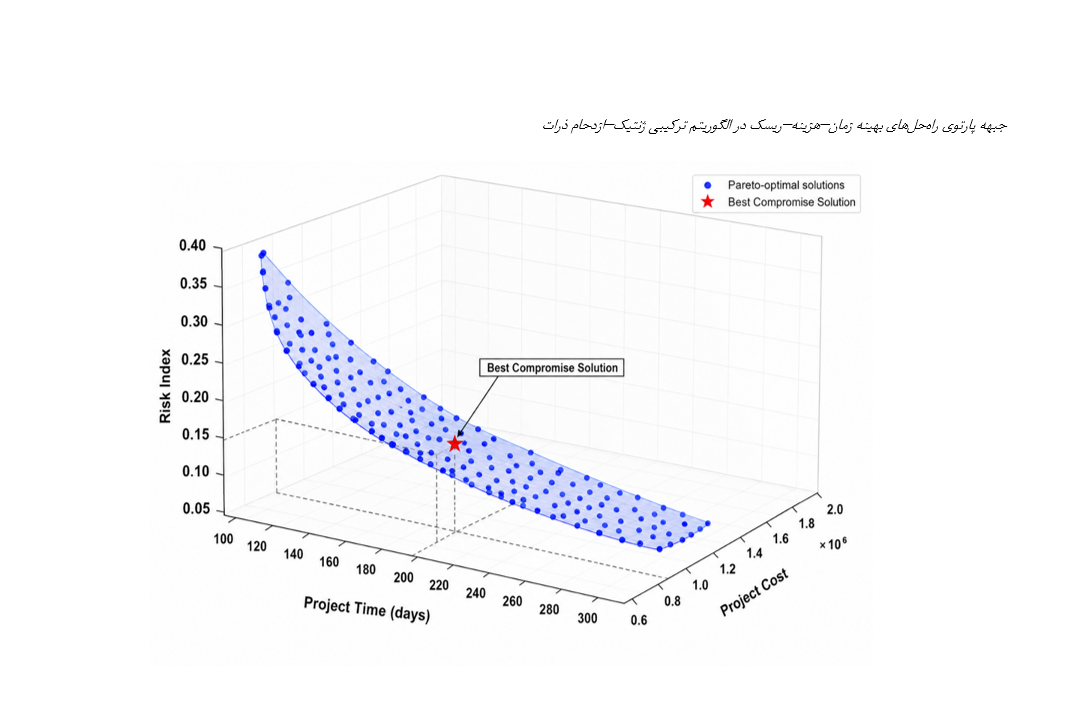
هدف این پژوهش، توسعه و ارزیابی یک چارچوب بهینهسازی یکپارچه برای مدیریت همزمان زمان، هزینه و ریسک در پروژههای EPC با استفاده از الگوریتمهای ترکیبی فراابتکاری و تحلیل سناریوهای عدم قطعیت بود. این پژوهش از نوع مدلسازی کاربردی و شبیهسازیمحور بود که با هدف طراحی یک ابزار تصمیمیار برای پروژههای مهندسی، تأمین و ساخت انجام شد. ابتدا ساختار شکست کار پروژه EPC تدوین و روابط تقدم و تأخر فعالیتها، محدودیتهای منابع، هزینههای مستقیم و غیرمستقیم، و متغیرهای ریسک شناسایی شدند. سپس یک تابع هدف چندمعیاره برای حداقلسازی همزمان مدت کل پروژه، هزینه نهایی و سطح ریسک تعریف شد. برای حل مدل، از الگوریتم ژنتیک، الگوریتم ازدحام ذرات و نسخههای ترکیبی فراابتکاری استفاده گردید. بهمنظور لحاظ کردن عدم قطعیت پویا در زمان فعالیتها و دسترسی به منابع، بیش از 5,000 سناریوی شبیهسازیشده تحلیل شد و عملکرد چارچوب پیشنهادی با رویکردهای کلاسیک زمانبندی و تخصیص منابع مقایسه گردید. نتایج استنباطی نشان داد که چارچوب ترکیبی پیشنهادی در مقایسه با روشهای سنتی زمانبندی، عملکرد برتری در بهینهسازی همزمان زمان، هزینه و ریسک دارد. تحلیل مقایسهای سناریوها نشان داد که استفاده از الگوریتمهای فراابتکاری ترکیبی موجب کاهش حدود 20 تا 35 درصدی مدت کل پروژه و کاهش حدود 15 تا 30 درصدی هزینههای اضافی ناشی از تأخیر شد. همچنین ارزیابی حساسیت و مقایسه سناریوهای پرریسک نشان داد که مدل پیشنهادی توانست سطح ریسک کلی پروژه را بهطور معناداری نسبت به روشهای کلاسیک کاهش دهد و راهحلهای پارتوی کارآمدتری برای تصمیمگیری تحت محدودیت منابع ارائه کند. چارچوب پیشنهادی میتواند بهعنوان یک ابزار تصمیمیار هوشمند و یکپارچه در مدیریت پروژههای EPC مورد استفاده قرار گیرد. این مدل با ترکیب بهینهسازی چندهدفه، الگوریتمهای فراابتکاری و تحلیل عدم قطعیت، امکان انتخاب سناریوهای اجرایی کارآمدتر را فراهم میسازد و میتواند به کاهش تأخیر، کنترل هزینه و مدیریت ریسک در پروژههای صنعتی پیچیده کمک کند.
دانلودها
مراجع
Cao, P., & Lei, X. (2023). Evaluating Risk in Prefabricated Building Construction Under EPC Contracting Using Structural Equation Modeling: A Case Study of Shaanxi Province, China. Buildings, 13(6), 1465. https://doi.org/10.3390/buildings13061465
Capelo, C., Pereira, R., & Dias, J. F. (2021). Teaching the Dynamics of the Growth of a Business Venture Through Transparent Simulations. The International Journal of Management Education, 19(3), 100549. https://doi.org/10.1016/j.ijme.2021.100549
Chen, Y., Ren, Z., Hu, B., & Zheng, H. (2023). Investigation of the Critical Factors Influencing Multi-Stakeholders’ Participation in Design Optimization of EPC Projects. Buildings, 13(7), 1654. https://doi.org/10.3390/buildings13071654
Conduah, A. K., & Essiaw, M. N. (2022). Resilience and Entrepreneurship: A Systematic Review. F1000research, 11, 348. https://doi.org/10.12688/f1000research.75473.1
Entika, C. L., Mohammad, S., Jabor, M. K., & Osman, S. (2020). Reimagining Civil Engineer's Managerial Role as an Entrepreneurial Function in the Production System of a Construction Project. Civil Engineering and Architecture, 8(4), 417-425. https://doi.org/10.13189/cea.2020.080403
Fan, Z., Liu, Y., & Li, Y. (2023). Research on Collaborative Mechanisms of Railway EPC Project Design and Construction From the Perspective of Social Network Analysis. Systems, 11(9), 443. https://doi.org/10.3390/systems11090443
Faraji, A. (2021). Neuro-Fuzzy System Based Model for Prediction of Project Performance in Downstream Sector of Petroleum Industry in Iran. Journal of Engineering Design and Technology, 19(6), 1268-1290. https://doi.org/10.1108/jedt-06-2020-0241
Fine, C. H., Padurean, L., & Naumov, S. (2022). Operations for Entrepreneurs: Can Operations Management Make a Difference in Entrepreneurial Theory and Practice? Production and Operations Management, 31(12), 4599-4615. https://doi.org/10.1111/poms.13851
Haddad, E., Al-Dwairi, R. M., Al-Freijat, S. Y., & Mansour, A. (2024). The Impact of Strategic and Innovativeness Entrepreneurship and Social Capital on Business Overall Performance Through Building a Sustainable Supply Chain Management at Jordan Private Universities. Uncertain Supply Chain Management, 12(1), 65-76. https://doi.org/10.5267/j.uscm.2023.10.017
He, J., & Han, D. (2022). Evaluation of Key Factors of Logistics Risks for Overseas EPC Projects. Advances in Civil Engineering, 2022(1). https://doi.org/10.1155/2022/4447399
Henrekson, M., Sandström, C., & Stenkula, M. (2024). Moonshots and the New Industrial Policy: Questioning the Mission Economy. SSRN Electronic Journal. https://doi.org/10.2139/ssrn.4687261
Huang, J., Fu, X., Chen, X., & Wen, X. (2024). Supply Chain Management for the Engineering Procurement and Construction (EPC) Model: A Review and Bibliometric Analysis. https://doi.org/10.20944/preprints202410.1693.v1
Inderberg, T. H. J., Leikanger, I., & Westskog, H. (2023). Institutional Context, Innovations, and Energy Transitions: Exploring Solar Photovoltaics With Hydrogen Storage at a Secondary School in Norway. Energy Research & Social Science, 101, 103147. https://doi.org/10.1016/j.erss.2023.103147
Kandukuri, V., & Samunnatha, V. (2023). Role of EDPs in Harnessing Local Resources—with Special Reference to Hyderabad and Rangareddy Districts. Journal of Entrepreneurship and Innovation in Emerging Economies, 9(2), 288-311. https://doi.org/10.1177/23939575221145767
Lamanauw, B., & Lalowang, I. R. A. (2024). Exploring Strategic Financial Management Techniques in Entrepreneurship: A Detailed Literature Review on Practices That Drive Business Sustainability and Growth. Atestasi Jurnal Ilmiah Akuntansi, 7(2), 1111-1132. https://doi.org/10.57178/atestasi.v7i2.900
Latilo, A., Uzougbo, N. S., Ugwu, M. C., Oduro, P., & Aziza, O. R. (2024). Developing Legal Frameworks for Successful Engineering, Procurement, and Construction Projects. International Journal of Applied Research in Social Sciences, 6(8), 1868-1883. https://doi.org/10.51594/ijarss.v6i8.1430
Li, Q., Guo, Y., Wang, B., Chen, Y., Xie, J., & Wen, C. (2023). Research on Risk Evaluation of Hydropower Engineering EPC Project Based on Improved Fuzzy Evidence Reasoning Model. Systems, 11(7), 327. https://doi.org/10.3390/systems11070327
Liao, J. C. (2022). Self-Employment in the Construction Machinery Industry With Blockchain Technology in Mind. Kinetic Mechanical Engineering, 3(4). https://doi.org/10.38007/kme.2022.030403
Liu, G., Yin, Q., & Zhang, L. (2022). Relations Between Entrepreneur’s Social Identity and Strategic Entrepreneurship: Sustainable Leadership as Mediator. Frontiers in psychology, 13. https://doi.org/10.3389/fpsyg.2022.903927
Mardani, A., Song, M., Jabbour, C. J. C., & Saen, R. F. (2024). Guest Editorial: Navigating the Role of Circular Economy in Entrepreneurship: Opportunities and Challenges – Part One. Management Decision, 62(8), 2329-2339. https://doi.org/10.1108/md-08-2024-221
Margherita, A., Banchi, E., Biffi, A., Castri, G. d., & Morelli, R. (2022). Beyond Total Cost Management (TCM) to Systemic Value Management (SVM): Transformational Trends and a Research Manifesto for an Evolving Discipline. Sustainability, 14(19), 12890. https://doi.org/10.3390/su141912890
Nikjow, M. A., Li, L., Xi-jing, Q. I., & Sepasgozar, S. M. E. (2021). Engineering Procurement Construction in the Context of Belt and Road Infrastructure Projects in West Asia: A SWOT Analysis. Journal of Risk and Financial Management, 14(3), 92. https://doi.org/10.3390/jrfm14030092
Niu, T. (2025). LSTM and Simulated Annealing for Entrepreneurship Path Planning in Smart Rural Contexts. International Journal of Agricultural and Environmental Information Systems, 16(1), 1-17. https://doi.org/10.4018/ijaeis.387415
Nourelhouda, E. A. (2022). Green Entrepreneurship: External Environment Analysis on the Renewable Energy Industry in Jordan. Journal of Humanities Arts and Social Science, 6(3), 275-302. https://doi.org/10.26855/jhass.2022.09.002
Olurina, J. O., Gidiagba, J. O., Ehiaguina, V. E., Ndiwe, T. C., Ayodeji, S. A., Banso, A. A., Tula, O. A., & Ojo, G. G. (2023). Engineering Innovations and Sustainable Entrepreneurship: A Comprehensive Literature Review. Materials and Corrosion Engineering Management, 4(2), 70-79. https://doi.org/10.26480/macem.02.2023.70.79
Pandey, P. M., Kumar, P., & Sharma, V. (2021). Advances in Production and Industrial Engineering. https://doi.org/10.1007/978-981-15-5519-0
Piyush, P., Rajak, S., & Vimal, K. E. K. (2023). A Systematic Literature Review of Enablers and Technologies for Development of Digital Construction Management Capabilities Framework. https://doi.org/10.46254/in03.20230162
Putro, U. S., & Rino, M. (2023). Scenario Planning in Selecting Contract Strategy Scheme to Achieve OTOBOSOROR (On Time, on Budget, on Specification, on Regulation, and on Return) Target in PT Kilang Pertamina International. European Journal of Business Management and Research, 8(3), 332-341. https://doi.org/10.24018/ejbmr.2023.8.3.1987
Shu, M., Gao, X., & Duan, L. (2022). Facing the COVID-19 Pandemic and Developing a Sustainable Entrepreneurial Ecosystem: The Theory and Practice of Innovation and Entrepreneurship Policies in China. International journal of environmental research and public health, 19(14), 8797. https://doi.org/10.3390/ijerph19148797
Song, X., & Lu, T. (2025). Research on Factors Affecting and Strategies for Objective Control in Large-Scale International EPC Projects. Scientific reports, 15(1). https://doi.org/10.1038/s41598-025-29637-4
Sujatmiko, H., Raharjo, T. J., Fakhruddin, F., & Suminar, T. (2024). Students’ and Teachers’ Perceptions of Social Entrepreneurship Literacy: A Case Study in an Indonesian Vocational Boarding School. Industry and Higher Education, 40(1), 30-40. https://doi.org/10.1177/09504222241306609
Valmohammadi, C., Sadeghi, M., Taraz, R., & Mehdikhani, R. (2024). Business Analytics, Corporate Entrepreneurship, And open Innovation. Management Decision, 62(6), 1977-2001. https://doi.org/10.1108/md-04-2023-0502
Weihao, H. (2024). Review of Cost Control Research in Prefabricated Construction Under EPC Mode. Advances in Research, 25(4), 412-420. https://doi.org/10.9734/air/2024/v25i41120
Wu, H., Qian, Q. K., Straub, A., Visscher, H., & Zhuang, T. (2024). How Do Developers Influence the Transaction Costs of China’s Prefabricated Housing Development Process? An Investigation Through the Bayesian Belief Network Approach. Systems, 12(5), 147. https://doi.org/10.3390/systems12050147
Xia, M., Zhao, L., & Zhao, L. (2022). A Comprehensive Risk-Assessment Method for Prefabricated Buildings Using EPC: A Case Study From China. Sustainability, 14(3), 1910. https://doi.org/10.3390/su14031910
You, Z. (2022). Intelligent Construction: Unlocking Opportunities for the Digital Transformation of China's Construction Industry. Engineering Construction & Architectural Management, 31(4), 1429-1453. https://doi.org/10.1108/ecam-08-2022-0706
Zulu, B. C. (2021). An Economic Development Policy Implementation Approach to Creation of Sustainable Maritime SMMEs in the KwaZulu-Natal Province. 297-303. https://doi.org/10.1007/978-3-030-64088-0_26

دانلود
چاپ شده
ارسال
بازنگری
پذیرش
شماره
نوع مقاله
مجوز
حق نشر 1404 Ehsan Najafi Chimeh

این پروژه تحت مجوز بین المللی Creative Commons Attribution-NonCommercial 4.0 می باشد.