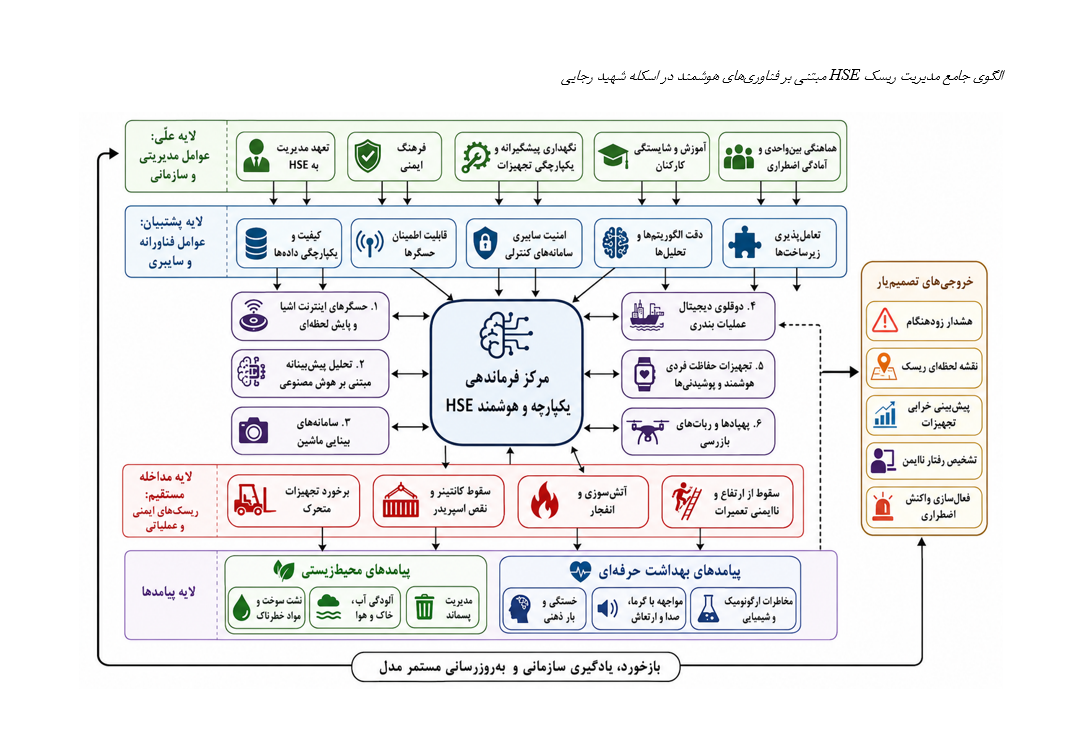
ارائه الگوی جامع مدیریت ریسک HSE مبتنی بر فناوریهای هوشمند در بنادر کانتینری با رویکرد تحلیل شبکهای و تصمیمگیری چندمعیاره در اسکله شهید رجایی
کلمات کلیدی:
مدیریت ریسک HSE, فناوری هوشمند, بندر کانتینری, فرایند تحلیل شبکهای, ویکور فازی, اسکله شهید رجاییچکیده
پژوهش حاضر با هدف ارائه و اعتبارسنجی الگوی جامع مدیریت ریسک بهداشت، ایمنی و محیطزیست مبتنی بر فناوریهای هوشمند در اسکله شهید رجایی با استفاده از تحلیل شبکهای و تصمیمگیری چندمعیاره انجام شد. این پژوهش از نظر هدف کاربردی ـ توسعهای و از نظر روش، آمیخته اکتشافی متوالی بود. جامعه پژوهش شامل مدیران و متخصصان HSE، عملیات کانتینری، فناوری اطلاعات، اتوماسیون، محیطزیست، آتشنشانی و مدیریت بحران اسکله شهید رجایی بود که از میان آنان ۲۴ خبره با روش نمونهگیری هدفمند و گلولهبرفی انتخاب شدند. دادهها با بررسی اسناد، مصاحبه نیمهساختاریافته، پرسشنامه دلفی فازی، ماتریس دیمتل فازی، مقایسات زوجی فرایند تحلیل شبکهای و ماتریس ارزیابی فناوریها گردآوری شد. تحلیل دادهها با تحلیل مضمون، دلفی فازی، دیمتل فازی، فرایند تحلیل شبکهای و ویکور فازی انجام گرفت. تحلیل کیفی به استخراج ۲۰ شاخص در پنج بعد ایمنی و عملیاتی، مدیریتی و سازمانی، فناورانه و سایبری، محیطزیستی و بهداشت حرفهای منجر شد. ضریب هماهنگی کندال در دور دوم دلفی برابر با ۰.۷۱ و معنادار بود. در تحلیل دیمتل، بعد مدیریتی و سازمانی با مقدار خالص ۱.۱۵ قویترین عامل علّی شناسایی شد. در فرایند تحلیل شبکهای، ابعاد ایمنی و عملیاتی، مدیریتی و سازمانی و فناورانه و سایبری بهترتیب وزنهای ۰.۲۸۶، ۰.۲۴۳ و ۰.۲۰۳ را کسب کردند. برخورد تجهیزات متحرک، سقوط کانتینر و ضعف فرهنگ ایمنی سه اولویت اصلی بودند. ویکور فازی نیز مرکز فرماندهی یکپارچه HSE، حسگرهای اینترنت اشیا و تحلیل پیشبینانه مبتنی بر هوش مصنوعی را در رتبههای نخست قرار داد. مدیریت مؤثر ریسک HSE در بنادر کانتینری مستلزم رویکردی شبکهای، پیشنگر و دادهمحور است که در آن اصلاح عوامل مدیریتی و سازمانی با استقرار تدریجی فناوریهای هوشمند و ایجاد مرکز فرماندهی یکپارچه همراه شود.
دانلودها
مراجع
Ashoori, H., Doosti, M., & Alavi, S. H. (2025). Effective Intervention Conditions on the Health and Safety System of School Sports in Iran. Educational Management - Health Sciences, 2(3), 19-28. https://www.eduhealthsci.ir/article_229292.html
Baker, L., Nguyen, T., & Patel, R. (2023). Job clarity and safety performance: A study of sports facility staff. Human Resource Management Review, 33(2), 100851. https://doi.org/10.1016/j.hrmr.2022.100851
Baroun, A. E. (2025). Challenges in Implementing Safety Procedures: Examining Kuwait’s Labor Law Article 83 Impact on Employee Performance. International Journal of Law and Management. https://doi.org/10.1108/ijlma-11-2024-0411
Bryce, C., & Dowling, M. (2024). The road to olympic failure is paved in poor risk management. Safety Science, 169, 106331. https://doi.org/10.1016/j.ssci.2023.106331
Carter, N., Nalbant, G., Chahal, P., & Chattopadhyay, K. (2024). Effectiveness and Safety of Self-Management Interventions for Improving Glycemic Control and Health-Related Quality of Life Among Adults with Type 2 Diabetes Mellitus in Sub-Saharan Africa: A Systematic Review and Meta-Analysis. JBI Evidence Synthesis, 22(9), 1715-1788. https://doi.org/10.11124/JBIES-23-00273
Doukari, O., Wakefield, J., Martinez, P., & Kassem, M. (2024). An ontology-based tool for safety management in building renovation projects. Journal of Building Engineering, 84. https://doi.org/10.1016/j.jobe.2024.108609
Fadhel, R., & Alqurs, A. (2025). Enhancing Occupational Health and Safety through Strategic Leadership: The Mediating Role of Total Quality Management in Hodeida Hospitals, Yemen. Risk Management and Healthcare Policy, 823-842. https://doi.org/10.2147/RMHP.S506296
Fisher, K. L., & Rosikiewicz, B. L. (2025). Implementing Psychological Safety in the Online Graduate Management Classroom. Management Teaching Review. https://doi.org/10.1177/23792981251326887
Gholamhoseinpour, M., Rahbari Najafabadi, S., & Aghahosseini, T. (2025). Investigating the relationship between health, safety, and environment management system performance and error acceptance culture among nurses: The mediating role of human error probability Naghsh Jahan Institute of Higher Education, Isfahan, Department of Industrial Engineering].
Glebova, E. V., Volokhina, А. Т., & Vikhrov, A. E. (2023). Assessment of the Efficiency of Occupational Safety Culture Management in Fuel and Energy Companies. Journal of Mining Institute, 259, 68-78. https://doi.org/10.31897/pmi.2023.12
Hao, F. (2025). Research on Safety Risk Management Standards for the Power Industry Based on Topic Mining and Knowledge Graph. Ieej Transactions on Electrical and Electronic Engineering. https://doi.org/10.1002/tee.70021
Hussein, A., & Akhtar, S. (2023). Psychological Safety and Self-Regulation among Public Sector Employees: The Moderating Effect of Organizational Justice. Public Personnel Management, 52(2), 245-268. https://doi.org/10.1177/00910260221098765
Jamil, Z., Nordin, S. M., Miraj, M., Alqahtani, M., Shaik, R. A., Akhter, S., & Isha, A. S. N. (2025). Sustainable Safety Practices and Hazard Management in the Oil and Gas Industry: An HSE Perspective. Frontiers in Public Health, 13. https://doi.org/10.3389/fpubh.2025.1611106
Jiang, W., Nazarudin, M. N., & Mazalan, N. S. (2024). Enhancing Safety and Quality in College Sports Management Through Big Data and Artificial Intelligence (AI). Journal of Information Systems Engineering & Management, 9(3), 24782. https://doi.org/10.55267/iadt.07.14849
Ketelaars, E., Gaudin, C., Flandin, S., & Poizat, G. (2024). Resilience training for critical situation management. An umbrella and a systematic literature review. Safety Science, 170, 106311. https://doi.org/10.1016/j.ssci.2023.106311
Kılıç, Y., & Vayvay, Ö. (2025). Integrating Occupational Health and Safety Into Enterprise Risk Management: A Structural Evaluation. Frontiers in Public Health, 13. https://doi.org/10.3389/fpubh.2025.1608227
Mendes, N., Vieira, J. G. V., & Mano, A. P. (2022). Risk Management in Aviation Maintenance: A Systematic Literature Review. Safety Science, 153, 105810. https://doi.org/10.1016/j.ssci.2022.105810
Mohy, A. A., Bassioni, H. A., Elgendi, E. O., & Hassan, T. M. (2024). Innovations in Safety Management for Construction Sites: The Role of Deep Learning and Computer Vision Techniques. Construction Innovation. https://doi.org/10.1108/CI-04-2023-0062
Mutegi, T. M., Joshua, P. M., & Maina, J. K. (2023). Workplace Safety, Employee Safety Attitudes and Employee Productivity of Manufacturing Firms. Sa Journal of Human Resource Management. https://doi.org/10.4102/sajhrm.v21i0.1989
Oyewole, A. T., Okoye, C. C., Ofodile, O. C., Odeyemi, O., Adeoye, O. B., Addy, W. A., & Ololade, Y. J. (2024). Human resource management strategies for safety and risk mitigation in the oil and gas industry: a review. International Journal of Management & Entrepreneurship Research, 6(3), 623-633. https://doi.org/10.51594/ijmer.v6i3.875
Rabbi, A. B. K., Jeelani, Idris. (2024). AI integration in construction safety: Current state, challenges, and future opportunities in text, vision, and audio based applications. Automation in Construction, 164, 105443. https://doi.org/10.1016/j.autcon.2024.105443
Yazdi, M., Zarei, E., Adumene, S., & Beheshti, A. (2024). Navigating the Power of Artificial Intelligence in Risk Management: A Comparative Analysis. Safety, 10(2), 42. https://doi.org/10.3390/safety10020042
Zong, Z., Long, T., Ou, Y., & Zhang, S. (2025). Dual-path influence of risk perception on construction workers’ safety participation and the moderating role of mindfulness. Journal of Construction Engineering and Management, 151(1), 04024194. https://ascelibrary.org/doi/abs/10.1061/JCEMD4.COENG-15534

دانلود
چاپ شده
ارسال
بازنگری
پذیرش
شماره
نوع مقاله
مجوز
حق نشر 2025 Kambiz Karimi zadeh

این پروژه تحت مجوز بین المللی Creative Commons Attribution-NonCommercial 4.0 می باشد.