The Effects of Competitive Intensity and Organizational Culture on the Relationship Between Strategic Entrepreneurship and Employee Retention: A Case Study of Knowledge-Based and Technology Firms Located in the Aras Growth Center
DOI:
https://doi.org/10.61838/kman.jtesm.492Keywords:
Competitive intensity, organizational culture, strategic entrepreneurship, employee retention, knowledge-based firmsAbstract
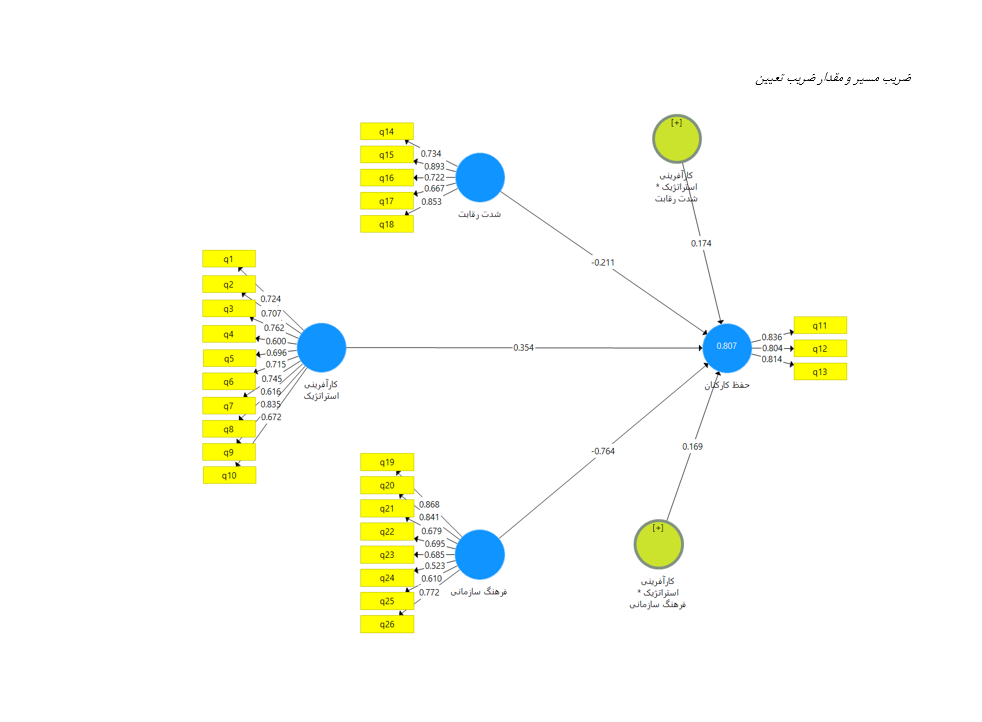
This study aimed to examine the moderating roles of competitive intensity and organizational culture in the relationship between strategic entrepreneurship and employee retention among knowledge-based and technology firms located in the Aras Growth Center. This applied study employed a descriptive cross-sectional survey design. The statistical population consisted of senior managers from 39 knowledge-based and technology firms operating in the Aras Growth Center. Because of the limited population size, all eligible firms were included through a census sampling approach. Data were collected using the standardized strategic entrepreneurship, employee retention, and competitive intensity questionnaire developed by Schulze and Dada and the organizational culture questionnaire developed by Grunert. Content validity was evaluated by academic experts, while construct validity was examined through confirmatory factor analysis. Cronbach’s alpha coefficients and composite reliability indices were used to assess internal consistency. The proposed conceptual model and research hypotheses were tested using partial least squares structural equation modeling and the bootstrapping procedure. The structural model demonstrated that competitive intensity had a positive and statistically significant moderating effect on the relationship between strategic entrepreneurship and employee retention (β=0.174, t=2.018, p<0.05). Organizational culture also positively and significantly moderated the relationship between strategic entrepreneurship and employee retention (β=0.169, t=2.448, p<0.05). Accordingly, both research hypotheses were supported. The coefficient of determination for employee retention was 0.807, indicating that the variables included in the model explained 80.7% of the variance in employee retention. Furthermore, the Q² value of 0.462 demonstrated that the structural model possessed satisfactory predictive relevance. Strategic entrepreneurship contributes more strongly to employee retention when firms operate under intense competitive conditions and maintain a supportive, participative, flexible, and innovation-oriented organizational culture. Managers of knowledge-based and technology firms should therefore complement entrepreneurial strategies with an enabling organizational culture, employee empowerment, agile decision-making structures, and human resource practices aligned with competitive environmental demands.
Downloads
References
Adomako, S., Opoku, R. A., & Frimpong, K. (2017). The moderating influence of competitive intensity on the relationship between CEOs' regulatory foci and SME internationalization. Journal of International Management, 23(3), 268-278. https://doi.org/10.1016/j.intman.2017.02.001
Almerri, H. S. H. (2023). Investigating the impact of organizational culture on employee retention: Moderating role of employee engagement. Journal of System and Management Sciences, 13(4), 488-507.
Alshawabkeh, R. O. K., Al-Abbadi, L. H., Eldahamsheh, M. M., Al-Quran, A. Z., Almomani, H. M., Bani-Khaled, A. K., & Al-Hawary, S. I. S. (2024). The impact of entrepreneurial leadership on organisational performance: Does innovation management matter? International Journal of Services and Operations Management, 47(2), 236-255. https://doi.org/10.1504/IJSOM.2024.136795
Cucu, G., & Guit, I. (2014). Organizational culture versus work motivation for the academic staff in a public university. Procedia - Social and Behavioral Sciences, 127, 448-453. https://doi.org/10.1016/j.sbspro.2014.03.288
DiCintio, M., Ghosh, S., & Grassi, E. (2017). Firm growth, R&D expenditures and exports: An empirical analysis of Italian SMEs. Research Policy, 46(4), 836-852. https://doi.org/10.1016/j.respol.2017.02.006
Farahi, A., Fazaili, A., & Ebrahimi, E. (2015). Introducing an optimal organizational culture model using a qualitative approach and managers' mind mining. Organizational Behavior Studies Quarterly, 4(4), 31-64.
Ganco, M., Ziedonis, R., & Agarwal, R. (2015). More stars stay, but the brightest ones still leave: Job hopping in the shadow of patent enforcement. Strategic management journal, 36(5), 659-685. https://doi.org/10.1002/smj.2239
Ireland, R. D., Hitt, M. A., & Sirmon, D. G. (2003). A model of strategic entrepreneurship: The construct and its dimensions. Journal of Management, 29(6), 963-989. https://doi.org/10.1016/S0149-2063(03)00086-2
Khazaeipour, J., Allameh, S. M., & Askari, N. (2016). Examining the effect of organizational culture: Emphasis on the role of knowledge sharing and organizational agility using the balanced scorecard approach. Organizational Culture Management, 14(2), 453-474.
Mirkamali, S. M., Haj Khazimeh, M., & Ebrahimi, S. a.-D. (2015). Identifying criteria for attracting and retaining human resources and providing appropriate solutions: The case of employees of the engineering campus faculties of the University of Tehran. Development and Transformation Management Journal, 22(3), 9-18.
Mirzaeian Vanab, Z., Mahdipour, A., & Azmesha, T. (2017). Presenting a strategic entrepreneurship model for achieving competitive advantage in sports boards of Khuzestan Province. Sport Management Studies, 9(45), 175-190.
Ogunleye, A. T., & Adebola, F. O. (2026). Leadership styles and their impact on employee engagement, retention, and productivity. The Sankalpa: International Journal of Management Decisions, 12(1), 19-28.
Rajabpour, E., Hamidianpour, F., & Tangestani, E. (2023). The effect of strategic entrepreneurship on competitive advantage: A study of knowledge-based companies in Bushehr County. Entrepreneurship Education and Management, 2(3), 19-34.
Schulze, A., & Dada, O. (2025). Building strategic human capital resources: The effects of strategic entrepreneurship on employee recruitment and retention. Journal of Small Business Management, 63(1), 388-421. https://doi.org/10.1080/00472778.2024.2322985
Shafique, M. N., Ahmad, N., Abbas, H., & Hussain, A. (2015). The impact of customer relationship management capabilities on organizational performance: Moderating role of competition intensity. Arabian Journal of Business and Management Review (Nigerian Chapter), 3(3), 28-47. https://doi.org/10.12816/0014506
Shao, Z. (2019). Interaction effect of strategic leadership behaviors and organizational culture on IS-business strategic alignment and enterprise systems assimilation. International Journal of Information Management, 44, 96-108. https://doi.org/10.1016/j.ijinfomgt.2018.09.010
Shiri, A., Yasini, A., & Hosseini, A. S. (2018). Examining the effect of organizational culture on hypocrisy in organizations with the mediating role of rumor-spreading in organizational layers. Organizational Behavior Studies Quarterly, 7(4), 213-243.
Thurik, A. R., Audretsch, D. B., Block, J. H., Burke, A., Carree, M. A., Dejardin, M., & Wiklund, J. (2024). The impact of entrepreneurship research on other academic fields. Small Business Economics, 62(2), 727-751. https://doi.org/10.1007/s11187-023-00781-3
Tokhirovna, T. S., & Khasanovich, J. E. (2024). The need and directions of entrepreneurship support. IMRAS, 7(2), 115-117.
Vedula, S., Doblinger, C., Pacheco, D., York, J. G., Bacq, S., Russo, M. V., & Dean, T. J. (2022). Entrepreneurship for the public good: A review, critique, and path forward for social and environmental entrepreneurship research. Academy of Management Annals, 16(1), 391-425. https://doi.org/10.5465/annals.2019.0143
Zainal, N. S. B., Wider, W., Lajuma, S., Ahmad Khadri, M. W. A. B., Taib, N. M., & Joseph, A. (2022). Employee retention in the service industry in Malaysia. Frontiers in Sociology, 7, 928951. https://doi.org/10.3389/fsoc.2022.928951
Downloads
Publication Timeline
- Submitted
- Revised
- Accepted
Issue
Section
License
Copyright (c) 2025 Seyed Samad Hosseini (Author); Mohammad Taheri

This work is licensed under a Creative Commons Attribution-NonCommercial 4.0 International License.