Development of an Entrepreneurship and Time–Cost–Risk Optimization Framework in EPC Projects Using Hybrid Metaheuristic Algorithms
Keywords:
EPC project management, multi-objective optimization, Genetic Algorithm, Particle Swarm Optimization, project scheduling, project cost, risk analysis, metaheuristic algorithms, uncertainty, intelligent decision-support systemExtended AbstractAbstract
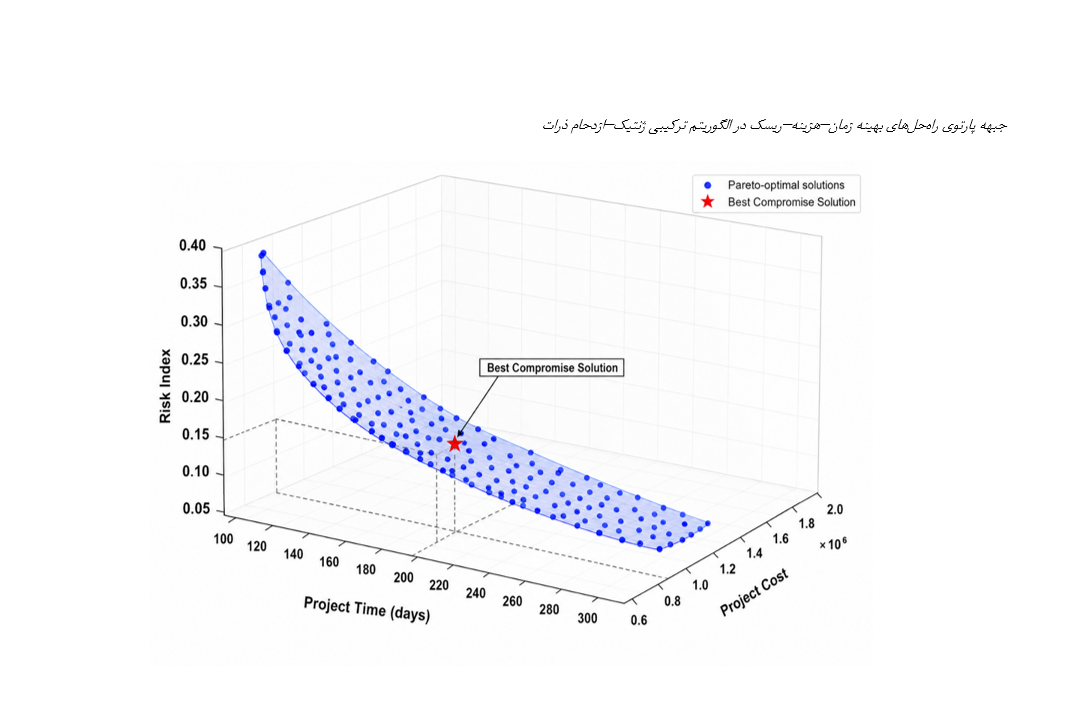
This study aimed to develop and evaluate an integrated optimization framework for the simultaneous management of time, cost, and risk in EPC projects using hybrid metaheuristic algorithms and uncertainty scenario analysis. This applied modeling and simulation-based study was conducted to design an advanced decision-support framework for engineering, procurement, and construction projects. First, the work breakdown structure of an EPC project was modeled, and activity precedence relationships, resource constraints, direct and indirect costs, and risk-related variables were identified. A multi-objective function was then formulated to simultaneously minimize total project duration, final project cost, and overall risk level. Genetic Algorithm, Particle Swarm Optimization, and hybrid metaheuristic configurations were employed to solve the optimization model. To incorporate dynamic uncertainty in activity durations and resource availability, more than 5,000 uncertainty scenarios were simulated and analyzed. The performance of the proposed framework was compared with conventional project scheduling and resource allocation approaches. Inferential results indicated that the proposed hybrid framework outperformed traditional scheduling methods in the simultaneous optimization of time, cost, and risk. Comparative scenario analysis demonstrated that the application of hybrid metaheuristic algorithms reduced total project duration by approximately 20% to 35% compared with conventional approaches. Moreover, delay-related additional costs decreased by approximately 15% to 30%. Sensitivity analysis and comparative assessment of high-risk scenarios further showed that the proposed model substantially reduced the overall project risk level and generated more efficient Pareto-optimal solutions for decision-making under resource constraints and uncertainty. The proposed framework can be used as an intelligent and integrated decision-support tool for EPC project management. By combining multi-objective optimization, hybrid metaheuristic algorithms, and uncertainty analysis, the model enables project managers to identify more efficient implementation scenarios. The framework may contribute to reducing delays, controlling cost overruns, improving risk mitigation, and supporting optimal managerial decision-making in complex industrial EPC projects.
Downloads
References
Cao, P., & Lei, X. (2023). Evaluating Risk in Prefabricated Building Construction Under EPC Contracting Using Structural Equation Modeling: A Case Study of Shaanxi Province, China. Buildings, 13(6), 1465. https://doi.org/10.3390/buildings13061465
Capelo, C., Pereira, R., & Dias, J. F. (2021). Teaching the Dynamics of the Growth of a Business Venture Through Transparent Simulations. The International Journal of Management Education, 19(3), 100549. https://doi.org/10.1016/j.ijme.2021.100549
Chen, Y., Ren, Z., Hu, B., & Zheng, H. (2023). Investigation of the Critical Factors Influencing Multi-Stakeholders’ Participation in Design Optimization of EPC Projects. Buildings, 13(7), 1654. https://doi.org/10.3390/buildings13071654
Conduah, A. K., & Essiaw, M. N. (2022). Resilience and Entrepreneurship: A Systematic Review. F1000research, 11, 348. https://doi.org/10.12688/f1000research.75473.1
Entika, C. L., Mohammad, S., Jabor, M. K., & Osman, S. (2020). Reimagining Civil Engineer's Managerial Role as an Entrepreneurial Function in the Production System of a Construction Project. Civil Engineering and Architecture, 8(4), 417-425. https://doi.org/10.13189/cea.2020.080403
Fan, Z., Liu, Y., & Li, Y. (2023). Research on Collaborative Mechanisms of Railway EPC Project Design and Construction From the Perspective of Social Network Analysis. Systems, 11(9), 443. https://doi.org/10.3390/systems11090443
Faraji, A. (2021). Neuro-Fuzzy System Based Model for Prediction of Project Performance in Downstream Sector of Petroleum Industry in Iran. Journal of Engineering Design and Technology, 19(6), 1268-1290. https://doi.org/10.1108/jedt-06-2020-0241
Fine, C. H., Padurean, L., & Naumov, S. (2022). Operations for Entrepreneurs: Can Operations Management Make a Difference in Entrepreneurial Theory and Practice? Production and Operations Management, 31(12), 4599-4615. https://doi.org/10.1111/poms.13851
Haddad, E., Al-Dwairi, R. M., Al-Freijat, S. Y., & Mansour, A. (2024). The Impact of Strategic and Innovativeness Entrepreneurship and Social Capital on Business Overall Performance Through Building a Sustainable Supply Chain Management at Jordan Private Universities. Uncertain Supply Chain Management, 12(1), 65-76. https://doi.org/10.5267/j.uscm.2023.10.017
He, J., & Han, D. (2022). Evaluation of Key Factors of Logistics Risks for Overseas EPC Projects. Advances in Civil Engineering, 2022(1). https://doi.org/10.1155/2022/4447399
Henrekson, M., Sandström, C., & Stenkula, M. (2024). Moonshots and the New Industrial Policy: Questioning the Mission Economy. SSRN Electronic Journal. https://doi.org/10.2139/ssrn.4687261
Huang, J., Fu, X., Chen, X., & Wen, X. (2024). Supply Chain Management for the Engineering Procurement and Construction (EPC) Model: A Review and Bibliometric Analysis. https://doi.org/10.20944/preprints202410.1693.v1
Inderberg, T. H. J., Leikanger, I., & Westskog, H. (2023). Institutional Context, Innovations, and Energy Transitions: Exploring Solar Photovoltaics With Hydrogen Storage at a Secondary School in Norway. Energy Research & Social Science, 101, 103147. https://doi.org/10.1016/j.erss.2023.103147
Kandukuri, V., & Samunnatha, V. (2023). Role of EDPs in Harnessing Local Resources—with Special Reference to Hyderabad and Rangareddy Districts. Journal of Entrepreneurship and Innovation in Emerging Economies, 9(2), 288-311. https://doi.org/10.1177/23939575221145767
Lamanauw, B., & Lalowang, I. R. A. (2024). Exploring Strategic Financial Management Techniques in Entrepreneurship: A Detailed Literature Review on Practices That Drive Business Sustainability and Growth. Atestasi Jurnal Ilmiah Akuntansi, 7(2), 1111-1132. https://doi.org/10.57178/atestasi.v7i2.900
Latilo, A., Uzougbo, N. S., Ugwu, M. C., Oduro, P., & Aziza, O. R. (2024). Developing Legal Frameworks for Successful Engineering, Procurement, and Construction Projects. International Journal of Applied Research in Social Sciences, 6(8), 1868-1883. https://doi.org/10.51594/ijarss.v6i8.1430
Li, Q., Guo, Y., Wang, B., Chen, Y., Xie, J., & Wen, C. (2023). Research on Risk Evaluation of Hydropower Engineering EPC Project Based on Improved Fuzzy Evidence Reasoning Model. Systems, 11(7), 327. https://doi.org/10.3390/systems11070327
Liao, J. C. (2022). Self-Employment in the Construction Machinery Industry With Blockchain Technology in Mind. Kinetic Mechanical Engineering, 3(4). https://doi.org/10.38007/kme.2022.030403
Liu, G., Yin, Q., & Zhang, L. (2022). Relations Between Entrepreneur’s Social Identity and Strategic Entrepreneurship: Sustainable Leadership as Mediator. Frontiers in psychology, 13. https://doi.org/10.3389/fpsyg.2022.903927
Mardani, A., Song, M., Jabbour, C. J. C., & Saen, R. F. (2024). Guest Editorial: Navigating the Role of Circular Economy in Entrepreneurship: Opportunities and Challenges – Part One. Management Decision, 62(8), 2329-2339. https://doi.org/10.1108/md-08-2024-221
Margherita, A., Banchi, E., Biffi, A., Castri, G. d., & Morelli, R. (2022). Beyond Total Cost Management (TCM) to Systemic Value Management (SVM): Transformational Trends and a Research Manifesto for an Evolving Discipline. Sustainability, 14(19), 12890. https://doi.org/10.3390/su141912890
Nikjow, M. A., Li, L., Xi-jing, Q. I., & Sepasgozar, S. M. E. (2021). Engineering Procurement Construction in the Context of Belt and Road Infrastructure Projects in West Asia: A SWOT Analysis. Journal of Risk and Financial Management, 14(3), 92. https://doi.org/10.3390/jrfm14030092
Niu, T. (2025). LSTM and Simulated Annealing for Entrepreneurship Path Planning in Smart Rural Contexts. International Journal of Agricultural and Environmental Information Systems, 16(1), 1-17. https://doi.org/10.4018/ijaeis.387415
Nourelhouda, E. A. (2022). Green Entrepreneurship: External Environment Analysis on the Renewable Energy Industry in Jordan. Journal of Humanities Arts and Social Science, 6(3), 275-302. https://doi.org/10.26855/jhass.2022.09.002
Olurina, J. O., Gidiagba, J. O., Ehiaguina, V. E., Ndiwe, T. C., Ayodeji, S. A., Banso, A. A., Tula, O. A., & Ojo, G. G. (2023). Engineering Innovations and Sustainable Entrepreneurship: A Comprehensive Literature Review. Materials and Corrosion Engineering Management, 4(2), 70-79. https://doi.org/10.26480/macem.02.2023.70.79
Pandey, P. M., Kumar, P., & Sharma, V. (2021). Advances in Production and Industrial Engineering. https://doi.org/10.1007/978-981-15-5519-0
Piyush, P., Rajak, S., & Vimal, K. E. K. (2023). A Systematic Literature Review of Enablers and Technologies for Development of Digital Construction Management Capabilities Framework. https://doi.org/10.46254/in03.20230162
Putro, U. S., & Rino, M. (2023). Scenario Planning in Selecting Contract Strategy Scheme to Achieve OTOBOSOROR (On Time, on Budget, on Specification, on Regulation, and on Return) Target in PT Kilang Pertamina International. European Journal of Business Management and Research, 8(3), 332-341. https://doi.org/10.24018/ejbmr.2023.8.3.1987
Shu, M., Gao, X., & Duan, L. (2022). Facing the COVID-19 Pandemic and Developing a Sustainable Entrepreneurial Ecosystem: The Theory and Practice of Innovation and Entrepreneurship Policies in China. International journal of environmental research and public health, 19(14), 8797. https://doi.org/10.3390/ijerph19148797
Song, X., & Lu, T. (2025). Research on Factors Affecting and Strategies for Objective Control in Large-Scale International EPC Projects. Scientific reports, 15(1). https://doi.org/10.1038/s41598-025-29637-4
Sujatmiko, H., Raharjo, T. J., Fakhruddin, F., & Suminar, T. (2024). Students’ and Teachers’ Perceptions of Social Entrepreneurship Literacy: A Case Study in an Indonesian Vocational Boarding School. Industry and Higher Education, 40(1), 30-40. https://doi.org/10.1177/09504222241306609
Valmohammadi, C., Sadeghi, M., Taraz, R., & Mehdikhani, R. (2024). Business Analytics, Corporate Entrepreneurship, And open Innovation. Management Decision, 62(6), 1977-2001. https://doi.org/10.1108/md-04-2023-0502
Weihao, H. (2024). Review of Cost Control Research in Prefabricated Construction Under EPC Mode. Advances in Research, 25(4), 412-420. https://doi.org/10.9734/air/2024/v25i41120
Wu, H., Qian, Q. K., Straub, A., Visscher, H., & Zhuang, T. (2024). How Do Developers Influence the Transaction Costs of China’s Prefabricated Housing Development Process? An Investigation Through the Bayesian Belief Network Approach. Systems, 12(5), 147. https://doi.org/10.3390/systems12050147
Xia, M., Zhao, L., & Zhao, L. (2022). A Comprehensive Risk-Assessment Method for Prefabricated Buildings Using EPC: A Case Study From China. Sustainability, 14(3), 1910. https://doi.org/10.3390/su14031910
You, Z. (2022). Intelligent Construction: Unlocking Opportunities for the Digital Transformation of China's Construction Industry. Engineering Construction & Architectural Management, 31(4), 1429-1453. https://doi.org/10.1108/ecam-08-2022-0706
Zulu, B. C. (2021). An Economic Development Policy Implementation Approach to Creation of Sustainable Maritime SMMEs in the KwaZulu-Natal Province. 297-303. https://doi.org/10.1007/978-3-030-64088-0_26
Downloads
Publication Timeline
- Submitted
- Revised
- Accepted
Issue
Section
License
Copyright (c) 1404 Ehsan Najafi Chimeh

This work is licensed under a Creative Commons Attribution-NonCommercial 4.0 International License.