Modeling the Role of Cognitive and Emotional Components in Entrepreneurs’ Strategic Decision-Making
DOI:
https://doi.org/10.61838/kman.jtesm.487Keywords:
Strategic decision-making, cognitive components, emotional components, entrepreneurs, thematic analysis, cognitive–emotional balance, thematic networkAbstract
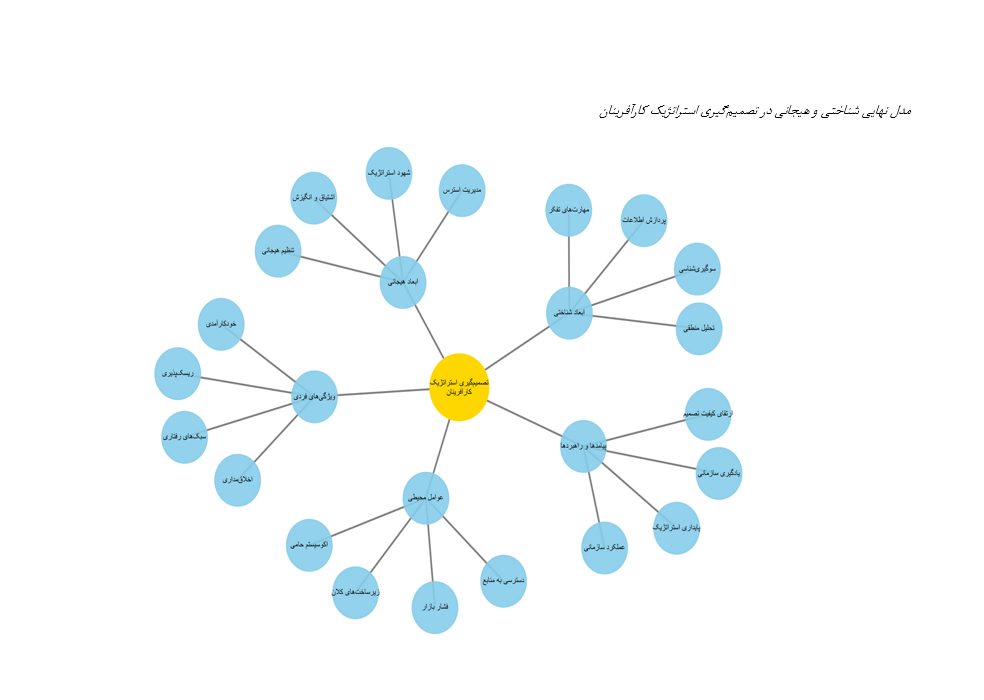
This study aimed to identify and model the interactive role of cognitive and emotional components in entrepreneurs’ strategic decision-making processes. This applied qualitative study was conducted using thematic analysis. The study population comprised university academics specializing in management and entrepreneurship, as well as experienced entrepreneurs working in start-ups and knowledge-based companies. Participants were recruited through purposive and snowball sampling, and in-depth semi-structured interviews were conducted with 12 participants until theoretical saturation was achieved. After audio recording and verbatim transcription, the interviews were analyzed through the thematic network approach in three consecutive stages: extracting basic themes, developing organizing themes, and constructing global themes. MAXQDA software was used to organize and code the qualitative data. The credibility and trustworthiness of the findings were enhanced through member checking, agreement among researchers during coding, the use of diverse data sources, and the simultaneous collection and analysis of data. The findings indicated that entrepreneurs’ strategic decision-making emerged from the interaction of five global themes: cognitive dimensions, emotional dimensions, individual characteristics, environmental factors, and outcomes and strategies. Cognitive dimensions, including information processing, option evaluation, analytical thinking, and knowledge-based learning, provided the rational foundation for strategic decisions. Emotional regulation, motivational emotions, intuition, and emotional intelligence influenced the direction, intensity, and implementation of these decisions. Individual characteristics, particularly resilience, risk-taking, self-efficacy, and an opportunity-oriented mindset, acted as catalytic factors that shaped entrepreneurs’ interpretations of environmental stimuli. Environmental conditions could either intensify or mitigate cognitive load and emotional pressure. The central phenomenon of the model was “cognitive–emotional balance,” through which rational analysis, experiential intuition, and emotional regulation were integrated. This balance contributed to improved organizational performance, adaptability, organizational learning, sustainable profitability, and competitive advantage. Effective strategic decision-making in entrepreneurship depends on the entrepreneur’s ability to integrate rational analysis with intuition, emotional regulation, and environmental adaptability; therefore, the simultaneous development of cognitive and emotional competencies can strengthen decision quality under uncertainty.
Downloads
References
Babaei, M., Ezzati, M., Mahjoub Eshratabadi, H., & Mehrbani, V. (2024). Identifying the Components of Complexity and Cognitive Biases Related to the Financial Decisions of Academic Entrepreneurs Using a Qualitative Grounded Theory Approach. Quarterly Journal of Applied Psychological Research, 15(3), 273-292.
Baron, R., Byrne, D., & Branscomb, N. (2020). Social Psychology (Y. Karimi, Trans.; 11th ed.). Rovan Publications.
Cheng, P., Wu, S., & Xiao, J. (2025). Exploring the Impact of Entrepreneurial Orientation and Market Orientation on Entrepreneurial Performance in the Context of Environmental Uncertainty. Scientific reports, 15(1), 1913. https://doi.org/10.1038/s41598-025-86344-w
Gholipour, A., Asadi, J., Tajari, T., & Bayani, A. (2022). Designing a Model for Encouraging Entrepreneurial Behavior Using Cognitive and Emotional Approaches: A Qualitative Study. Industrial and Organizational Psychology Studies, 9(2), 355-376. https://doi.org/10.22055/jiops.2023.42389.1313
Griffith, M. D., Bacq, S., & Chen, J. (2023). Emotions and Cognition in Entrepreneurial Decision Making: A Multilevel Perspective. Entrepreneurship Theory and Practice, 47(4), 985-1012.
Luoma, J., & Martela, F. (2021). A Dual-Processing View of Three Cognitive Strategies in Strategic Decision Making: Intuition, Analytic Reasoning, and Reframing. Long Range Planning, 54(3), 102065. https://doi.org/10.1016/j.lrp.2020.102065
Reeve, J. M. (2018). Motivation and Emotion (Y. Seyed Mohammadi, Trans.; 7th ed.). Veirayesh Publications.
Roosta Kalishami, A., Heidari, A., & Shahhosseini, M. (2025). Cognitive Biases in Strategic Decision-Making: A Systematic Review. New Research in Decision-Making, 10(1), 163-197.
Rostamzadeh, F., Keyhan, J., & Ebrahimi Nowruzabad, S. (2025). Entrepreneurial Mindfulness and Emotion Regulation as Prerequisites for Strategic Decision-Making under Economic Uncertainty. First National Conference on Professional Ethics and Social Responsibility in Management and Financial Sciences, Urmia.
Sanda, M. A., & Sallama, M. N. (2023). Mediation Effect of Emotions on Relational Dynamics between Entrepreneurs' Thinking Processes and Their Entrepreneurial Decision-Making. Journal of the International Council for Small Business, 4(4), 337-350. https://doi.org/10.1080/26437015.2022.2156312
Sassetti, S., Cavaliere, V., & Lombardi, S. (2022). The Rhythm of Effective Entrepreneurs' Decision-Making Process: The Pathways of Alertness Scanning and Search and Cognitive Style. A Mediation Model. International Entrepreneurship and Management Journal, 18(2), 555-578. https://doi.org/10.1007/s11365-021-00759-1
Serna-Zuluaga, J. C., Juarez-Varon, D., Mengual-Recuerda, A., & Medina-Lopez, A. (2024). Analysis of the Influence of Emotions on the Decision-Making of Entrepreneurs Using Neurotechnologies. International Entrepreneurship and Management Journal, 20(3), 2169-2186. https://doi.org/10.1007/s11365-024-00960-y
Urban, B. (2012). Researching Entrepreneurship from a Cognitive Perspective: A Focus on Necessity Entrepreneurs in the Johannesburg Area. African journal of business management, 6(48), 11732-11742. https://doi.org/10.5897/AJBM11.2669
Downloads
Publication Timeline
- Submitted
- Revised
- Accepted
Issue
Section
License
Copyright (c) 2025 Jahangir Yadollahi Farsi (Author); Danial Zahirifard

This work is licensed under a Creative Commons Attribution-NonCommercial 4.0 International License.