The Effect of Transparency in the Use of Artificial Intelligence in Marketing on Customer Trust: The Mediating Roles of Brand Authenticity and Perceived Risk
DOI:
https://doi.org/10.61838/kman.jtesm.537Keywords:
Recommender system, Marketing strategy, Online products, Sentiment analysis, User reviews, Deep learning, Convolutional neural networkAbstract
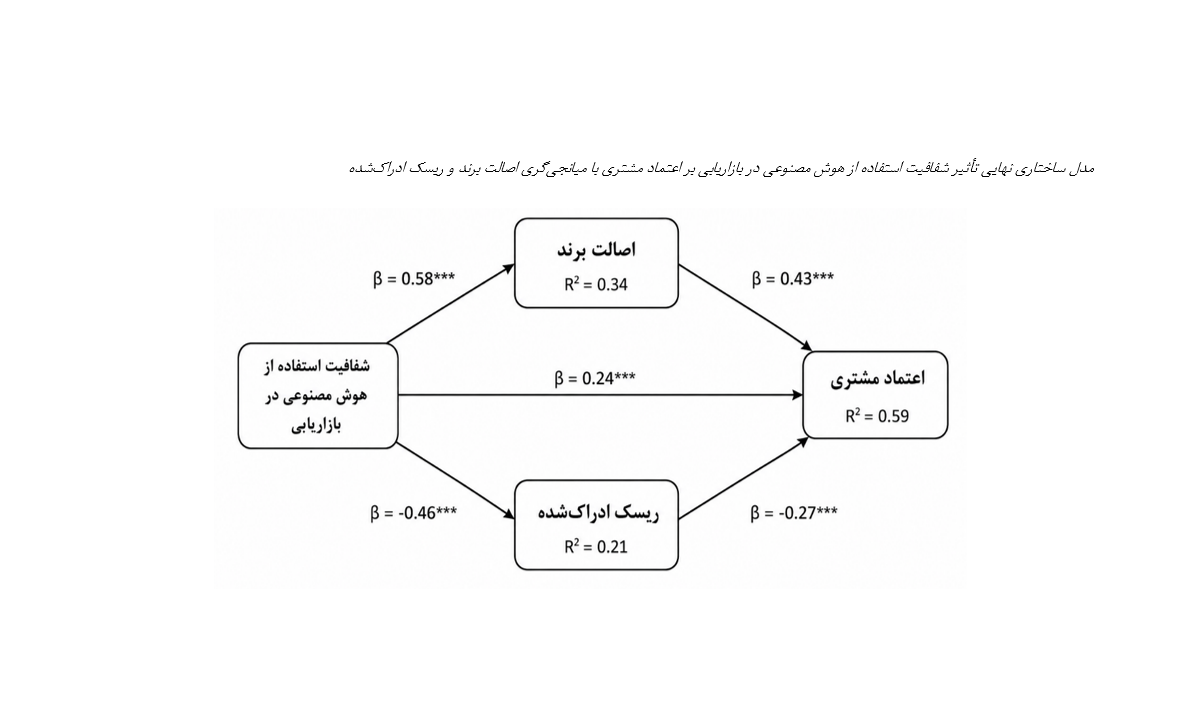
This study aimed to examine the effect of transparency in the use of artificial intelligence in marketing on customer trust, considering the mediating roles of brand authenticity and perceived risk among customers in Tehran. This applied study employed a descriptive-correlational design using structural equation modeling. The statistical population consisted of customers residing in Tehran who had encountered at least one form of AI-enabled marketing during the previous six months. Initially, 420 participants were recruited through convenience sampling, and after excluding invalid responses, data from 384 participants were analyzed. Data were collected using a multidimensional questionnaire assessing AI-use transparency, brand authenticity, perceived risk, and customer trust. Construct validity was examined through confirmatory factor analysis, while internal consistency was assessed using Cronbach’s alpha and composite reliability. Pearson correlation, confirmatory factor analysis, structural equation modeling, and bootstrapping with 5000 resamples were used for data analysis. Structural model results showed that AI-use transparency had a significant positive effect on brand authenticity (β = 0.58, p < 0.001) and a significant negative effect on perceived risk (β = -0.46, p < 0.001). Transparency also had a significant direct positive effect on customer trust (β = 0.24, p < 0.001). Brand authenticity positively predicted customer trust (β = 0.43, p < 0.001), whereas perceived risk negatively predicted trust (β = -0.27, p < 0.001). The indirect effect of transparency on trust through brand authenticity was 0.25, while the indirect effect through perceived risk was 0.12; both effects were statistically significant. The model explained 59 percent of the variance in customer trust. Transparency in AI-enabled marketing can enhance customer trust both directly and indirectly by strengthening brand authenticity and reducing perceived risk; therefore, clear and responsible disclosure of AI use should be treated as a strategic component of brand trust management.
Downloads
References
Beyari, H. (2025). Assessing Artificial Intelligence’s Impact on E-Customer Loyalty in the Saudi Arabian Market. Frontiers in Artificial Intelligence, 8. https://doi.org/10.3389/frai.2025.1541678
Cutinha, Z. P., & Mokshagundam, S. S. (2024). Sustainability Practices in E-Commerce: Opportunities and Challenges for Digital Marketers. International Journal of Research Publication and Reviews, 5(2), 1068-1075. https://doi.org/10.55248/gengpi.5.0224.0435
Daher, M. M. (2026). How Generative AI Shapes Sustainable Wine Consumption and the Role of Anthropomorphism and Trust in the Lebanese Market. International Journal of Customer Relationship Marketing and Management, 16(1), 1-32. https://doi.org/10.4018/ijcrmm.396868
Esch, P. v., Cui, Y., Arli, D., & Eskridge, B. (2026). Virtual Social Influencer Scale Development and Validation: An Algorithmic Approach. Australasian Marketing Journal, 34(3), 283-297. https://doi.org/10.1177/14413582261423028
Gupta, A. S., & Mukherjee, J. (2024). Framework for Adoption of Generative AI for Information Search of Retail Products and Services. International Journal of Retail & Distribution Management, 53(2), 165-181. https://doi.org/10.1108/ijrdm-05-2024-0203
Hm, R. K. (2026). From Feed to Conversation:How AI Brand Persona Continuity Shapes Social Presence and Consumer Trust. https://doi.org/10.21203/rs.3.rs-10413097/v1
Iazzi, A., Maizza, A., Lamusta, S., & Pizzi, S. (2025). The Evolution of Impression Management Research in Social Media: A Bibliometric Perspective. Corporate Social Responsibility and Environmental Management, 33(3), 4070-4087. https://doi.org/10.1002/csr.70373
Jenifer, V. (2024). Examining the Duality of Immersive Artificial Intelligence AI in the Luxury Hospitality Sector : Understanding How Immersive AI Influences Consumer Distinction and Adds Value to Luxury Experiences. International Journal for Multidimensional Research Perspectives, 2(4), 113-126. https://doi.org/10.61877/ijmrp.v2i4.140
Krishna, S., & Pranava, P. (2023). AI Impact on Consumer Perception in Digital Marketing in Chennai City. JDMS, 11(19), 57-65. https://doi.org/10.53422/jdms.2024.111906
Krishnan, V., Guo, J., Nusraningrum, D., Widyanty, W., & Pentang, J. (2024). AI-Powered Influence: Unveiling Consumer Engagement and Purchase Intentions in Malaysia. Journal of Ecohumanism, 3(8). https://doi.org/10.62754/joe.v3i8.5099
Loureiro, S. M. C. (2023). Overview of the Brand Journey and Opportunities for Future Studies. Italian Journal of Marketing, 2023(2), 179-206. https://doi.org/10.1007/s43039-023-00069-0
Morales‐Muñoz, A., Iniesta‐Bonillo, M. Á., Estrella‐Ramón, A., & Herrada‐Lores, S. (2026). Artificial Intelligence and Consumer Behaviour in Social Media: Systematic Literature Review and Future Research Agenda. International Journal of Consumer Studies, 50(1). https://doi.org/10.1111/ijcs.70173
Nadeem, M. (2024). Generative Artificial Intelligence [GAI]: Enhancing Future Marketing Strategies With Emotional Intelligence [EI], and Social Skills? British Journal of Marketing Studies, 12(1), 1-15. https://doi.org/10.37745/bjms.2013/vol12n1115
Nallasivam, A., Krishnan, S. G., Jagadeeswari, I. U., Desai, G., & Bandhu, D. (2025). Predicting Consumer Adoption of Luxury Products via Instagram Marketing: A Machine Learning Approach. F1000research, 14, 890. https://doi.org/10.12688/f1000research.169639.2
Okonkwo, I. E., & Namkoisse, E. (2023). The Role of Influencer Marketing in Building Authentic Brand Relationships Online. Journal of Digital Marketing and Communication, 3(2), 81-90. https://doi.org/10.53623/jdmc.v3i2.350
Peltier, J. W., Dahl, A. J., & Schibrowsky, J. A. (2023). Artificial Intelligence in Interactive Marketing: A Conceptual Framework and Research Agenda. Journal of Research in Interactive Marketing, 18(1), 54-90. https://doi.org/10.1108/jrim-01-2023-0030
Pentina, I., Xie, T., Hancock, T., & Bailey, A. A. (2023). Consumer–machine Relationships in the Age of Artificial Intelligence: Systematic Literature Review and Research Directions. Psychology and Marketing, 40(8), 1593-1614. https://doi.org/10.1002/mar.21853
Pizzi, G., Matta, S., Caboni, F., & Stewart, D. W. (2025). Immersive and Generative Technology: New Tools for Marketing, New Tools for Consumer Response. Psychology and Marketing, 42(12), 3236-3250. https://doi.org/10.1002/mar.70036
Qadri, U. A., & Moustafa, A. M. A. (2025). They Made It Just for Me! How AI Transparency and Influencer Well‐Being Shape Consumer Responses to AI‐Driven Content. Psychology and Marketing, 43(3), 591-608. https://doi.org/10.1002/mar.70075
Rebge, S., & Nevzat, R. (2026). Between Passion and Prediction: AI, Identity, and Fan Engagement Among Generation Z Football Supporters. Sport Marketing Quarterly, 35(3), 247-262. https://doi.org/10.1177/10616934261433377
Shiau, W. L., Lin, C. L., Jiang, S., Dwivedi, Y. K., Yu, W. P., & Chen, K. (2025). Exploring Core Knowledge in Mobile Payment Research. Journal of Organizational and End User Computing, 37(1), 1-38. https://doi.org/10.4018/joeuc.379684
Sorosrungruang, T., Ameen, N., & Hackley, C. (2024). How Real Is Real Enough? Unveiling the Diverse Power of Generative AI‐enabled Virtual Influencers and the Dynamics of Human Responses. Psychology and Marketing, 41(12), 3124-3143. https://doi.org/10.1002/mar.22105
Su, B.-c. (2025). Navigating the New Frontier: The Role of AI‐driven Virtual Influencers in Consumer Engagement. Ai Magazine, 46(2). https://doi.org/10.1002/aaai.70012
Tang, X., Hao, Z., & Li, X. (2025). The Effect of Celebrity Co‐Streamer Type on Consumer Behaviors in Live‐Streaming. Journal of Consumer Behaviour, 24(5), 2251-2272. https://doi.org/10.1002/cb.70004
Tao, X., Zeng, J., Shahzad, M. F., Asif, M., & Butt, S. (2026). Exploring the Intersection of Generative AI and eWOM: A Bibliometric Perspective on Emerging Research Directions. Sage Open, 16(1). https://doi.org/10.1177/21582440261423988
Vyas, Y., & Vishwakarma, P. (2026). Artificial Intelligence in Brand Communication: A Comprehensive Literature Review and Research Outlook. International Journal of Consumer Studies, 50(1). https://doi.org/10.1111/ijcs.70170
Westerbeek, H. (2025). Augmented Authenticity in Athlete Branding Through Human-Ai Co-Production. Frontiers in Sports and Active Living, 7. https://doi.org/10.3389/fspor.2025.1643885
Westerbeek, H., & Schaik, T. v. (2025). Platform Power, Athlete Branding, Generative AI, and the Future of Sport Governance—a Systematic Review. Frontiers in Sports and Active Living, 7. https://doi.org/10.3389/fspor.2025.1642180
Wilson, G. R., Johnson, O., & Brown, W. L. (2024). The Influence of Digital Marketing on Consumer Purchasing Decisions. https://doi.org/10.20944/preprints202408.0347.v1
Downloads
Publication Timeline
- Submitted
- Revised
- Accepted
Issue
Section
License
Copyright (c) 2025 Ehsan Peimani

This work is licensed under a Creative Commons Attribution-NonCommercial 4.0 International License.