Validation of the Coachability Model for Sales Employees Using Structural Equation Modeling: A Case Study of Family Mall Erbil
Keywords:
Coachability, Retailing, Structural Equation Modeling (SEM), Family Mall Erbil, Professional DevelopmentAbstract
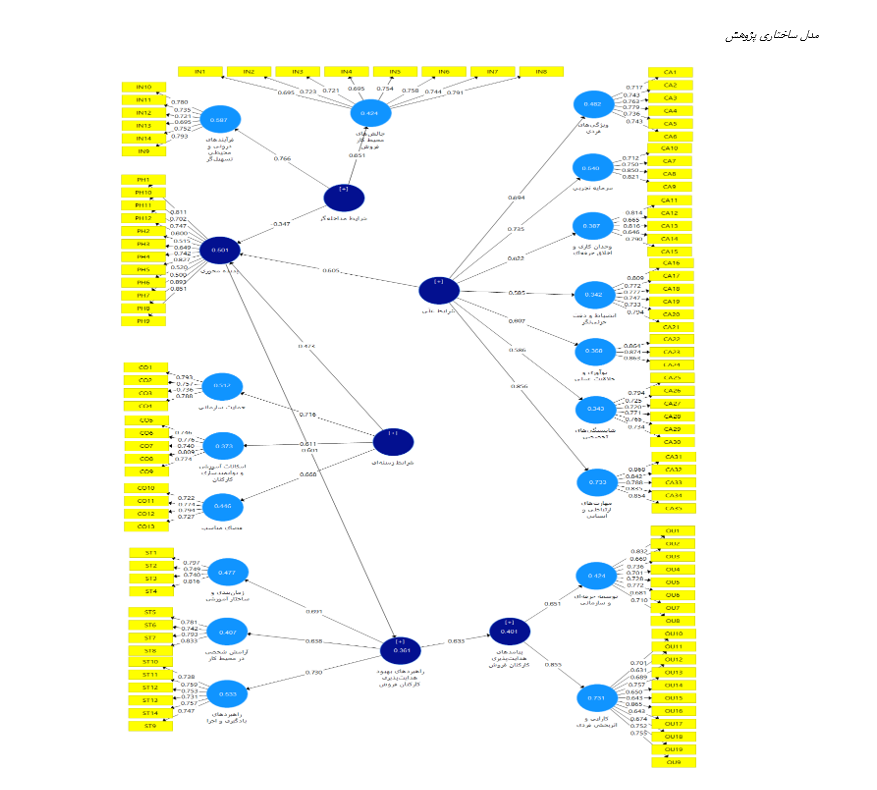
This study aimed to validate a structural model of sales employees’ coachability at Family Mall Erbil and examine the relationships among causal conditions, intervening conditions, contextual conditions, the core phenomenon of coachability, improvement strategies, and coachability outcomes. This applied study employed a descriptive-correlational design based on structural equation modeling. The statistical population comprised 2,000 sales employees working at Family Mall Erbil, of whom 384 were selected based on the Krejcie and Morgan sample-size table using proportionate stratified random sampling. Data were collected using a structured 107-item questionnaire scored on a five-point Likert scale and covering causal conditions, the core phenomenon, intervening conditions, contextual conditions, coachability improvement strategies, and coachability outcomes. Face and content validity, construct validity, convergent and discriminant validity, and reliability based on Cronbach’s alpha and composite reliability were confirmed. Data were analyzed using SPSS version 27 and SmartPLS version 4 through partial least squares structural equation modeling (PLS-SEM). Structural model analysis indicated that causal conditions had a significant positive effect on sales employees’ coachability (β=0.505, t=10.096), whereas intervening conditions exerted a significant negative effect (β=-0.347, |t|=5.680). Contextual conditions also significantly and positively predicted coachability (β=0.473, t=6.899). Furthermore, coachability had a significant positive effect on coachability improvement strategies (β=0.601, t=13.131), and these strategies significantly predicted professional and organizational outcomes (β=0.633, t=12.248). Accordingly, all five structural hypotheses were supported. The overall goodness-of-fit index was 0.522, indicating satisfactory model fit. Sales employees’ coachability is a multidimensional organizational phenomenon shaped jointly by individual and professional capabilities, supportive contextual conditions, and workplace barriers. Higher coachability facilitates the adoption of effective improvement strategies, which subsequently contribute to favorable professional and organizational outcomes. Strengthening employees’ competencies, developing supportive training infrastructures, and reducing adverse intervening conditions may therefore enhance the effectiveness of coaching and human-resource development initiatives in retail environments.
Downloads
References
Akhavan Kharazian, M., & Dadbeh, S. (2021). A Multilevel Model of the Impact of Sales Employees' Personality Types and Customers' Personality Types on Trust in the Seller. Business Management, 13(2), 412-434.
Amiri, R., & Ghanbaripour, S. (2020). Examining the Relationship between Transformational Leadership and Employee Receptivity to Guidance in Government Organizations. Manager Psychology Quarterly, 28(1), 63-80.
Christina, R., & Nathan, M. D. M. (2024). Enhancing organizational performance through employee coaching: A review of current practices and future directions. Cahiers Magellanes-NS, 6(2), 1090-1101.
Febrian, W. D., & Sani, I. (2023). Analysis of work environment, attitude, coaching, and servant leadership on job satisfaction mediated by career development (Literature review study). Indonesian Journal of Business Analytics, 3(4), 1089-1104. https://doi.org/10.55927/ijba.v3i4.5031
Fournet, A. C. (2024). Coaching Isn't Just for Little League Anymore: A Theory of Individual Coachability Louisiana Tech University].
hosein goli, a., & khadem hojati, t. (2022). The effect of business intelligence on marketing on increasing sales in manufacturing companies. Journal of Accounting and Management Vision, 5(59), 91-100. https://www.jamv.ir/article_149897.html
Hwang, C. Y., Kang, S. W., & Choi, S. B. (2023). Coaching leadership and creative performance: A serial mediation model of psychological empowerment and constructive voice behavior. Frontiers in psychology, 14, 1077594. https://doi.org/10.3389/fpsyg.2023.1077594
Johnson, M. J., Kim, K. H., Colarelli, S. M., & Boyajian, M. (2021). Coachability and the development of the coachability scale. Journal of Management Development, 40(7/8), 585-610. https://doi.org/10.1108/JMD-06-2020-0174
Jung, J., Kim, B. J., & Kim, M. J. (2023). The effect of unstable job on employee turnover intention: The importance of coaching leadership. Frontiers in Public Health, 11, 1068293. https://doi.org/10.3389/fpubh.2023.1234387
Middleton, E. D., Zajac, S. A., Cavanaugh, K. J., Westmoreland, K., Brown, R. P., & Smith, D. B. (2024). Assessing workplace coachability: a multi-study approach to design and validation. Coaching: An International Journal of Theory, Research and Practice, 15-24. https://doi.org/10.1080/17521882.2024.2367425
Mmaditla, T., & Ndlovu-Hlatshwayo, E. N. (2023). The Perceived Applicability of Coaching Skills among Human Resource Business Partners of South African State-Owned Entities. Journal of Management and Entrepreneurship Research, 3(2), 106-120. https://doi.org/10.34001/jmer.2022.12.03.2-31
Mollaei. (2021). The Role of Individual Differences in Providing and Receiving Guidance from the Perspective of Quranic Verses and Hadiths [Master's thesis, Hakim Sabzevari University, Faculty of Literature and Humanities].
Moradi, H., Taban, J., & Maleki, Y. (2021). Dimensions of Human Receptivity to Guidance from the Perspective of the Quran and Their Compatibility with Citizenship Rights. Bioethics Journal, 10(1), 295-309.
Pousa, C., Liu, Y., & Aman, A. (2020). The Effect of Managerial Coaching on Salesperson's Relationship Behaviors: New Evidence from Frontline Bank Employees in China. International Journal of Bank Marketing, 38(6), 1259-1277. https://doi.org/10.1108/IJBM-12-2019-0437
Reeves, M. (2025). Coaching for Managers: Essential Skills for Developing High-Performing Teams. https://www.togetherplatform.com/blog/coaching-for-managers
Sahafzadeh, A., & Haghighi, M. (2023). Designing a Model for Empowering Iranian Brands with an Emphasis on the Open Innovation Approach in the Home Appliances Industry. New Marketing Research Journal, 12(4), 91-112. https://doi.org/10.22108/nmrj.2023.135031.2756
Shabani, M., Shafiei, F. S., & Diyalameh, N. (2024). Developing a Model of the Role of Educational Leadership in Students' Receptivity to Guidance with an Emphasis on the Holy Quran: The Guiding Leadership Style. Applied Issues in Islamic Education, 9(1), 9-15.
Toolabi, M., Farahani, A., Ghorbani Ghahfarokhi, L., & Rezaei Soufi, M. (2025). Designing a Paradigmatic Model of Organizational Coaching in Sports Organizations with a Human Resource Empowerment Approach. Organizational Behavior Management in Sport Studies, 12(2), 78-99. https://doi.org/10.30473/fmss.2025.72591.2637
Weiss, J. A. (2020). An Examination of Employee Coachability and Managerial Coaching in Organizations (Publication Number 323)
Zare Zeidi, A., Jafari Kalarijani, S. A., Mehrara, A., & Bagherzadeh, M. R. (2026). Identifying and Validating the Components of Coaching for Managers of Government Organizations with Emphasis on Sustainable Human Resources. Personal Development and Organizational Transformation, 4(1), 1-24. https://doi.org/10.61838/kman.jpdot.578
Zeraatpisheh, H., Masoudi, O. A., & Darzian Rostami, H. (2025). Providing a Coaching Model for Public Relations Managers of Petrochemical Companies: A Case Study of the South Pars Region of Assaluyeh. Communication and Culture Path, 5(3), 105-121.
Downloads
Publication Timeline
- Submitted
- Revised
- Accepted
Issue
Section
License
Copyright (c) 2026 Noura Kazem Omran Noor (Author); Mohsen Alizadeh Sani; Meysam Shirkhodaie, Aboalhasan Hosseini, Mohammad Safari (Author)

This work is licensed under a Creative Commons Attribution-NonCommercial 4.0 International License.