Identification and Prioritization of Factors Affecting Employer Branding and Employee Mental Well-Being Using Interpretive Structural Modeling
Keywords:
Employer Branding, Employee Mental Well-Being, Interpretive Structural Modeling, Organizational Development, Organizational Culture, Internal Communication, MICMAC AnalysisAbstract
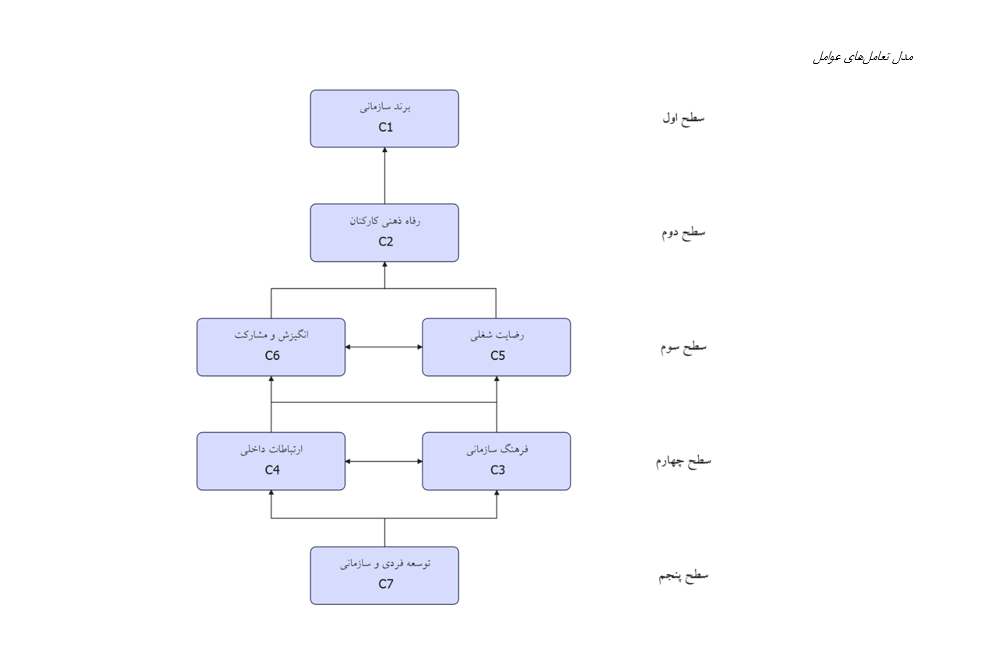
The present study aimed to identify, structure, and prioritize the factors influencing employer branding and employee mental well-being and to explain the causal relationships among these factors in organizations affiliated with the Social Security Organization. This applied qualitative study employed Interpretive Structural Modeling (ISM) to develop a hierarchical model of influential factors. Participants consisted of experts in human resource management, employer branding, and employee well-being selected through purposive and snowball sampling. Data were collected through extensive literature review and in-depth semi-structured interviews conducted until theoretical saturation was achieved. Extracted factors were analyzed qualitatively, after which expert judgments were used to construct the Structural Self-Interaction Matrix. Initial and final reachability matrices were generated to determine driving power and dependence levels among variables. Subsequently, hierarchical level partitioning and MICMAC analysis were applied to classify variables and validate the structural stability of the proposed model. Inferential results revealed that the determinants of employer branding and employee mental well-being are organized into seven interrelated dimensions forming a hierarchical system. Individual and organizational development emerged as the most influential driving factor, functioning as the foundational element of the model. Organizational culture and internal communication operated as linkage variables, transferring developmental effects across organizational processes. Job satisfaction together with employee motivation and participation played mediating roles by translating organizational conditions into psychological outcomes. Employee mental well-being was identified as a prerequisite for successful employer branding, while organizational brand represented the final dependent outcome characterized by high dependence and limited driving power. MICMAC analysis demonstrated strong interconnectivity among variables and indicated that systemic changes originating from foundational factors propagate throughout the entire organizational structure. The findings indicate that sustainable employer branding is primarily an internal organizational outcome rather than a purely external promotional construct. Continuous employee development, supportive organizational culture, effective communication systems, and enhanced psychological well-being collectively create the conditions necessary for a strong employer brand. Organizations should therefore adopt a systemic and development-oriented strategy, beginning with investment in employee growth and organizational learning, to foster motivation, job satisfaction, and mental well-being, ultimately strengthening long-term employer brand attractiveness.
Downloads
References
Afjeh, S. A. A., & Alizadehfar, Z. (2017). The relationship between employer brand perception and employees' job attitudes. Management Studies (Improvement and Transformation), 26(84), 73-96. https://www.sid.ir/fa/VEWSSID/J_pdf/4004513968404.pdf
Asanlu, B., & Khodami, S. (2015). The impact of customers' emotional attachment on brand equity emphasizing the mediating role of relationship quality and brand citizenship behavior in the industrial market. Brand Management Quarterly, 2(4), 97-124. https://journal.alzahra.ac.ir/article_2580.html
Barrow, S., & Mosley, R. (2005). The employer brand: Bringing the best of brand management to people at work. John Wiley & Sons. https://books.google.com/books?hl=en&lr=&id=Pu3XEAAAQBAJ&oi=fnd&pg=PR11&dq=Barrow,+S.+and+R.+Mosley+(2005).+The+employer+brand:+Bringing+the+best+of+brand+management+to+people+at+work,+John+Wiley+%26+Sons.+%09&ots=HgVYWwQhSC&sig=XdngzFAtnVYdIkjvAolWB7nSd2A
Benraiss-Noailles, L., & Viot, C. (2021). Employer brand equity effects on employees well-being and loyalty. Journal of Business Research, 126, 605-613. https://doi.org/10.1016/j.jbusres.2020.02.002
Bozorgi, Z., Khodadad Hosseini, S. H., & Ahmadi, P. (2021). Investigating how employer brand equity affects employee performance with attention to the role of employee well-being and loyalty (Case study: Dana Insurance). Proceedings of the 18th International Management Conference, Tehran.
Chiang, H. H., & Yu, S. Y. (2021). Employer branding and employee-based brand equity: The mediating and moderating effects in multilevel models. Management Comments, 40(1), 131-154. https://www.management-review.org/uploads/pdf/paper/mr_2021_01_jan_03.pdf.pdf
Choudhary, S., & Joshi, R. (2025). Unveiling the power of employer branding: enhancing talent retention through organizational advocacy. Asia-Pacific Journal of Business Administration, 17(4), 1093-1114. https://doi.org/10.1108/APJBA-04-2024-0225
Devito, L., Brown, A., Bannister, B., Cianci, M., & Mujtaba, B. (2016). Employee motivation based on the hierarchy of needs, expectancy and the two-factor theories applied with higher education employees. International Journal of Advances in Management, Economics and Entrepreneurship, 3. https://nova.elsevierpure.com/en/publications/employee-motivation-based-on-the-hierarchy-of-needs-expectancy-an-2
Dziedzic, J. (2024). From Organizational Identity to Impact: Employer Branding Strategies for Talent Attraction. Strategiczne zarządzanie w przedsiębiorstwach i administracji publicznej, 23. https://www.ceeol.com/search/article-detail?id=1342436
Elufioye, O. A., Ndubuisi, N. L., Daraojimba, R. E., Awonuga, K. F., Ayanponle, L. O., & Asuzu, O. F. (2024). Reviewing employee well-being and mental health initiatives in contemporary HR Practices. International Journal of Science and Research Archive, 11(1), 828-840. https://doi.org/10.30574/ijsra.2024.11.1.0153
Fernandez-Lores, S., Gavilan, D., Avello, M., & Blasco, F. (2016). Affective commitment to the employer brand: Development and validation of a scale. BRQ Business Research Quarterly, 19(1), 40-54. https://doi.org/10.1016/j.brq.2015.06.001
Goyal, R., & Kaur, G. (2023). Identifying the impact of employer branding in the retention of nurses: the mediating role of organizational culture and career development. Humanities and Social Sciences Communications, 10(1), 1-10. https://doi.org/10.1057/s41599-023-01794-9
Heide, M., Schröder, S., Wittemann, N., & Don, P. (2024). Employer branding-employer attractiveness as a new mindset in the healthcare sector. Management Dynamics in the Knowledge Economy, 12(1), 70-85. https://doi.org/10.2478/mdke-2024-0005
Hein, A. Z., Elving, W. J., Koster, S., & Edzes, A. (2024). Is your employer branding strategy effective? The role of employee predisposition in achieving employer attractiveness. Corporate Communications: An International Journal, 29(7), 1-20. https://doi.org/10.1108/CCIJ-07-2022-0070
Hoppe, D. (2018). Linking employer branding and internal branding: Establishing perceived employer brand image as an antecedent of favourable employee brand attitudes and behaviours. Journal of Product & Brand Management, 27(4), 452-467. https://doi.org/10.1108/JPBM-12-2016-1374
Lievens, F., & Slaughter, J. E. (2016). Employer image and employer branding: What we know and what we need to know. Annual Review of Organizational Psychology and Organizational Behavior, 3(1), 407-440. https://doi.org/10.1146/annurev-orgpsych-041015-062501
Mishra, S., & Kumar, S. P. (2019). E-recruitment and training comprehensiveness: untapped antecedents of employer branding. Industrial and Commercial Training, 51(2), 125-136. https://doi.org/10.1108/ICT-12-2017-0106
Moroko, L., & Uncles, M. D. (2008). Characteristics of successful employer brands. Journal of Brand Management, 16(3), 160-175. https://doi.org/10.1057/bm.2008.4
Nazari, M., Karimi, F., & Ahmdpour, S. (2018). The impact of employer brand on human resource productivity with the mediating role of talent management. Quarterly Journal of Organizational Management, 9(3), 33-58. https://www.noormags.ir/view/fa/articlepage/1502276/
Park, J., & Kim, J. (2024). Exploring the relationships among internal branding, work engagement, and turnover intention in public sports organizations after the pandemic. Sustainability, 16(3), 1342. https://doi.org/10.3390/su16031342
Rahimian, A. (2013). Employer brand: A new strategy for human capital management. Human Resource Management Research, 5(2), 127-150. https://hrmj.ihu.ac.ir/article_5052_146704a67b2dc99fa96b5a37d51fab75.pdf
Raj, A. B., & Goute, A. K. (2025). Internal branding and technostress among employees - the mediation role of employee wellbeing and moderating effects of digital internal communication. Acta Psychologica, 255, 104943. https://doi.org/10.1016/j.actpsy.2025.104943
Reis, I., Sousa, M. J., & Dionísio, A. (2021). Employer branding as a talent management tool: A systematic literature revision. Sustainability, 13(19), 10698. https://doi.org/10.3390/su131910698
Rita, P., António, N., & Raminhos, V. (2026). Using employee feedback to build effective employer branding strategies: a mixed method approach. International Journal of Organizational Analysis, 34(1), 256-282. https://doi.org/10.1108/IJOA-04-2024-4469
Ronda, L., Valor, C., & Abril, C. (2018). Are they willing to work for you? An employee-centric view to employer brand attractiveness. Journal of Product & Brand Management, 27(5), 573-596. https://doi.org/10.1108/JPBM-07-2017-1522
Sandeepanie, M. H. R., Gamage, P., Perera, G. D. N., & Sajeewani, T. L. (2023). The role of talent management and employee psychological contract on employer branding: a pragmatic conceptual model. Management Research Review, 46(2), 196-222. https://doi.org/10.1108/MRR-02-2021-0136
Shah, M. (2011). Talent Retention through Employer Branding. Journal of Marketing & Communication, 6(3). https://search.ebscohost.com/login.aspx?direct=true&profile=ehost&scope=site&authtype=crawler&jrnl=09732330&asa=Y&AN=80241250&h=f3NaIAtJ6OAL0HO3NYaqawpEyrEIbzdzhu0kJQC2IAfpNeWZYCgZw0R9dczIIh4JtuPJxsUXfEIo6%2BF3Z6CCCA%3D%3D&crl=c
Shoghi Lord, A., Akbari, N., & Sadeghi, R. (2019). A comparison of employer brand attractiveness in Iran's public and private sectors. Human Resource Management Studies, 10(1), 55-78. https://www.jipas.ir/article_84221.html
Sokro, E. (2012). Impact of employer branding on employee attraction and retention. http://digitalrepository.cipmlk.org/handle/1/847
Downloads
Publication Timeline
- Submitted
- Revised
- Accepted
Issue
Section
License
Copyright (c) 2025 Karim Abedikhah, Ali Pirzad, Hassan Soltani (Author)

This work is licensed under a Creative Commons Attribution-NonCommercial 4.0 International License.