Econometric Analysis of Productivity Drivers in the Cement Industry: A Technology-Oriented Approach to Entrepreneurship and Strategic Management
DOI:
https://doi.org/10.61838/kman.jtesm.495Keywords:
Labor productivity, Cement industry, Technology orientation, Organizational entrepreneurship, Strategic management, Econometric analysisAbstract
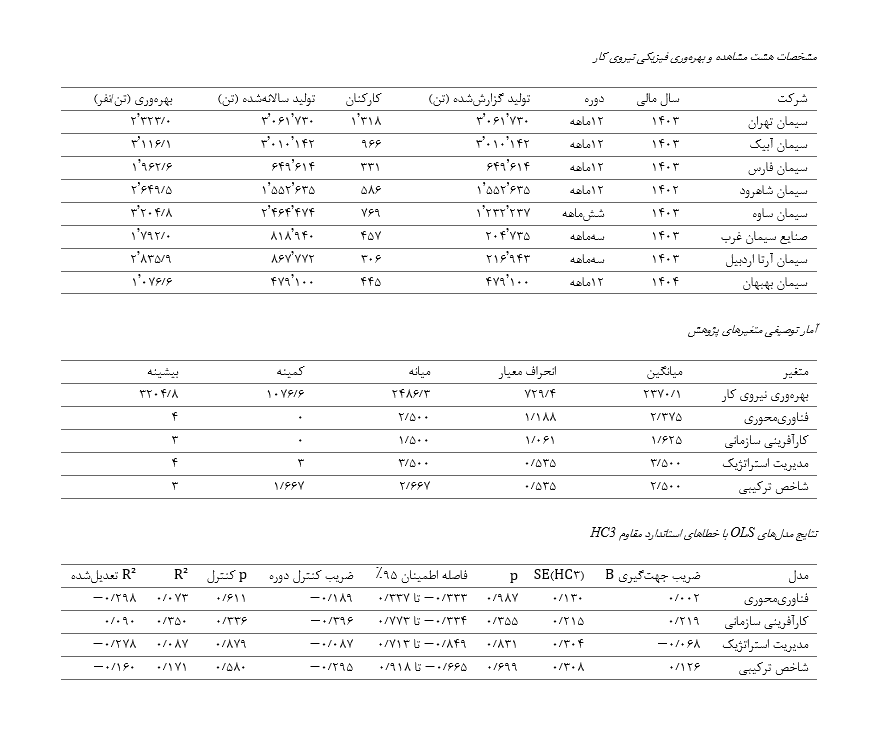
This study aimed to examine the relationships of technology orientation, organizational entrepreneurship, strategic management, and their composite index with physical labor productivity in Iranian cement companies. This applied study employed a documentary, correlational, and econometric design. The study population comprised cement-producing companies listed on the Tehran Stock Exchange and Iran Fara Bourse during fiscal years 2023–2026. A purposive sample was selected based on the simultaneous availability of production figures, workforce information, and documented managerial evidence, resulting in eight firm-period observations. Labor productivity was calculated by dividing annualized cement production by the reported number of employees. Technology orientation, organizational entrepreneurship, and strategic management were scored from zero to four based on documented evidence of implemented or ongoing initiatives disclosed in official corporate reports. Spearman rank correlations and separate ordinary least squares regression models were employed, with reporting-period type included as a control variable. HC3 heteroskedasticity-robust standard errors and the residual-degrees-of-freedom t distribution were used for statistical inference. Spearman correlations between labor productivity and technology orientation, organizational entrepreneurship, strategic management, and the composite index were 0.125, 0.222, −0.218, and 0.235, respectively; none was statistically significant. In the regression models, the estimated standardized coefficients for technology orientation, organizational entrepreneurship, strategic management, and the composite index were 0.002, 0.219, −0.068, and 0.126, respectively. The corresponding p-values were 0.987, 0.355, 0.831, and 0.699. Thus, none of the four research hypotheses was supported at the 0.05 significance level. Sensitivity analyses further indicated that the estimated relationships were dependent on sample composition, reporting-period type, and influential observations. The available evidence was insufficient to establish a definitive relationship between the examined managerial factors and labor productivity. Nevertheless, the findings indicate that a reliable assessment of technology, entrepreneurship, and strategic management effects requires a larger multi-year panel, control of firm-level technical characteristics, and consideration of the time lag between project implementation and productivity outcomes.
Downloads
References
Andrijevskaja, J., & Volkova, A. (2025). Industrial Energy Use, Efficiency, and Savings: Methods for Quantitative Analysis. Energy Efficiency, 18, 76. https://doi.org/10.1007/s12053-025-10367-5
Bansal, S., Filippini, M., & Srinivasan, S. (2026). Market-Based Energy Policy Instruments and Total Factor Productivity in Developing Countries: Evidence from the Cement Industry in India. Energy Economics, 157, 109287. https://doi.org/10.1016/j.eneco.2026.109287
Barba-Sanchez, V., Meseguer-Martinez, A., Gouveia-Rodrigues, R., & Raposo, M. L. (2024). Effects of Digital Transformation on Firm Performance: The Role of IT Capabilities and Digital Orientation. Heliyon, 10(6), e27725. https://doi.org/10.1016/j.heliyon.2024.e27725
Cantini, A., Leoni, L., De Carlo, F., Martini, C., Salvio, M., & Martini, F. (2021). Technological Energy Efficiency Improvements in Cement Industries. Sustainability, 13(7), 3810. https://doi.org/10.3390/su13073810
Chang, W., Whang, J. B., & Lee, J. H. (2026). The Strategic Use of Digital Transformation Capability: A Meta-Analytic Approach. European Journal of Innovation Management, 29(5), 1535-1560. https://doi.org/10.1108/EJIM-06-2025-0836
Dana, L. P., Salamzadeh, A., Mortazavi, S., & Hadizadeh, M. (2022). Investigating the Impact of International Markets and New Digital Technologies on Business Innovation in Emerging Markets. Sustainability, 14(2), 983. https://doi.org/10.3390/su14020983
Eghbalian, P., Ghobadian, V., & Mahmoudi Zarandi, M. (2024). Increasing Energy Productivity and Reducing Pollution in the Design of Cement Factories in Iran: A LEED-Based Approach. Armanshahr Architecture and Urban Development, 17(47), 145-157. https://doi.org/10.22034/AAUD.2024.421739.2833
Eskandari, N., & Mohammadi-Nasab, M. (2023). Strategic Analysis of the Cement Industry for Realizing the Vision of the Industry's Strategic Document on the 2025 Horizon. Business Reviews, 21(122), 105-134. https://doi.org/10.22034/BS.2023.1988675.2737
Ige, O. E., & Kabeya, M. (2025). Decarbonizing the Cement Industry: Technological, Economic, and Policy Barriers to CO2 Mitigation Adoption. Clean Technologies, 7(4), 85. https://doi.org/10.3390/cleantechnol7040085
Jang, S. H., & Lee, C. W. (2025). Digital Entrepreneurial Orientation, Technology Absorptive Capacity, and Digital Innovation on Business Performance. Systems, 13(4), 300. https://doi.org/10.3390/systems13040300
Kaidpour, F., Sayadmanesh, S., Salmani, Y., & Sadeghi, Z. (2020). Measuring the Efficiency and Productivity of Cement Industry Companies Listed on the Tehran Stock Exchange Using Data Envelopment Analysis and the Malmquist Productivity Index in a Grey Environment. Innovation Management and Operational Strategies, 1(4), 363-382. https://doi.org/10.22105/IMOS.2021.276467.1038
Kindermann, B., Beutel, S., Garcia de Lomana, G., Strese, S., Bendig, D., & Brettel, M. (2021). Digital Orientation: Conceptualization and Operationalization of a New Strategic Orientation. European Management Journal, 39(5), 645-657. https://doi.org/10.1016/j.emj.2020.10.009
Mahnashi, I., Salah, B., & Ragab, A. E. (2023). Industry 4.0 Framework Based on Organizational Diagnostics and Plan-Do-Check-Act Cycle for the Saudi Arabian Cement Sector. Sustainability, 15(14), 11261. https://doi.org/10.3390/su151411261
Nassani, A. A., Grigorescu, A., Yousaf, Z., Condrea, E., Javed, A., & Haffar, M. (2023). Does Technology Orientation Determine Innovation Performance Through Digital Innovation? A Glimpse of the Electronic Industry in the Digital Economy. Electronics, 12(8), 1854. https://doi.org/10.3390/electronics12081854
Santos Junior, E. d., da Silva, D. C., Spitzeck, H. H., de Sousa, P. R., de Carvalho, R. B., & da Veiga, C. P. (2026). Sustainability Maturity Assessment: Benchmarking in Brazilian Cement Plants Using Fuzzy Multi-Criteria Methods. Process Integration and Optimization for Sustainability. https://doi.org/10.1007/s41660-026-00788-9
Taghizadeh, H., & Pourrabi, M. (2013). Evaluation of Energy Efficiency of Companies Listed on the Tehran Stock Exchange: Case Study of the Cement Industry. Financial Knowledge of Securities Analysis, 20(6).
Tsai, W. H., & Lin, W. H. (2024). Production Decision Model for the Cement Industry in Pursuit of Carbon Neutrality: Analysis of the Impact of Carbon Tax and Carbon Credit Costs. Sustainability, 16(6), 2251. https://doi.org/10.3390/su16062251
Tu, H., Dai, W., & Xiao, X. (2022). Study on the Environmental Efficiency of the Chinese Cement Industry Based on the Undesirable Output DEA Model. Energies, 15(9), 3396. https://doi.org/10.3390/en15093396
Downloads
Publication Timeline
- Submitted
- Revised
- Accepted
Issue
Section
License
Copyright (c) 2025 Reza Bakhtiari (Author); Arshad Farahmandian; Mohammad Hasan Abdollahi (Author)

This work is licensed under a Creative Commons Attribution-NonCommercial 4.0 International License.