Explaining the Process of Market Share Maximization through the Application of Artificial Intelligence in Marketing Strategies: The Case of Iran Insurance Company
Keywords:
Market share, artificial intelligence, marketing strategies, smart marketing, Iranian insuranceAbstract
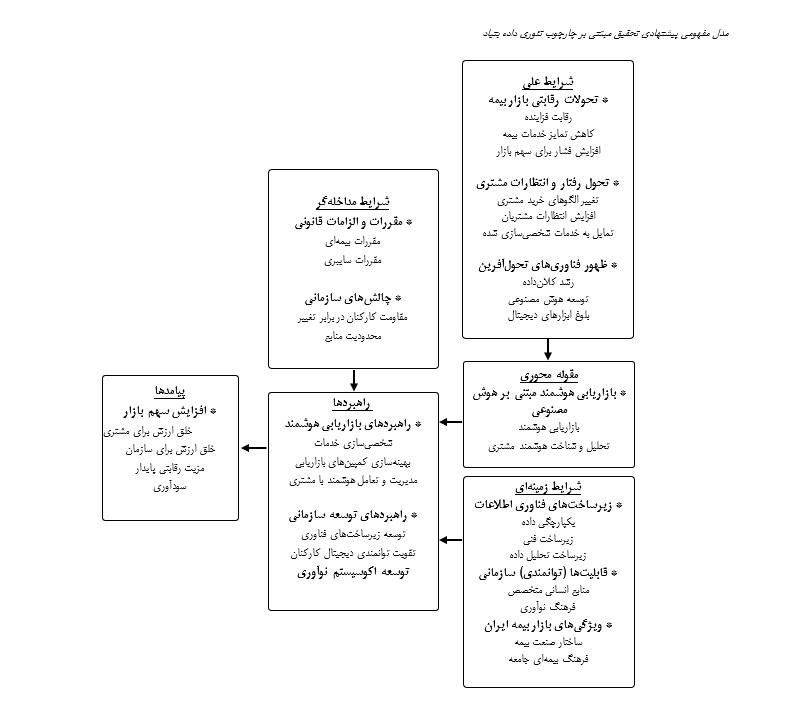
This study aimed to explain the process through which Iran Insurance Company can maximize its market share by identifying the mechanisms, conditions, and strategies associated with the application of artificial intelligence in marketing. This applied study adopted an exploratory–explanatory qualitative design. The participants were 14 managers, senior experts, and specialists in insurance marketing, information technology, data analytics, and digital transformation, selected through purposive and snowball sampling until theoretical saturation was achieved. Data were collected through semi-structured interviews, which were recorded, transcribed, and prepared for analysis. The data were analyzed using the grounded theory methodology of Strauss and Corbin through open, axial, and selective coding. A paradigmatic model was subsequently developed comprising causal conditions, contextual conditions, intervening conditions, strategies, a central phenomenon, and consequences. The analysis generated 372 initial concepts, which were consolidated into 32 components and 12 principal dimensions. Competitive transformations in the insurance market, changing customer behaviors and expectations, and the emergence of transformative technologies were identified as causal conditions. Artificial intelligence-based intelligent marketing, including intelligent marketing practices and advanced customer analysis, emerged as the central phenomenon. Information technology infrastructure, organizational capabilities, and the specific characteristics of the Iranian insurance market constituted the contextual conditions. Insurance and cybersecurity regulations, employee resistance to change, and resource limitations were identified as intervening conditions. The principal strategies included service personalization, marketing campaign optimization, intelligent customer interaction management, technological infrastructure development, enhancement of employees’ digital competencies, and development of an innovation ecosystem. These strategies facilitated value creation for customers and the organization, sustainable competitive advantage, profitability, and ultimately increased market share. Maximizing the market share of Iran Insurance Company requires an integrated intelligent marketing system in which data infrastructure, organizational capabilities, artificial intelligence technologies, and customer-oriented strategies are developed and implemented coherently.
Downloads
References
Ahadi, S., Jalali, S. M., & Hasoumi, T. (2025). Identifying and Prioritizing the Dimensions of Artificial Intelligence-Based Marketing Management in Iran's Steel Industry: A Mixed-Methods Study. Technology in Entrepreneurship and Strategic Management, 4(3).
Alizadeh, H., Damavandinejad, M., & Behradfar, A. (2026). The Role of Artificial Intelligence Capabilities in Strengthening the Effect of B2B Marketing on Export Performance: A Study in the Petrochemical Industry. Technology in Entrepreneurship and Strategic Management, 5(2).
Bauer, W. A., & Dubljević, V. (2020). AI Assistants and the Paradox of Internal Automaticity. Neuroethics, 13, 303-310. https://doi.org/10.1007/s12152-019-09423-6
Bolourian Tehrani, M. (2024). Marketing and Market Management (6th ed.). Institute for Trade Studies and Research Publications.
Chen, Y., Du, L., Zhang, B., Wang, L., Wang, K., Huang, X., & Shi, Y. (2025). The Impact of Artificial Intelligence on the Sustainability of International Trade Enterprises. International Review of Economics & Finance, 101, 104136. https://doi.org/10.1016/j.iref.2025.104136
Chui, M., Manyika, J., & Miremadi, M. (2024). Notes from the AI Frontier.
Crawford, I., & Wang, Z. (2025). Is the Market Underreacting or Overreacting to Open Market Share Repurchases? A UK Perspective. Research in International Business and Finance, 26, 26-46. https://doi.org/10.1016/j.ribaf.2011.05.002
Dadkhah, M. R., & Kamali, K. (2022). Marketing and Market Management (3rd ed.). Mehrashoub Press.
Holzinger, A., Weippl, E., Tjoa, A. M., & Kieseberg, P. (2021). Digital Transformation for Sustainable Development Goals: A Security, Safety and Privacy Perspective on AI. In Lecture Notes in Computer Science (Vol. 12844, pp. 1-20). https://doi.org/10.1007/978-3-030-84060-0_1
Huang, M. H., & Rust, R. T. (2021). A Strategic Framework for Artificial Intelligence in Marketing. Journal of the Academy of Marketing Science. https://doi.org/10.1007/s11747-020-00749-9
Jafari, M. (2025). Artificial Intelligence in Marketing: A Review of Applications and Challenges First International Conference on Advances in Artificial Intelligence in Engineering and Humanities,
Lemon, K. N., & Verhoef, P. C. (2024). Understanding Customer Experience throughout the Customer Journey and Its Impact on Market Outcomes. Journal of Marketing, 88(2), 68-96. https://doi.org/10.1177/00222429231145892
Loursen, K., & Meliciai, V. (2022). The Role of ICT Knowledge Flows for International Market Share Dynamics. Research Policy, 39(2010), 687-697. https://doi.org/10.1016/j.respol.2010.02.007
Marber, A., Wellen, P., & Polsuszny, S. (2022). The Merging of Marketing and Sports: A Case Study. The Marketing Management Journal, 15(1), 162-171. https://doi.org/10.63963/001c.150881
Moghaddaspour, A., Gholipour Souteh, R., & Ansari, M. (2026). Presenting a Model of Data-Driven Marketing Strategies for the Digital Marketing of Knowledge-Based Companies. Technology in Entrepreneurship and Strategic Management, 5(2).
Mohebi, Z., & Kazemi, B. (2025). The Role of Artificial Intelligence in Marketing Management International Conference on Management Research and Humanities Studies in Iran,
Najaflou, H. (2024, 2024/02/06-2024/02/07). Examining the Impact of Artificial Intelligence on Marketing and Branding Strategies in Small and Medium-Sized Enterprises Third International Congress on Management, Economics, Humanities, and Business Development,
Potwora, M., Vdovichena, O., Semchuk, D., & Lipych, L. (2024). The Use of Artificial Intelligence in Marketing Strategies: Automation, Personalization and Forecasting. Journal of Management World, 2024(2), 41-49. https://doi.org/10.53935/jomw.v2024i2.275
Razeghian, M., & Weber, T. A. (2025). Strategic Durability with Sharing Markets. Sustainable Production and Consumption, 19, 79-96. https://doi.org/10.1016/j.spc.2019.02.007
Saeidi, S., & Alizadeh, H. (2026). The Effect of Artificial Intelligence Capabilities on Competitive Advantage in International Markets: The Mediating Role of Entrepreneurial Orientation and the Moderating Role of Strategic Agility. Technology in Entrepreneurship and Strategic Management, 5(2).
Seyed Javadin, S. R., & Bahmanirad, M. H. (2025). The Effect of Business Culture on the Role of Artificial Intelligence in Formulating Business Strategies. Quarterly Journal of New Approaches in Management and Marketing, 4(2), 317-335. https://doi.org/10.22034/jnamm.2025.561673.1213
Shahsavari, N. (2024). A Systematic Review and Analysis of Research on Artificial Intelligence in Marketing. Quarterly Journal of Applied Market Management Research, 10(36).
Steinhoff, L., Arli, D., Weaven, S., & Kozlenkova, I. (2023). Strategic Use of Digital Marketing and Its Impact on Customer Acquisition and Market Performance. Journal of Business Research, 156, 113498. https://doi.org/10.1016/j.jbusres.2022.113498
Teng, M., Tianjiao, L., Song, W., & Dong, J. (2026). The Effect of Artificial Intelligence on the Optimization of Digital Advertising Campaigns. International Journal of Information Management, 80, 102851. https://doi.org/10.1016/j.ijinfomgt.2024.102851
Thompson, L., McKinsey, E., & Wong, H. (2026). Artificial Intelligence Status: Current Trends of Artificial Intelligence in Marketing Insurance Companies. https://www.mckinsey.com/business-functions/mckinsey-digital/our-insights/the-state-of-ai-in-2025
Wang, J., & Yu, L. (2025). Application and Practice of Artificial Intelligence in Marketing Strategy. Discover Artificial Intelligence, 5, 103. https://doi.org/10.1007/s44163-025-00346-1

Downloads
Published
Submitted
Revised
Accepted
Issue
Section
License
Copyright (c) 2025 Ansiyeh Faegh (Author); Ahmad Askari; Dariyoush Jamshidi (Author)

This work is licensed under a Creative Commons Attribution-NonCommercial 4.0 International License.