تبیین سازوکارهای اثرگذاری تابآوری زنجیره تأمین دیجیتال بر عملکرد مالی و غیرمالی شرکتها با نقش میانجی چابکی سازمانی و تعدیلگری عدمقطعیت محیطی
کلمات کلیدی:
تابآوری زنجیره تأمین دیجیتال, عملکرد مالی, عملکرد غیرمالی, چابکی سازمانی, عدمقطعیت محیطی, مدلسازی معادلات ساختاریچکیده
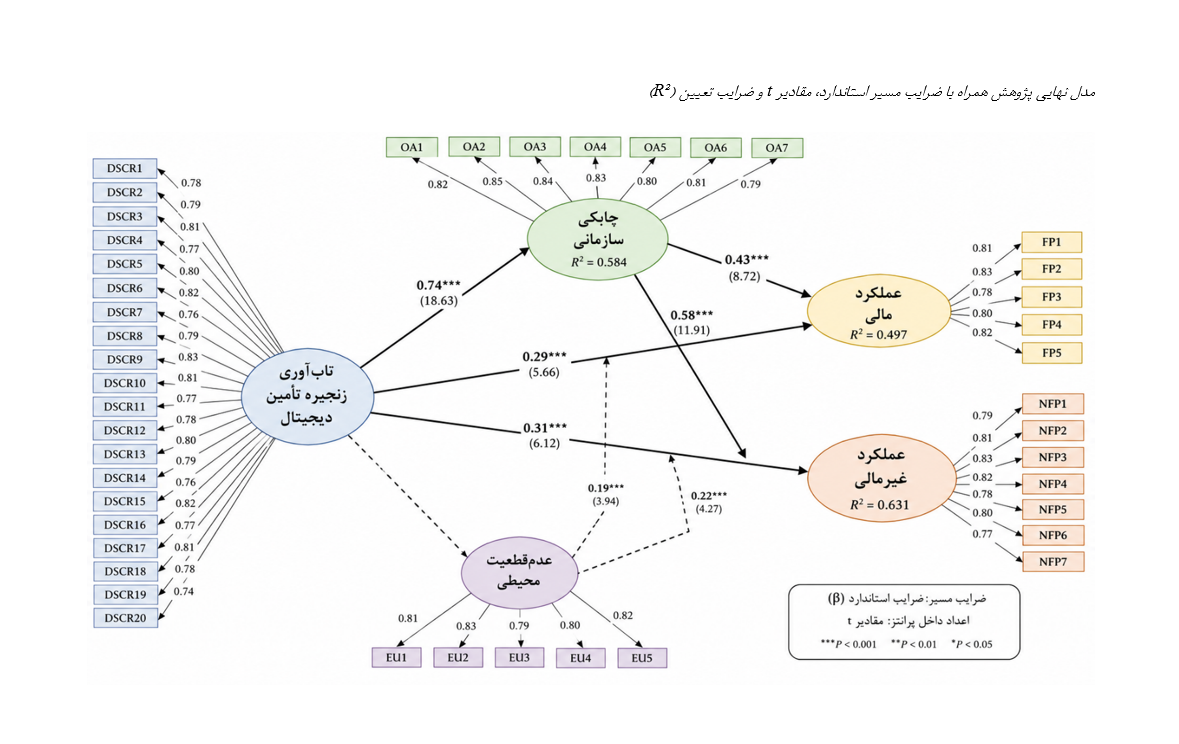
هدف این پژوهش تبیین سازوکارهای اثرگذاری تابآوری زنجیره تأمین دیجیتال بر عملکرد مالی و غیرمالی شرکتها با بررسی نقش میانجی چابکی سازمانی و نقش تعدیلگر عدمقطعیت محیطی در شرکتهای متوسط و بزرگ شهر تهران بود. این پژوهش از نظر هدف کاربردی و از نظر روش اجرا توصیفی-همبستگی مبتنی بر مدلسازی معادلات ساختاری بود. جامعه آماری پژوهش شامل مدیران ارشد، مدیران زنجیره تأمین، مدیران فناوری اطلاعات، مدیران عملیات و کارشناسان برنامهریزی استراتژیک شرکتهای متوسط و بزرگ شهر تهران در سال 1405 بود. حجم نمونه بر اساس فرمول کوکران 384 نفر تعیین شد که پس از حذف پرسشنامههای ناقص، 372 پرسشنامه معتبر مورد تحلیل قرار گرفت. ابزار گردآوری دادهها شامل پرسشنامههای استاندارد تابآوری زنجیره تأمین دیجیتال، چابکی سازمانی، عملکرد مالی و غیرمالی و عدمقطعیت محیطی بود. برای تجزیه و تحلیل دادهها از نرمافزارهای SPSS 27 و SmartPLS 4 استفاده شد و فرضیههای پژوهش از طریق مدلسازی معادلات ساختاری، تحلیل اثرات میانجی و آزمون اثرات تعدیلگر مورد بررسی قرار گرفت. نتایج مدل ساختاری نشان داد که تابآوری زنجیره تأمین دیجیتال تأثیر مثبت و معناداری بر چابکی سازمانی (β=0.74، t=18.63)، عملکرد مالی (β=0.29، t=5.66) و عملکرد غیرمالی (β=0.31، t=6.12) دارد. همچنین چابکی سازمانی تأثیر مثبت و معناداری بر عملکرد مالی (β=0.43، t=8.72) و عملکرد غیرمالی (β=0.58، t=11.91) نشان داد. نتایج آزمون بوتاسترپ بیانگر معنادار بودن نقش میانجی چابکی سازمانی در رابطه بین تابآوری زنجیره تأمین دیجیتال و عملکرد مالی (β=0.32، t=7.88) و عملکرد غیرمالی (β=0.43، t=9.76) بود. افزون بر این، عدمقطعیت محیطی نقش تعدیلگر معناداری در رابطه بین تابآوری زنجیره تأمین دیجیتال و عملکرد مالی (β=0.19، t=3.94) و عملکرد غیرمالی (β=0.22، t=4.27) ایفا کرد. یافتههای پژوهش نشان داد که تابآوری زنجیره تأمین دیجیتال به عنوان یک قابلیت راهبردی، نقش مهمی در ارتقای عملکرد مالی و غیرمالی سازمانها دارد. این تأثیر علاوه بر اثرات مستقیم، از طریق تقویت چابکی سازمانی نیز محقق میشود و در شرایط عدمقطعیت بالای محیطی شدت بیشتری پیدا میکند. بنابراین، سرمایهگذاری در توسعه قابلیتهای دیجیتال و افزایش چابکی سازمانی میتواند به عنوان راهکاری مؤثر برای بهبود عملکرد و حفظ مزیت رقابتی سازمانها در محیطهای متلاطم و پیچیده مورد توجه مدیران قرار گیرد.
دانلودها
مراجع
Abourokbah, S. H., Mashat, R. M., & Salam, M. A. (2023). Role of Absorptive Capacity, Digital Capability, Agility, and Resilience in Supply Chain Innovation Performance. Sustainability, 15(4), 3636. https://doi.org/10.3390/su15043636
Akbar, H. M., & Isfianadewi, D. (2023). The Role of Supply Chain Resilience to Relationships Supply Chain Risk Management Culture and Firm Performance During Disruption. International Journal of Research in Business and Social Science (2147-4478), 12(2), 643-652. https://doi.org/10.20525/ijrbs.v12i2.2392
Akhtar, P., Ghouri, A. M., Saha, M., Khan, M. R., Shamim, S., & Nallaluthan, K. (2024). Industrial Digitization, the Use of Real-Time Information, and Operational Agility: Digital and Information Perspectives for Supply Chain Resilience. Ieee Transactions on Engineering Management, 71, 10387-10397. https://doi.org/10.1109/tem.2022.3182479
Alakaş, E. Ö., Bölük, A. A., & Karadoğan, D. (2025). Resilient Logistics in Strategic Management: Going Beyond Low Cost and Sustainability. Business Strategy & Development, 8(3). https://doi.org/10.1002/bsd2.70197
Ali, E., & Gossaye, W. (2023). The Effects of Supply Chain Viability on Supply Chain Performance and Marketing Performance in Case of Large Manufacturing Firm in Ethiopia. Brazilian Journal of Operations & Production Management, 20(2), 1535. https://doi.org/10.14488/bjopm.1535.2023
Cabrera, B. D., Santa, R., Tegethoff, T., Morante, D., & Ferrer, M. (2023). Supply Chain Resilience in the Colombian Defense Sector Before and During the COVID-19 Pandemic: A Comparative Study. PLoS One, 18(3), e0282793. https://doi.org/10.1371/journal.pone.0282793
Cao, Q., Trimi, S., & Schniederjans, D. G. (2024). Ambidextrous Supply Chain Strategy: Roles and Consequences With Agile Manufacturing and Resilience. The International Journal of Logistics Management, 35(6), 1981-2011. https://doi.org/10.1108/ijlm-10-2023-0429
Ding, J., & Lee, E.-S. (2024). Improving the Maritime Supply Chain Resilience: The Role of Firms’ Dynamic Knowledge Management and Organizational Innovation. Journal of Organizational Change Management, 37(6), 1322-1339. https://doi.org/10.1108/jocm-01-2024-0006
Dubey, R., Bryde, D., Dwivedi, Y. K., Graham, G., Foropon, C., & Παπαδόπουλος, Θ. (2023). Dynamic Digital Capabilities and Supply Chain Resilience: The Role of Government Effectiveness. International Journal of Production Economics, 258, 108790. https://doi.org/10.1016/j.ijpe.2023.108790
Elnadi, M., Gheith, M. H., Troise, C., Abdallah, Y. O., & Abdelaziz, M. A. A. (2025). Digital Transformation and Sustainable Supply Chain Performance for Sustainable Development: The Mediating Role of Supply Chain Capabilities. Sustainable Development, 34(S1), 611-637. https://doi.org/10.1002/sd.70191
Gong, C., & Ribière, V. (2023). Understanding the Role of Organizational Agility in the Context of Digital Transformation: An Integrative Literature Review. VINE Journal of Information and Knowledge Management Systems, 55(2), 351-378. https://doi.org/10.1108/vjikms-09-2022-0312
Hsieh, C. C., Chen, S.-L., & Huang, C.-C. (2023). Investigating the Role of Supply Chain Environmental Risk in Shaping the Nexus of Supply Chain Agility, Resilience, and Performance. Sustainability, 15(20), 15003. https://doi.org/10.3390/su152015003
Kamar, M. A., Albadry, O. M., Sheikhelsouk, S., Al‐Abyadh, M. H. A., & Alsetoohy, O. (2023). Dynamic Capabilities Influence on the Operational Performance of Hotel Food Supply Chains: A Mediation-Moderation Model. Sustainability, 15(18), 13562. https://doi.org/10.3390/su151813562
Kang, T., Taylor, M., & Park, M. (2023). Agility Prevalence Across Industry Type: A Proposed Model. International Journal of Economics Business and Management Research, 07(09), 54-67. https://doi.org/10.51505/ijebmr.2023.7905
Mbamalu, E. I., Chike, N. K., Oguanobi, C. A., & Egbunike, C. F. (2023). Sustainable Supply Chain Management and Organisational Performance: Perception of Academics and Practitioners. Annals of Management and Organization Research, 5(1), 13-30. https://doi.org/10.35912/amor.v5i1.1758
Negi, P. (2025). Supply Chain Resilience, Organizational Effectiveness, and Firm Performance: A Systematic Review and Future Research Agenda. Sage Open, 15(4). https://doi.org/10.1177/21582440251393994
Pertheban, T. R., Marimuthu, A., Venkatachalam, K. R., Annamalah, S., Paraman, P., & Hoo, W. C. (2023). The Impact of Proactive Resilience Strategies on Organizational Performance: Role of Ambidextrous and Dynamic Capabilities of SMEs in Manufacturing Sector. Sustainability, 15(16), 12665. https://doi.org/10.3390/su151612665
Phadnis, S. S. (2023). A Review of Research on Supply Chain Adaptability: Opening the Black Box. Journal of Business Logistics, 45(1). https://doi.org/10.1111/jbl.12370
Piprani, A. Z., Khan, S. A. R., & Yu, Z. (2024). Driving Success Through Digital Transformation: Influence of Industry 4.0 on Lean, Agile, Resilient, Green Supply Chain Practices. Journal of Manufacturing Technology Management, 35(6), 1175-1198. https://doi.org/10.1108/jmtm-05-2023-0179
Qader, G., Rehman, J., Shamsi, M., & Abro, S. (2025). Examining the Impact of Dynamic Capabilities and Industry4.0 Technologies in Pharmaceutical Manufacturing Firms: A Sustainable Supply Chain Performance Framework. Business Strategy & Development, 8(3). https://doi.org/10.1002/bsd2.70205
Rahman, M. K., Piprani, A. Z., Mohiuddin, S., Nazir, S., & Shah, A. A. (2026). Unraveling the Impact of Organizational Ambidexterity: The Role of Integration and Agility in Enhancing Performance Amidst Supply Chain Disruptions. Global Business and Organizational Excellence. https://doi.org/10.1002/joe.70028
Rana, J., Daultani, Y., Goswami, M., & Kumar, S. (2025). Exploring the Impact of Supply Chain Digital Transformation on Supply Chain Performance: An Empirical Investigation. Business Strategy and the Environment, 34(3), 3497-3521. https://doi.org/10.1002/bse.4157
Roh, T., & Xiao, S. (2024). Extending the Research Agenda for Supply Chain Management in the Age of Disruption: The Multifaceted Role and Implications of Dynamic Capabilities. Journal of General Management, 50(1), 5-15. https://doi.org/10.1177/03063070241272373
Ruan, Z. (2025). Driving Supply Chain Agility Through Digitalization. Journal of Global Information Management, 33(1), 1-28. https://doi.org/10.4018/jgim.395354
Shafaghizadeh, S., & Sajadi, S. M. (2023). Ranking Agility Factors to Reliably Sustain a Green Industrial Supply Chain Using the Fuzzy Analytic Network Process and Ordinal Priority Approach. Sustainability, 15(22), 16005. https://doi.org/10.3390/su152216005
Sharma, M., Antony, R., Sharma, A., & Daim, T. (2024). Can Smart Supply Chain Bring Agility and Resilience for Enhanced Sustainable Business Performance? The International Journal of Logistics Management, 36(2), 501-555. https://doi.org/10.1108/ijlm-09-2023-0381
Soledispa-Cañarte, B. J., Pionce, M. S. P., Merchán-Ponce, N. P., Alvarez, D. M., Tovar-Quintero, J., Escobar-Molina, D., Cedeño-Ramírez, J. D., & Rincón-Guio, C. (2023). The Role of Logistics 4.0 in Agribusiness Sustainability and Competitiveness, a Bibliometric and Systematic Literature Review. Operations and Supply Chain Management an International Journal, 109-120. https://doi.org/10.31387/oscm0520376
Tripathi, S., & Roy, S. S. (2023). Linking Supply Chain Performance with Organizational Strategic Performance – A Review and Research Agenda. International Journal of Productivity and Performance Management, 73(7), 2037-2067. https://doi.org/10.1108/ijppm-09-2022-0461
Xu, H., Zheng, H., Sun, D., Wang, M., & Ye, C. (2024). An Integrated Framework for Enablers in Supply Chain Resilience: Model Development and Analysis. IEEE Access, 12, 42490-42508. https://doi.org/10.1109/access.2024.3379212
Xu, T., & Liu, X. (2023). Achieving Manufacturing Supply Chain Resilience: The Role of Paradoxical Leadership and Big Data Analytics Capability. Journal of Manufacturing Technology Management, 35(2), 205-225. https://doi.org/10.1108/jmtm-05-2023-0206
Ye, F., Ke, M., Ouyang, Y., Li, Y., Li, L., Zhan, Y., & Zhang, M. (2023). Impact of Digital Technology Usage on Firm Resilience: A Dynamic Capability Perspective. Supply Chain Management an International Journal, 29(1), 162-175. https://doi.org/10.1108/scm-12-2022-0480

دانلود
چاپ شده
ارسال
بازنگری
پذیرش
شماره
نوع مقاله
مجوز
حق نشر 1404 Mohammad Hossein kachouei (Author)

این پروژه تحت مجوز بین المللی Creative Commons Attribution-NonCommercial 4.0 می باشد.