بررسی نقش تعدیلگر مؤلفههای چابکی استراتژیک در رابطه بین برنامهریزی استراتژیک و تصمیمگیری استراتژیک
DOI:
https://doi.org/10.61838/kman.jtesm.527کلمات کلیدی:
برنامهریزی استراتژیک, تصمیمگیری استراتژیک, چابکی استراتژیک, حساسیت استراتژیک, وحدت رهبری, سیالیت منابعچکیده
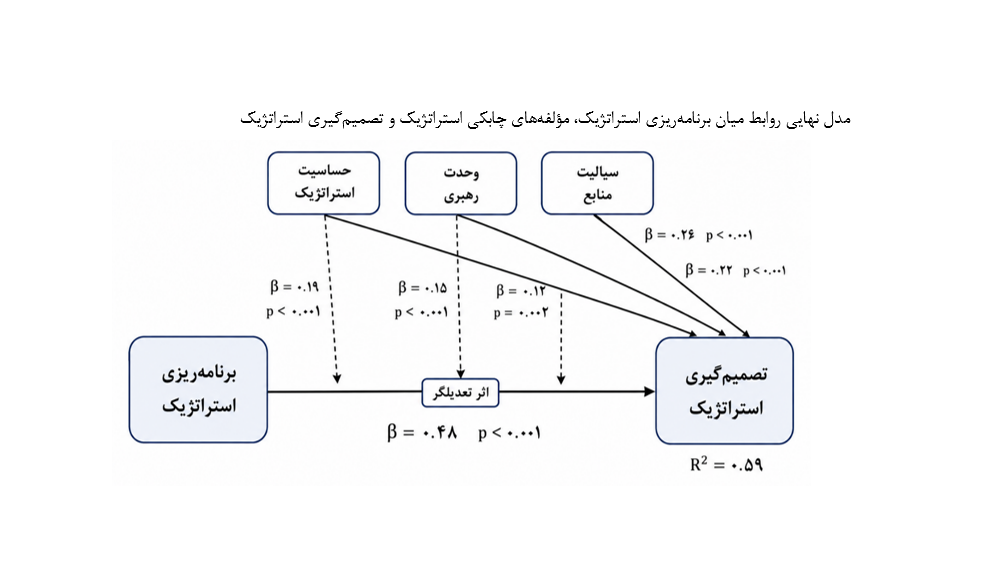
هدف پژوهش حاضر بررسی نقش تعدیلگر مؤلفههای چابکی استراتژیک شامل حساسیت استراتژیک، وحدت رهبری و سیالیت منابع در رابطه بین برنامهریزی استراتژیک و تصمیمگیری استراتژیک در میان مدیران و کارشناسان ارشد سازمانها و شرکتهای فعال در شهر تهران بود. پژوهش حاضر از نظر هدف کاربردی و از نظر روش، توصیفی ـ همبستگی از نوع مدلسازی معادلات ساختاری بود. جامعه آماری شامل مدیران و کارشناسان ارشد سازمانها و شرکتهای فعال در شهر تهران در سال ۲۰۲۶ بود که از میان آنان ۳۸۴ نفر به روش نمونهگیری در دسترس و هدفمند انتخاب شدند. دادهها با استفاده از پرسشنامهای چندبخشی شامل مقیاسهای برنامهریزی استراتژیک، تصمیمگیری استراتژیک و چابکی استراتژیک با سه مؤلفه حساسیت استراتژیک، وحدت رهبری و سیالیت منابع گردآوری شد. روایی سازه با تحلیل عاملی تأییدی و پایایی با آلفای کرونباخ و پایایی ترکیبی بررسی شد. برای تحلیل دادهها از ضریب همبستگی پیرسون، تحلیل عاملی تأییدی، مدلسازی معادلات ساختاری، آزمون اثرهای تعاملی و تحلیل شیب ساده استفاده شد. نتایج نشان داد برنامهریزی استراتژیک اثر مستقیم مثبت و معناداری بر تصمیمگیری استراتژیک داشت (β = ۰.۴۸، p < ۰.۰۰۱). حساسیت استراتژیک (β = ۰.۲۶، p < ۰.۰۰۱)، وحدت رهبری (β = ۰.۲۲، p < ۰.۰۰۱) و سیالیت منابع (β = ۰.۱۸، p < ۰.۰۰۱) نیز بهطور مستقیم تصمیمگیری استراتژیک را پیشبینی کردند. اثر تعاملی برنامهریزی استراتژیک و حساسیت استراتژیک (β = ۰.۱۹، p < ۰.۰۰۱)، برنامهریزی استراتژیک و وحدت رهبری (β = ۰.۱۵، p < ۰.۰۰۱) و برنامهریزی استراتژیک و سیالیت منابع (β = ۰.۱۲، p = ۰.۰۰۲) معنادار بود. مدل نهایی ۵۹ درصد از واریانس تصمیمگیری استراتژیک را تبیین کرد و از برازش مطلوبی برخوردار بود. یافتهها نشان داد که چابکی استراتژیک نقش مهمی در تقویت تبدیل برنامهریزی استراتژیک به تصمیمگیری اثربخش دارد. هر سه مؤلفه حساسیت استراتژیک، وحدت رهبری و سیالیت منابع این رابطه را تقویت کردند و حساسیت استراتژیک قویترین اثر تعدیلگر را نشان داد. بنابراین، سازمانها برای افزایش اثربخشی برنامهریزی استراتژیک باید همزمان قابلیت شناسایی سریع تغییرات محیطی، همسویی رهبری و بازتخصیص انعطافپذیر منابع را توسعه دهند.
دانلودها
مراجع
Ajike, E. O., Adeleke, A. A., Bamidele, A. G., Olubiyi, T. O., Adesuyi, O. O., Ilori, G. E., Ariguzo, V. A., & Binuyo, B. O. (2024). The Moderating Role of Supply Chain Agility on the Relationship Between Strategic Flexibility and Organizational Market Performance in Nigerian Pharmaceutical Industry. PaperASIA, 40(5b), 337-349. https://doi.org/10.59953/paperasia.v40i5b.259
Al Khasabah, M. A. I., & Al-Badayneh, G. A. M. (2025). The Impact of Strategic Intelligence on Organizational Creativity in Jordanian Islamic Banks: The Mediating Role of Organizational Agility. Corporate and Business Strategy Review, 6(2), 195-206. https://doi.org/10.22495/cbsrv6i2art19
Almelhes, S. (2025). Big Data Analytical Capability and Strategic Agility; A Perspective of Online Academies Institutions Teaching Arabic as Second Language. Sage Open, 15(3). https://doi.org/10.1177/21582440251381591
Ameen, N., Tarba, S. Y., Cheah, J. H., Xia, S., & Sharma, G. D. (2024). Coupling Artificial Intelligence Capability and Strategic Agility for Enhanced Product and Service Creativity. British Journal of Management, 35(4), 1916-1934. https://doi.org/10.1111/1467-8551.12797
Balzano, M. (2025). Post-Error Adjustments: Strategic Agility and Organizational Zemblanity. California Management Review, 67(4), 121-153. https://doi.org/10.1177/00081256251332311
Bouguerra, A., Gölgeci̇, İ., Gligor, D., Khan, Z., Arslan, A., & Tatoğlu, E. (2024). Strategic Agility and Product Development in Emerging Markets: The Role of Employee Resilience and Self-Efficacy as Microfoundations. Ieee Transactions on Engineering Management, 71, 1598-1612. https://doi.org/10.1109/tem.2023.3333218
Dube, N., Selviaridis, K., Oorschot, K. E. v., & Jahre, M. (2024). Riding the Waves of Uncertainty: Towards Strategic Agility in Medicine Supply Systems. Journal of Operations Management, 70(8), 1234-1260. https://doi.org/10.1002/joom.1330
Faten Ahmed Mohammed Abd El, s., & Ahmed, M. (2024). Effect of Strategic Leadership on Organization Ambidexterity and Agility as Perceived by Staff Nurses. Assiut Scientific Nursing Journal, 0(0), 0-0. https://doi.org/10.21608/asnj.2024.289173.1821
Ghalenoei, M., Chapari, L., Hojabrnia, Z., & Alam, Z. (2023). Scenario planning of the future of strategic agility in the Ministry of Sports and Youth of the Islamic Republic of Iran.
Kasamani, G. I., Changeiywo, N. C., & Karim, H. (2024). Strategic Agility in Dynamic Markets: Leveraging Innovation for Competitive Advantage. International Journal of Social Science and Humanities Research (Ijsshr) Issn 2959-7056 (O) 2959-7048 (P), 2(3), 404-410. https://doi.org/10.61108/ijsshr.v2i3.150
Khavari, S., Arasteh, H., & Jafari, P. (2019). Factors Influencing the Agility of Academic Educational Programs Based on Grounded Theory. Educational Planning Studies Biannual, 8(15), 252-281. https://eps.journals.umz.ac.ir/article_2501.html?lang=en
Mansur, D. M. (2025). Strategic Marketing Innovation in Startups: Navigating Uncertainty with Agility and Creativity. Golden Ratio of Mapping Idea and Literature Format, 5(2). https://doi.org/10.52970/grmilf.v5i2.1545
Mata, M. N., Moleiro Martins, J., & Inácio, P. L. (2024). Collaborative innovation, strategic agility, & absorptive capacity adoption in SMEs: the moderating effects of customer knowledge management capability. Journal of Knowledge Management, 28(4), 1116-1140. https://doi.org/10.1108/JKM-10-2022-0803
Mueller‐Saegebrecht, S., & Walter, A. T. (2025). Strategic Agility—An Urgent Capability for Successful Business Model Innovation? A Conceptual Process Model and Theoretical Framework. Strategic Change, 34(3), 407-428. https://doi.org/10.1002/jsc.2645
Naqavi, A., Azar, A., & Asadi Mir, M. (2015). Prioritizing Organizational Agility Enablers in Universities and Higher Education Centers in Yazd. Research and Planning in Higher Education, 21(1), 61-81.
Ongesa, T. (2025). Enhancing Strategic Agility and Real Time Decision-Making in the Technology Sector: Exploring the Role of AI and E-HRM Systems. F1000research, 14, 1238. https://doi.org/10.12688/f1000research.167708.1
Paula Vidal, G. H., Caiado, R. G. G., Scavarda, L. F., Ivson, P., & Garza-Reyes, J. A. (2022). Decision support framework for inventory management combining fuzzy mu lticriteria methods, genetic algorithm, and artificial neural network. Computers and Industrial Engineering, 174, 108777. https://doi.org/10.1016/j.cie.2022.108777
Salahat, M. A. (2021). Employee empowerment, knowledge management and decision-making agility; mediating role of extra-role performance. International Journal of Academic Research in Business and Social Sciences, 11(7), 960-977. https://doi.org/10.6007/IJARBSS/v11-i7/10327
Shao, W. (2025). The Role of Digital Transformation in Enhancing Organizational Agility and Competitive Advantages: A Strategic Perspective. Advances in Economics Management and Political Sciences, 154(1), 115-120. https://doi.org/10.54254/2754-1169/2024.19552
Shayanmehr, Jafari, N., & Khodami. (2025). The Effect of Human Resource Management Strategies on Organizational Resilience with Strategic Agility. Strategic Management Studies Quarterly, 16(63), 39-60.
Tenggono, E., Soetjipto, B. W., & Sudhartio, L. (2025). Dynamic Managerial Capabilities In action: Advancing Strategic Agility and Digital Readiness in Healthcare Organizations. Journal of Organizational Change Management. https://doi.org/10.1108/jocm-12-2024-0772
Troise, C., Jones, P., Candelo, E., & Sorrentino, M. (2026). The role of entrepreneurial alertness, digital platform capability, organisational agility and business model innovation on young innovative companies’ performance. Technology Analysis & Strategic Management, 38(3), 265-278.
Ürü, F. O., Gözükara, E., & Ünsal, A. A. (2024). Organizational Ambidexterity, Digital Transformation, and Strategic Agility for Gaining Competitive Advantage in SMEs. Sosyal Mucit Academic Review, 5(1), 1-23. https://doi.org/10.54733/smar.1386357
Valipour Khatir, M., Mohammadi Pour Omran, M., & Akbarzadeh, Z. (2022). Organizational Agility Indicators Using Fuzzy Multicriteria Decision-Making Techniques (Case Study: Iran Power Generation Development Organization). Journal of Innovation and Value Creation, 3(7). http://journalie.ir/fa/Article/305/FullText
Varkiani Pour, N., & Sarhadi, S. B. (2024). The impact of strategic human resource management and artificial intelligence on determining supply chain agility and supply chain resilience.
دانلودها
گاهشمار انتشار
- ارسال
- بازنگری
- پذیرش
شماره
نوع مقاله
مجوز
حق نشر 2025 Hussein Ali Al-Tamimi; Mohammad Faryabi , Alireza Fazlzadeh , Sajjad Naghdi (Author)

این پروژه تحت مجوز بین المللی Creative Commons Attribution-NonCommercial 4.0 می باشد.