The Moderating Role of Strategic Agility Components in the Relationship between Strategic Planning and Strategic Decision-Making
DOI:
https://doi.org/10.61838/kman.jtesm.527Keywords:
Strategic Planning, Strategic Decision-Making, Strategic Agility, Leadership Unity, Resource Fluidity, Strategic SensitivityAbstract
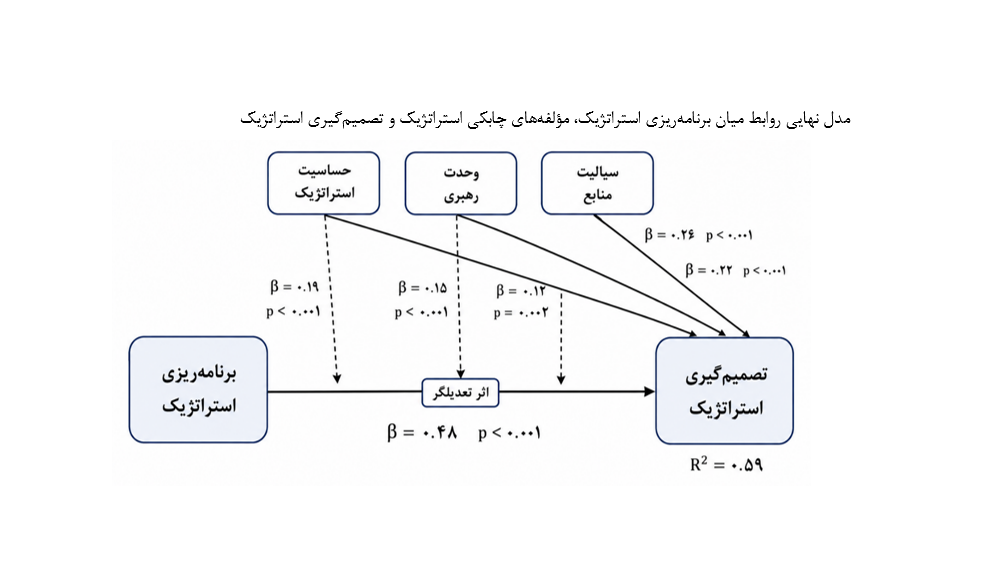
The present study aimed to investigate the moderating role of strategic agility components, including strategic sensitivity, leadership unity, and resource fluidity, in the relationship between strategic planning and strategic decision-making among managers and senior experts of organizations and companies operating in Tehran. This applied study employed a descriptive-correlational design based on structural equation modeling. The statistical population consisted of managers and senior experts working in organizations and companies in Tehran in 2026, from whom 384 participants were selected through purposive and convenience sampling. Data were collected using a multi-section questionnaire assessing strategic planning, strategic decision-making, and strategic agility through three components: strategic sensitivity, leadership unity, and resource fluidity. Construct validity was assessed through confirmatory factor analysis, while reliability was examined using Cronbach's alpha and composite reliability. Pearson correlation, confirmatory factor analysis, structural equation modeling, interaction-effect testing, and simple slope analysis were used to analyze the data. The results showed that strategic planning had a significant positive direct effect on strategic decision-making (β = 0.48, p < 0.001). Strategic sensitivity (β = 0.26, p < 0.001), leadership unity (β = 0.22, p < 0.001), and resource fluidity (β = 0.18, p < 0.001) also significantly predicted strategic decision-making. The interaction between strategic planning and strategic sensitivity was significant (β = 0.19, p < 0.001), as were the interactions between strategic planning and leadership unity (β = 0.15, p < 0.001) and between strategic planning and resource fluidity (β = 0.12, p = 0.002). The final model explained 59% of the variance in strategic decision-making and demonstrated satisfactory fit. The findings indicate that strategic agility substantially strengthens the translation of strategic planning into effective strategic decision-making. All three components of strategic agility enhanced this relationship, with strategic sensitivity demonstrating the strongest moderating effect. Accordingly, organizations seeking to improve the effectiveness of strategic planning should simultaneously develop their capacity to detect environmental changes rapidly, achieve leadership alignment, and flexibly redeploy organizational resources.
Downloads
References
Ajike, E. O., Adeleke, A. A., Bamidele, A. G., Olubiyi, T. O., Adesuyi, O. O., Ilori, G. E., Ariguzo, V. A., & Binuyo, B. O. (2024). The Moderating Role of Supply Chain Agility on the Relationship Between Strategic Flexibility and Organizational Market Performance in Nigerian Pharmaceutical Industry. PaperASIA, 40(5b), 337-349. https://doi.org/10.59953/paperasia.v40i5b.259
Al Khasabah, M. A. I., & Al-Badayneh, G. A. M. (2025). The Impact of Strategic Intelligence on Organizational Creativity in Jordanian Islamic Banks: The Mediating Role of Organizational Agility. Corporate and Business Strategy Review, 6(2), 195-206. https://doi.org/10.22495/cbsrv6i2art19
Almelhes, S. (2025). Big Data Analytical Capability and Strategic Agility; A Perspective of Online Academies Institutions Teaching Arabic as Second Language. Sage Open, 15(3). https://doi.org/10.1177/21582440251381591
Ameen, N., Tarba, S. Y., Cheah, J. H., Xia, S., & Sharma, G. D. (2024). Coupling Artificial Intelligence Capability and Strategic Agility for Enhanced Product and Service Creativity. British Journal of Management, 35(4), 1916-1934. https://doi.org/10.1111/1467-8551.12797
Balzano, M. (2025). Post-Error Adjustments: Strategic Agility and Organizational Zemblanity. California Management Review, 67(4), 121-153. https://doi.org/10.1177/00081256251332311
Bouguerra, A., Gölgeci̇, İ., Gligor, D., Khan, Z., Arslan, A., & Tatoğlu, E. (2024). Strategic Agility and Product Development in Emerging Markets: The Role of Employee Resilience and Self-Efficacy as Microfoundations. Ieee Transactions on Engineering Management, 71, 1598-1612. https://doi.org/10.1109/tem.2023.3333218
Dube, N., Selviaridis, K., Oorschot, K. E. v., & Jahre, M. (2024). Riding the Waves of Uncertainty: Towards Strategic Agility in Medicine Supply Systems. Journal of Operations Management, 70(8), 1234-1260. https://doi.org/10.1002/joom.1330
Faten Ahmed Mohammed Abd El, s., & Ahmed, M. (2024). Effect of Strategic Leadership on Organization Ambidexterity and Agility as Perceived by Staff Nurses. Assiut Scientific Nursing Journal, 0(0), 0-0. https://doi.org/10.21608/asnj.2024.289173.1821
Ghalenoei, M., Chapari, L., Hojabrnia, Z., & Alam, Z. (2023). Scenario planning of the future of strategic agility in the Ministry of Sports and Youth of the Islamic Republic of Iran.
Kasamani, G. I., Changeiywo, N. C., & Karim, H. (2024). Strategic Agility in Dynamic Markets: Leveraging Innovation for Competitive Advantage. International Journal of Social Science and Humanities Research (Ijsshr) Issn 2959-7056 (O) 2959-7048 (P), 2(3), 404-410. https://doi.org/10.61108/ijsshr.v2i3.150
Khavari, S., Arasteh, H., & Jafari, P. (2019). Factors Influencing the Agility of Academic Educational Programs Based on Grounded Theory. Educational Planning Studies Biannual, 8(15), 252-281. https://eps.journals.umz.ac.ir/article_2501.html?lang=en
Mansur, D. M. (2025). Strategic Marketing Innovation in Startups: Navigating Uncertainty with Agility and Creativity. Golden Ratio of Mapping Idea and Literature Format, 5(2). https://doi.org/10.52970/grmilf.v5i2.1545
Mata, M. N., Moleiro Martins, J., & Inácio, P. L. (2024). Collaborative innovation, strategic agility, & absorptive capacity adoption in SMEs: the moderating effects of customer knowledge management capability. Journal of Knowledge Management, 28(4), 1116-1140. https://doi.org/10.1108/JKM-10-2022-0803
Mueller‐Saegebrecht, S., & Walter, A. T. (2025). Strategic Agility—An Urgent Capability for Successful Business Model Innovation? A Conceptual Process Model and Theoretical Framework. Strategic Change, 34(3), 407-428. https://doi.org/10.1002/jsc.2645
Naqavi, A., Azar, A., & Asadi Mir, M. (2015). Prioritizing Organizational Agility Enablers in Universities and Higher Education Centers in Yazd. Research and Planning in Higher Education, 21(1), 61-81.
Ongesa, T. (2025). Enhancing Strategic Agility and Real Time Decision-Making in the Technology Sector: Exploring the Role of AI and E-HRM Systems. F1000research, 14, 1238. https://doi.org/10.12688/f1000research.167708.1
Paula Vidal, G. H., Caiado, R. G. G., Scavarda, L. F., Ivson, P., & Garza-Reyes, J. A. (2022). Decision support framework for inventory management combining fuzzy mu lticriteria methods, genetic algorithm, and artificial neural network. Computers and Industrial Engineering, 174, 108777. https://doi.org/10.1016/j.cie.2022.108777
Salahat, M. A. (2021). Employee empowerment, knowledge management and decision-making agility; mediating role of extra-role performance. International Journal of Academic Research in Business and Social Sciences, 11(7), 960-977. https://doi.org/10.6007/IJARBSS/v11-i7/10327
Shao, W. (2025). The Role of Digital Transformation in Enhancing Organizational Agility and Competitive Advantages: A Strategic Perspective. Advances in Economics Management and Political Sciences, 154(1), 115-120. https://doi.org/10.54254/2754-1169/2024.19552
Shayanmehr, Jafari, N., & Khodami. (2025). The Effect of Human Resource Management Strategies on Organizational Resilience with Strategic Agility. Strategic Management Studies Quarterly, 16(63), 39-60.
Tenggono, E., Soetjipto, B. W., & Sudhartio, L. (2025). Dynamic Managerial Capabilities In action: Advancing Strategic Agility and Digital Readiness in Healthcare Organizations. Journal of Organizational Change Management. https://doi.org/10.1108/jocm-12-2024-0772
Troise, C., Jones, P., Candelo, E., & Sorrentino, M. (2026). The role of entrepreneurial alertness, digital platform capability, organisational agility and business model innovation on young innovative companies’ performance. Technology Analysis & Strategic Management, 38(3), 265-278.
Ürü, F. O., Gözükara, E., & Ünsal, A. A. (2024). Organizational Ambidexterity, Digital Transformation, and Strategic Agility for Gaining Competitive Advantage in SMEs. Sosyal Mucit Academic Review, 5(1), 1-23. https://doi.org/10.54733/smar.1386357
Valipour Khatir, M., Mohammadi Pour Omran, M., & Akbarzadeh, Z. (2022). Organizational Agility Indicators Using Fuzzy Multicriteria Decision-Making Techniques (Case Study: Iran Power Generation Development Organization). Journal of Innovation and Value Creation, 3(7). http://journalie.ir/fa/Article/305/FullText
Varkiani Pour, N., & Sarhadi, S. B. (2024). The impact of strategic human resource management and artificial intelligence on determining supply chain agility and supply chain resilience.
Downloads
Publication Timeline
- Submitted
- Revised
- Accepted
Issue
Section
License
Copyright (c) 2025 Hussein Ali Al-Tamimi; Mohammad Faryabi , Alireza Fazlzadeh , Sajjad Naghdi (Author)

This work is licensed under a Creative Commons Attribution-NonCommercial 4.0 International License.