Designing a Model of Ecotourism Management Requirements Using SWARA and DEMATEL Methods
Keywords:
Requirements, Ecotourism Management, SWARA Method, DEMATEL Method, Sustainable Development, Sulaymaniyah, IraqAbstract
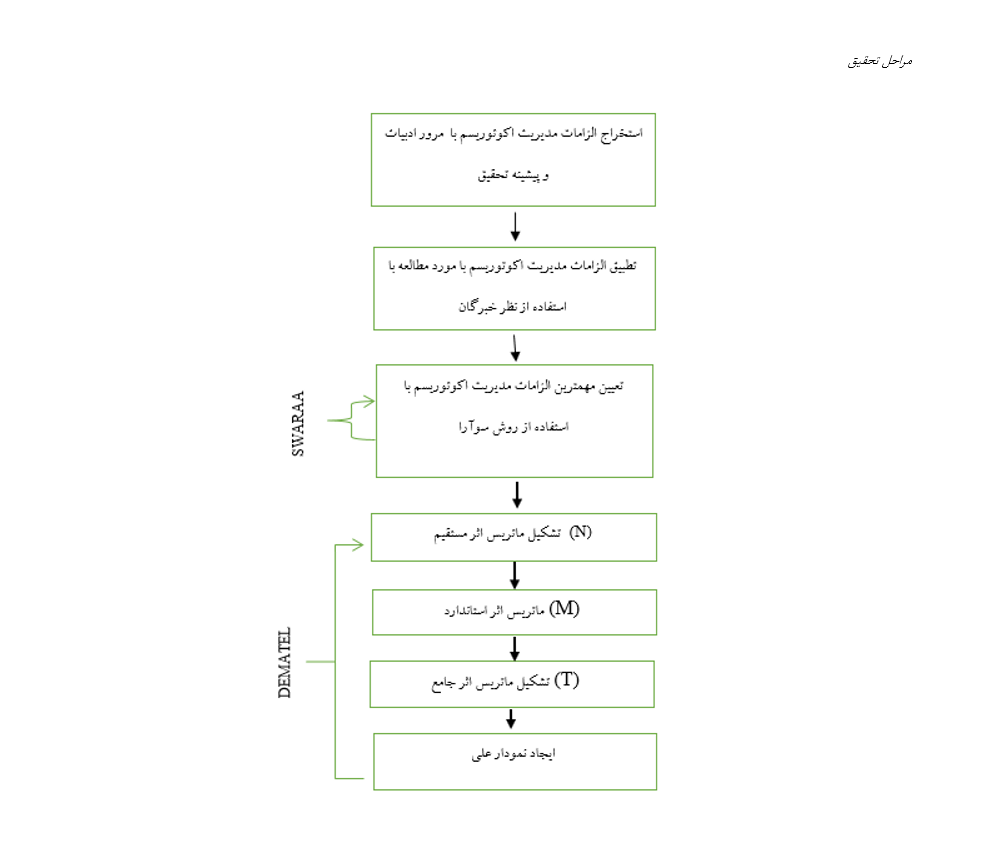
This study aimed to identify, prioritize, and analyze the causal relationships among ecotourism management requirements in Sulaymaniyah, Iraq, using the SWARA and DEMATEL methods. This applied study was conducted using a descriptive–analytical approach. The statistical population consisted of 25 experts, including tourism practitioners and academic specialists familiar with ecotourism management in Sulaymaniyah, Iraq, selected through purposive snowball sampling. Initially, 48 sub-criteria were extracted from the literature and categorized into five dimensions: planning, organizing, directing, coordinating, and monitoring. Subsequently, the Delphi technique was employed to finalize 24 key requirements based on expert consensus. The SWARA method was used to determine the relative importance of the identified requirements, while the DEMATEL method was applied to analyze the causal and effect relationships among them. Data were collected through semi-structured questionnaires and analyzed using multi-criteria decision-making techniques. The SWARA results indicated that “defining and clarifying long-term and short-term objectives,” “monitoring compliance with guidelines,” and “determining tourism development priorities based on risk analysis” were the most important ecotourism management requirements. DEMATEL findings further revealed that “defining and clarifying objectives,” “directing based on sustainable resource management principles,” and “directing through effective stakeholder communication” were the most influential causal variables within the system. Conversely, “controlling environmental impacts,” “forecasting and planning tourism infrastructure and services,” and “monitoring compliance with guidelines” were identified as the most affected variables. The results demonstrated that effective ecotourism management depends on coherent managerial drivers, institutional coordination, and sustainable resource governance. The findings demonstrated that ecotourism management in Sulaymaniyah operates as a multidimensional and interconnected system in which strategic and managerial drivers play a decisive role in achieving sustainable tourism development. The proposed model provides tourism managers and policymakers with a practical framework for identifying strategic priorities, optimizing resource allocation, enhancing institutional coordination, and mitigating environmental impacts, thereby facilitating the sustainable development of ecotourism in the region.
Downloads
References
Ahmad, A. F., & khalid Balisany, W. M. (2023). Sustainable Tourism Management and Ecotourism as a Tool to Evaluate Tourism's Contribution to the Sustainable Development Goals and Local Community. OTS Canadian Journal, 2(4). https://doi.org/10.58840/838qdx22
Aiba, S., Zada, S. A. W., & Harada, K. (2025). Role of an Eco-tour Guide Certification System in Sustainable Ecotourism on Amami-Oshima Island, Japan. Journal of Forest Planning, 31, 1-11. https://doi.org/10.20659/jfp.2024.001
Ali, A. M., & Frew, E. (2014). ICT and Sustainable Tourism Development: An Innovative Perspective in Sultanate of Oman. Tourism Management Perspectives, 12, 74-83. https://doi.org/10.1108/jhtt-12-2012-0034
Alqahtani, A. Y., & Makki, A. A. (2023). A DEMATEL-ISM Integrated Modeling Approach of Influencing Factors Shaping Destination Image in the Tourism Industry. Administrative Sciences, 13(9), 201. https://doi.org/10.3390/admsci13090201
Alsaad, M. A., & Lazim, Y. Y. (2023). The Impact of the Sustainable Strategy on Strategic Performance: Field Study in the Iraqi Tourism Sector. South Asian Journal of Social Sciences and Humanities, 4(1), 55-68. https://doi.org/10.48165/sajssh.2023.4104
Andesta, I. (2025). Penerapan Asean Ecotourism Standard di Edu-ekowisata Pengudang Bintan Mangrove Kabupaten Bintan. TOBA: Journal of Tourism, Hospitality, and Destination, 4(1), 8-17. https://doi.org/10.61141/home.v7i1.627
Ardakani, T., Mikaili Tabrizi, A., Salman Mahini, A., & Mohammadzadeh, M. (2021). Enhancing the Management of Visitation Areas Based on Key Ecotourism Management Strategies. Journal of environmental science and technology, 23(5), 17-27.
Aydin, I. Z., & Öztürk, A. (2023). Identifying, Monitoring, and Evaluating Sustainable Ecotourism Management Criteria and Indicators for Protected Areas in Türkiye: The Case of Camili Biosphere Reserve. Sustainability, 15(4), 2933. https://doi.org/10.3390/su15042933
Baloch, Q. B., Shah, S. N., Iqbal, N., Sheeraz, M., Asadullah, M., Mahar, S., & Khan, A. U. (2023). Impact of Tourism Development upon Environmental Sustainability: A Suggested Framework for Sustainable Ecotourism. Environmental Science and Pollution Research, 30(3), 5917-5930.
Bawi, S. V. (2025). Revitalizing Ritual Performances for Environmental Conservation and Climate Change Adaptation: A Case Study of Ecotourism in Khaw Nu M'cung National Park, Myanmar. Forest and Society, 9(1), 48-69. https://doi.org/10.24259/fs.v9i1.33163
Da Silva, A. E., Maracajá, K. F., Batalhão, A. C., Silva, V. F., & Borges, I. M. (2025). Ecotourism and Co-Management: Strengthening Socio-Ecological Resilience in Local Food Systems. Sustainability, 17(6), 2443. https://doi.org/10.3390/su17062443
Da Silva, A. E., & Maracajá, K. F. B. (2025). Exploring Sustainability in Ecotourism: Advancing the SDGs Through Socio-Ecological Resilience, Co-Management and Co-Production. In Advancing the SDGs in Developing and Emerging Economies (pp. 167-180). Springer. https://doi.org/10.1007/978-3-031-86500-8_12
Davis, J., Albert, J., Vavages, A., Pijawka, D., Wentz, E., & Hale, M. (2025). Resilience-Based Adaptation in Data Scarce Areas: Flood Risk Assessment Using Geodesign in the Tohono O'odham Nation. Journal of Planning Education and Research, 45(1), 159-180. https://doi.org/10.1177/0739456x231191543
Davis, S. (2025). Engaging Local Communities in the Creation of Handcraft Souvenirs for the Mason River Protected Area, Jamaica. In Ecotourism and Sustainable Tourism (pp. 163-179). Apple Academic Press. https://doi.org/10.1201/9781003494461-16
Fang, W. T., Hassan, A. A., & Horng, M. (2024). Ecotourism Planning and Management. In Ecotourism: Environment, Health, and Education (pp. 195-231). Springer Nature Singapore. https://doi.org/10.1007/978-981-99-9097-9_7
Fennell, D. A. (2020). Ecotourism (5th ed.). Routledge. https://doi.org/10.4324/9780203121108.ch31
Fennell, D. A. (2021). Routledge Handbook of Ecotourism. Routledge. https://doi.org/10.4324/9781003001768
Gaonkar, S., & Sukthankar, S. V. (2025). Measuring and Evaluating the Influence of Cultural Sustainability Indicators on Sustainable Cultural Tourism Development: Scale Development and Validation. Heliyon, 11(4). https://doi.org/10.1016/j.heliyon.2025.e42514
Guo, Y., & Chai, Y. (2025). Toward Green Tourism: The Role of Renewable Energy for Sustainable Development in Developing Nations. Frontiers in Sustainable Tourism, 4, 1512922. https://doi.org/10.3389/frsut.2025.1512922
Habibulloev, S., Han, F., Bakhtiyorov, Z., Ma, X., & Nuhzor, O. (2024). Factors Influencing Sustainable Development in Eco-Tourism Settlements: A Comparative Analysis. Heliyon, 10(4). https://doi.org/10.1016/j.heliyon.2024.e26454
Jackson, G. (2022). Ecotourism.
Karakuş, C. B. (2024). Assessment of Ecotourism Potentiality Based on GIS-Based Fuzzy Logarithm Methodology of Additive Weights (F-LMAW) Method for Sustainable Natural Resource Management. Environment, Development and Sustainability, 26(10), 27001-27055. https://doi.org/10.1007/s10668-024-05283-0
Karimifar, S., Khatibi, S. M. R., & Beigdelirad, V. (2023). Meta-Analysis of the Most Important Factors in Sustainable Ecotourism Development in Iran. Future City Outlook Quarterly, 4(4), 37-58. https://doi.org/10.61186/jvfc.4.4.5
Khan, A., Bibi, S., Lorenzo, A., Lyu, J., & Babar, Z. U. (2020). Tourism and Development in Developing Economies: A Policy Implication Perspective. Sustainability, 12(4), 1618. https://doi.org/10.3390/su12041618
Khasawneh, F. A., & Khassawneh, E. M. (2024). Performance Assessment via Post-Occupancy Evaluation of an Environmental Education and Ecotourism Center Based on Employees' Experience. Civil Engineering and Architecture, 12, 141-159. https://doi.org/10.13189/cea.2024.120112
Kia, Z. (2021). Ecotourism in Indonesia: Local Community Involvement and the Affecting Factors. Journal of Governance and Public Policy, 8(2), 93-105. https://doi.org/10.18196/jgpp.v8i2.10789
Lalicic, L., & Weber-Sabil, J. (2022). Stakeholder Engagement in Sustainable Tourism Planning through Serious Gaming. In Qualitative Methodologies in Tourism Studies (pp. 192-212). Routledge. https://doi.org/10.4324/9781003274117-13
Langle-Flores, A., Rossell, M. D., Chávez-Dagostino, R. M., & Aguilar-Rodríguez, A. (2025). Islas Marietas: Strengthening Polycentric Governance in Response to an MPA Tourism Ban. Anthropocene Coasts, 8(1), 7. https://doi.org/10.1007/s44218-025-00071-3
Manzoor, F., Wei, L., Asif, M., Haq, M. Z. U., & Rehman, H. U. (2019). The Contribution of Sustainable Tourism to Economic Growth and Employment in Pakistan. International journal of environmental research and public health, 16(19), 3785. https://doi.org/10.3390/ijerph16193785
Marcías, M. L., Salvadeo, C., Salgado-Beltrán, L., & García-Castañeda, O. (2025). Charisma Is Not Enough: Measuring Short- and Long-Term Environmental Consciousness in Wildlife Tourism Activities. Frontiers in Conservation Science, 6, 1539683. https://doi.org/10.3389/fcosc.2025.1539683
Menbere, I. P., & Menbere, T. P. (2017). Opportunities and Challenges for Community-Based Ecotourism Development: A Case Study in Dinsho and Goba Woredas, Southeast Ethiopia. International Journal of Ecology and Ecosolution, 4(1), 5-16. https://doi.org/10.30918/ijee.41.16.024
Mic, M. (2025). Rethinking Sustainable Tourism Certification: A Bottom-Up Evaluation of the Global Sustainable Tourism Council Framework as Measured by Certification Systems. In. https://doi.org/10.4337/9781839100895.00035
Minenkova, V., Filobok, A., Mamonova, A., Kaitamba, M., & Rotai, E. (2025). Ecotourism Development Strategy in Specially Protected Natural Areas. In Harnessing Biodiversity Tourism for Regenerative Conservation Management (pp. 1-22). IGI Global Scientific Publishing. https://doi.org/10.4018/979-8-3693-8232-5.ch001
Mobasheri, A. A., Shakari, F., Baqeri, M., Movaen, Z., & Kiani, M. (2022). Model of Ecotourism Development in Iran: Dimensions and Strategies. Tourism Management Studies (Tourism Studies), 17(57), 147-178. https://doi.org/10.1016/j.tmp.2015.09.005
Mohammed, M. W. (2024). GIS Based Ecotourism Potentially Assessment in Kurdistan Region–Iraq University of Tabriz].
Mohammed, M. W., Feizizadeh, B., & Klug, H. (2023). Ecotourism Sustainability Assessment Using Geospatial Multiple Approach in the Kurdistan Region of Iraq. Geojournal, 88, 3283-3306. https://doi.org/10.1007/s10708-022-10807-0
Monti, F., Duriez, O., Dominici, J. M., Sforzi, A., Robert, A., Fusani, L., & Grémillet, D. (2018). The Price of Success: Integrative Long-Term Study Reveals Ecotourism Impacts on a Flagship Species at a UNESCO Site. Animal Conservation, 21(6), 448-458. https://doi.org/10.1111/acv.12407
Muga, R., & Sawu, M. R. (2025). Collaborative Management in Ecotourism: A Case Study of Koja Doi Tourism Village, Sikka Regency, East Nusa Tenggara Province. Jurnal Inovasi Ekonomi dan Teknologi Finansial, 9(3). https://doi.org/10.7176/jees/15-1-04
Neupane, R., Kc, A., Aryal, M., & Rijal, K. (2021). Status of Ecotourism in Nepal: A Case of Bhadaure-Tamagi Village of Panchase Area. Environment, Development and Sustainability, 23(11), 15897-15920. https://doi.org/10.1007/s10668-021-01317-z
Noor, M. A., Hossain, T., & Shirazi, H. (2022). Acceptance of New Standards for Financial Inclusion by Financial Service Providers in Bangladesh. South Asian Journal of Social Sciences and Humanities, 3(6), 102-122. https://doi.org/10.48165/sajssh.2022.3607
Panja, S., Podder, A., Chakrabarty, M., & Homechaudhuri, S. (2022). Spatial Pattern of Freshwater Habitats and Their Prioritization Using Additive Partitions of Beta Diversity of Inhabitant Piscine Assemblages in the Terai–Dooars Ecoregion of Eastern Himalayas. Limnology, 23(1), 57-72. https://doi.org/10.1007/s10201-021-00666-y
Pavolová, H., Bakalár, T., Tokarčík, A., & Cimboláková, I. (2024). The Sustainable Management of Ecohotels for the Support of Ecotourism—A Case Study. Sustainability, 16(20), 8863. https://doi.org/10.3390/su16208863
Pham, K., Andereck, K. L., & Vogt, C. A. (2025). Stakeholders' Involvement in an Evidence-Based Sustainable Tourism Plan. Journal of Sustainable Tourism, 33(4), 673-696. https://doi.org/10.1080/09669582.2023.2259117
Ramaano, A. I. (2025). Toward Tourism-Oriented Community-Based Natural Resource Management for Sustainability and Climate Change Mitigation Leadership in Rural Municipalities. Journal of Humanities and Applied Social Sciences, 7(2), 107-131. https://doi.org/10.1108/jhass-07-2024-0099
Roxas, F. M. Y., Rivera, J. P. R., & Gutierrez, E. L. M. (2020). Mapping Stakeholders' Roles in Governing Sustainable Tourism Destinations. Journal of Hospitality and Tourism Management, 45, 387-398. https://doi.org/10.1016/j.jhtm.2020.09.005
Rumba, R., & Rahayu, M. (2025). Assessment of Human Resource Management in the Advancement of Ecotourism at the Gunung Tunak Nature Tourism Park Destination. International Journal of Social Science, 4(6), 811-818. https://doi.org/10.53625/ijss.v4i6.10028
Saputra, K. A. K., & Jayawarsa, A. K. (2025). Revealing the Hegemony of Selective Perception in Managing Ecotourism Based on Natural Environmental Preservation. Journal of Sustainability Science and Management, 20(6), 1138-1157. https://doi.org/10.46754/jssm.2025.06.002
Shams, R., Razieh Son, R., & Motamed Ara, M. (2025). Ecotourism Management and Strategies for Sustainable Development. Proceedings of the Ninth International Conference on Food Science and Industry, Agricultural Engineering and Environment, Tehran, Iran.
Shang, Y., Lian, Y., Chen, H., & Qian, F. (2023). The Impacts of Energy Resource and Tourism on Green Growth: Evidence from Asian Economies. Resources Policy, 81, 103359. https://doi.org/10.1016/j.resourpol.2023.103359
Sobhani, P., Esmaeilzadeh, H., Sadeghi, S. M. M., & Wolf, I. D. (2024). Land Potential for Ecotourism Development and Assessing Landscape Ecology in Areas on Protection of Iran. Environment, Development and Sustainability, 26(3), 8103-8137. https://doi.org/10.1007/s10668-023-02978-8
Srifitriani, A., Soeprobowati, T. R., & Puryono, S. (2025). Empowering Communities in Mangrove Ecotourism: A Pathway to Sustainability and Climate Resilience in Bengkulu City. E3s Web of Conferences,
Stanković, V., Batrićević, A., & Joldžić, V. (2022). Legal Aspects of Ecotourism: Towards Creating an International Legislative Framework. Tourism Review, 77(2), 503-514. https://doi.org/10.1108/tr-07-2019-0286
Sukserm, T., Thiengkamol, N., & Thiengkamol, T. (2012). Development of the Ecotourism Management Model for Forest Park. Journal of the Social Sciences, 7(1), 95-99. https://doi.org/10.3923/sscience.2012.95.99
Suryawan, I. W. K., Gunawan, V. D., & Lee, C. H. (2025). The Role of Local Adaptive Capacity in Marine Ecotourism Scenarios. Tourism Management, 107, 105039. https://doi.org/10.1016/j.tourman.2024.105039
Swangjang, K., & Kornpiphat, P. (2021). Does Ecotourism in a Mangrove Area at Klong Kone, Thailand, Conform to Sustainable Tourism? A Case Study Using SWOT and DPSIR. Environment, Development and Sustainability, 23(11), 15960-15985. https://doi.org/10.1007/s10668-021-01313-3
Tampubolon, L. R. R. U., Marwiyah, S., & Haryati, E. (2025). Integrating CBT and SWOT Models for Marine Ecotourism Management in Tlocor Indonesia. Cogent Social Sciences, 11(1), 2494713. https://doi.org/10.1080/23311886.2025.2494713
Tamrin, M. H., Muhafidin, D., Nurasa, H., & Muhtar, E. A. (2024). Stakeholders Analysis of Tourism Governance in Dalegan Beach Ecotourism, East Java, Indonesia. Journal of Infrastructure, Policy and Development, 8(3), 1-15. https://doi.org/10.24294/jipd.v8i3.3107
Tse, S. W. T., & Tung, V. W. S. (2025). Advocating Sustainable Tourism in China: A Transitory, Top-Down Stakeholder Engagement Perspective. International Journal of Tourism Research, 27(3), e70034. https://doi.org/10.1002/jtr.70034
Unwto. (2025). International Tourist Arrivals Grew 5% in Q1 2025. https://www.unwto.org/news/international-tourist-arrivals-grew-5-in-q1-202
Wondirand, A., Tolkach, D., & King, B. (2020). Stakeholder Collaboration as a Major Factor for Sustainable Ecotourism Development in Developing Countries. Tourism Management, 78, 104024-104021-104021. https://doi.org/10.1016/j.tourman.2019.104024
Yeboah, T. (2024). Dynamics of Ecotourism Benefits Distribution. Tourism Planning & Development, 21(1), 122-137. https://doi.org/10.1080/21568316.2021.1876161
Downloads
Publication Timeline
- Submitted
- Revised
- Accepted
Issue
Section
License
Copyright (c) 2025 Amir Mohammad Fakoor Saghih; Mohammad Abdulhussein Kadhim Al-Fayyadh, Mohammad Mehraeen, Ghasem Eslami (Author)

This work is licensed under a Creative Commons Attribution-NonCommercial 4.0 International License.