Designing a Model for Technological Corporate Entrepreneurship in the Petrochemical Industry
Keywords:
corporate entrepreneurship, technological entrepreneurship, petrochemical industry, grounded theoryAbstract
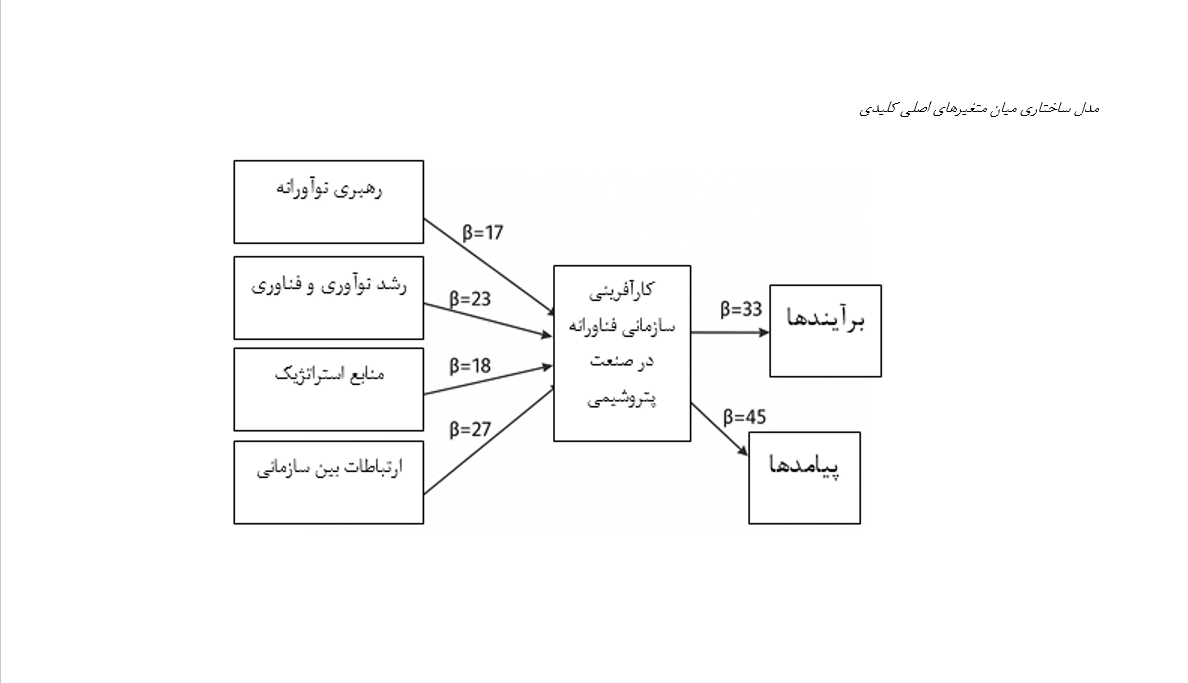
The present study aimed to design and validate a model of technological corporate entrepreneurship in the petrochemical industry with an emphasis on key determinants of innovation development and organizational competitive advantage. This applied research employed a mixed-methods (qualitative–quantitative) design. In the qualitative phase, grounded theory and semi-structured interviews with 18 academic and industrial experts were used to identify the main concepts and dimensions of the model. The qualitative data were analyzed through open, axial, and selective coding, resulting in the extraction of 10 core categories and 35 concepts. In the quantitative phase, the statistical population consisted of managers and experts working in the petrochemical industry, from which 291 participants were selected using Cochran’s formula. Data were collected using a researcher-made questionnaire based on a five-point Likert scale. Content validity and construct validity were confirmed through expert review and confirmatory factor analysis, respectively, while reliability was confirmed with a Cronbach’s alpha coefficient of 0.89. Data analysis was conducted using SPSS and SmartPLS software through confirmatory factor analysis and structural equation modeling. The results of confirmatory factor analysis indicated that all constructs had factor loadings above 0.70, average variance extracted values above 0.50, and composite reliability values above 0.80, confirming the adequacy of the measurement model. Structural equation modeling revealed that innovative leadership (β=0.17), innovation and technology growth (β=0.23), strategic resources (β=0.18), and inter-organizational communication (β=0.27) had significant positive effects on technological corporate entrepreneurship. Furthermore, technological corporate entrepreneurship significantly affected organizational outcomes (β=0.33) and organizational consequences (β=0.45). The model fit indices, including CFI=0.96, RMSEA=0.042, and χ²/df=2.58, demonstrated an acceptable model fit. The findings demonstrated that the development of technological corporate entrepreneurship in the petrochemical industry depends on strengthening innovative leadership, technological growth, strategic resources, and inter-organizational interactions. Moreover, technological corporate entrepreneurship can improve organizational performance, enhance innovation capability, increase competitive advantage, and contribute to long-term organizational sustainability. The proposed model provides a localized and practical framework for policymakers and managers in the petrochemical industry to foster innovation ecosystems and technological entrepreneurship.
Downloads
References
Abdullayeva, M., & N, A. S. (2022). Ways of Rational Use of Water Resources in the Oil Industry. World Science(5(77)). https://doi.org/10.31435/rsglobal_ws/30092022/7868
Alhassan, A. M., Yusuf, B. O., Hussain, I., Tanimu, A., Alhooshani, K., Ali, B. E., & Ganiyu, S. A. (2025). Crude‐to‐Chemical Revolution: Integrating Technologies, Economic Feasibility, and Policy Frameworks for Sustainable Light Olefin Production. The Chemical Record, 25(8). https://doi.org/10.1002/tcr.202500011
Bauer, F., Nielsen, T., Nilsson, L. J., Palm, E., Ericsson, K., Fråne, A., & Cullen, J. M. (2022). Plastics and Climate Change—Breaking Carbon Lock-Ins Through Three Mitigation Pathways. One Earth, 5(4), 361-376. https://doi.org/10.1016/j.oneear.2022.03.007
Bondarenko, T. G., Borodin, A., Zholamanova, М., Panaedova, G., Belyanchikova, T. V., & Gurieva, L. (2020). Investments to the Petrochemical Sector: The Value of the Competitiveness of Petrochemical Companies. Journal of Entrepreneurship and Sustainability Issues, 7(3), 2510-2525. https://doi.org/10.9770/jesi.2020.7.3(70)
Bostan, I., Roman, C., & Boariu, C. (2020). The Romanian Chemical Production Sector (SRPC): Economic Parameters and Some Recent Trends Within European Context. Revista De Chimie, 71(6), 145-153. https://doi.org/10.37358/rc.20.6.8179
Chakraborty, S., Kalhori, S. K., González, Y., Mendoza, J. M., & Galatro, D. (2024). Student Perception of Sustainability in Industry: A Case Study in an Undergraduate Petroleum Processing Course. Frontiers in Education, 9. https://doi.org/10.3389/feduc.2024.1396377
Du, C., Li, X., Liu, C., Song, C., & Lu, J. (2023). Online Corrosion Management Based on the Situation of Long-Cycle Operation of Oil Refining Chemical Plants. 1776-1784. https://doi.org/10.2991/978-2-38476-126-5_201
Feltrin, L., Mah, A., & Brown, D. (2022). Noxious Deindustrialization: Experiences of Precarity and Pollution in Scotland’s Petrochemical Capital. Environment and Planning C Politics and Space, 40(4), 950-969. https://doi.org/10.1177/23996544211056328
Götz, M., & Kruse, A. (2024). A Proposal for Evaluating the Economic Viability of Biorefineries Against Petrochemical Benchmarks. Chemie Ingenieur Technik, 96(3), 355-362. https://doi.org/10.1002/cite.202300124
Griffiths, S., Sovacool, B. K., Kim, J., Bazilian, M., & Uratani, J. M. (2022). Decarbonizing the Oil Refining Industry: A Systematic Review of Sociotechnical Systems, Technological Innovations, and Policy Options. Energy Research & Social Science, 89, 102542. https://doi.org/10.1016/j.erss.2022.102542
Kapsarc. (2021). The Future of the Petrochemicals Industry and Sino-Saudi Cooperation. https://doi.org/10.30573/ks--2020-wb12
Kumar, A. (2023). Challenges and Opportunities to Conduct a Smart Supply Chain Management in Oil and Gas Industry With a Sustainable Strategies. https://doi.org/10.52783/jier.v3i2.171
Kuyukina, M. S., Krivoruchko, A. V., & Ившина, И. Б. (2020). Advanced Bioreactor Treatments of Hydrocarbon-Containing Wastewater. Applied Sciences, 10(3), 831. https://doi.org/10.3390/app10030831
Larraz, R. (2021). A Brief History of Oil Refining. Substantia, 5(2), 129-152. https://doi.org/10.36253/substantia-1191
Marinina, O., Tsvetkova, A., Vasilev, Y., Komendantova, N., & Parfenova, A. (2022). Evaluating the Downstream Development Strategy of Oil Companies: The Case of Rosneft. Resources, 11(1), 4. https://doi.org/10.3390/resources11010004
Mathur, S. B., Gosnell, G., Sovacool, B. K., Dylan, D. F. D. R., Griffiths, S., Bazilian, M., & Kim, J. (2022). Industrial Decarbonization via Natural Gas: A Critical and Systematic Review of Developments, Socio-Technical Systems and Policy Options. Energy Research & Social Science, 90, 102638. https://doi.org/10.1016/j.erss.2022.102638
Meese, A. F., Wu, X., Le, L., Napier, C., Hernandez, M., Laroco, N., Linden, K. G., Cox, J., Kurup, P., McCall, J., Greene, D., Talmadge, M., Huang, Z., Macknick, J., Sitterley, K. A., Miara, A., Evans, A., Thirumaran, K., Malhotra, M., . . . Kim, J. H. (2021). Opportunities and Challenges for Industrial Water Treatment and Reuse. Acs Es&t Engineering, 2(3), 465-488. https://doi.org/10.1021/acsestengg.1c00282
Michael, A. O. (2022). 30,000 BPD Capacity Modified Modular Refinery Operations in Nigeria. Open Journal of Modelling and Simulation, 10(04), 340-348. https://doi.org/10.4236/ojmsi.2022.104020
Mofo, L. (2020). Future-Proofing the Plastics Value Chain in Southern Africa. https://doi.org/10.35188/unu-wider/2020/905-1
Norouzi, N. (2021). Post‐COVID ‐19 and Globalization of Oil and Natural Gas Trade: Challenges, Opportunities, Lessons, Regulations, and Strategies. International Journal of Energy Research, 45(10), 14338-14356. https://doi.org/10.1002/er.6762
Orazbayeva, K., Sadu, Z., Nurgaliyeva, Z., Akisheva, A., & Ussenbayev, T. (2023). Formation and Development of Petrochemical Production in Kazakhstan According to the Cluster Principle. Bio Web of Conferences, 65, 09001. https://doi.org/10.1051/bioconf/20236509001
Øverland, I., & Poussenkova, N. (2020a). LUKOIL: Patriotic Cosmopolite. https://doi.org/10.4337/9781788978019.00014
Øverland, I., & Poussenkova, N. (2020b). Tatneft: Genghis Can. https://doi.org/10.4337/9781788978019.00017
Pagliaro, M., & Meneguzzo, F. (2020). Oil Refining in Sicily: A Critical Perspective Looking to the Future. Energy Science & Engineering, 8(3), 566-573. https://doi.org/10.1002/ese3.604
Pattnaik, F., Patra, B. R., Nanda, S., Mohanty, M., Dalai, A. K., & Rawat, J. K. (2024). Drivers and Barriers in the Production and Utilization of Second-Generation Bioethanol in India. Recycling, 9(1), 19. https://doi.org/10.3390/recycling9010019
Prodanova, N., Gordova, M., & Parasotskaya, N. (2023). Industrial Ecology and Environmental Management: Reducing the Level of Systemic Risks. E3s Web of Conferences, 371, 05019. https://doi.org/10.1051/e3sconf/202337105019
Rahman, M., Munadi, S., Widarsono, B., & Caryana, Y. K. (2022). Technology Challenges in Indonesia Oil and Gas Development. Scientific Contributions Oil and Gas, 34(1), 11-17. https://doi.org/10.29017/scog.34.1.787
Randolph, N. (2021). Pipeline Logic and Culpability: Establishing a Continuum of Harm for Sacrifice Zones. Frontiers in Environmental Science, 9. https://doi.org/10.3389/fenvs.2021.652691
Steininger, B. (2021). Ammonia Synthesis on the Banks of the Mississippi: A Molecular-Planetary Technology. The Anthropocene Review, 8(3), 262-279. https://doi.org/10.1177/20530196211029676
Tullo, A. (2021). C&EN’s Global Top 50. C&en Global Enterprise, 99(27), 27-33. https://doi.org/10.1021/cen-09927-cover
Tullo, A. H. (2021). C&EN’s Global Top 50 for 2021. Chemical & Engineering News, 26-33. https://doi.org/10.47287/cen-09927-cover
Wegner, R. C., & Fernandes, M. P. (2021). Business and Development Strategies in China: Inferences Based on the Evolution of SINOPEC. Estudos Internacionais Revista De Relações Internacionais Da Puc Minas, 9(1), 70-93. https://doi.org/10.5752/p.2317-773x.2021v9n1p70-93
Yadav, V. G., Yadav, G. D., & Patankar, S. C. (2020). The Production of Fuels and Chemicals in the New World: Critical Analysis of the Choice Between Crude Oil and Biomass Vis-À-Vis Sustainability and the Environment. Clean Technologies and Environmental Policy, 22(9), 1757-1774. https://doi.org/10.1007/s10098-020-01945-5
Zastupov, A. V. (2020). Increasing Innovation, Technology and Digital Potential of Industrial Enterprises. 113-121. https://doi.org/10.15405/epsbs.2020.03.16
Журавлева, М. В., Valeeva, E., Klimentova, G., Гончарова, И. Н., & Тагашева, Р. Г. (2021). Interdisciplinary Engineering Education for Sustainable Development of Russian Petrochemical Cluster. 1485-1492. https://doi.org/10.15405/epsbs.2021.09.02.166
Downloads
Publication Timeline
- Submitted
- Revised
- Accepted
Issue
Section
License
Copyright (c) 1405 Sina Faraji (Author); Bijan Rezaee; Sohrab Delangizan (Author)

This work is licensed under a Creative Commons Attribution-NonCommercial 4.0 International License.