طراحی الگوی کارآفرینی سازمانی فناورانه در صنعت پتروشیمی
کلمات کلیدی:
کارآفرینی سازمانی, کارآفرینی فناورانه, صنعت پتروشیمی, نظریه دادهبنیادچکیده
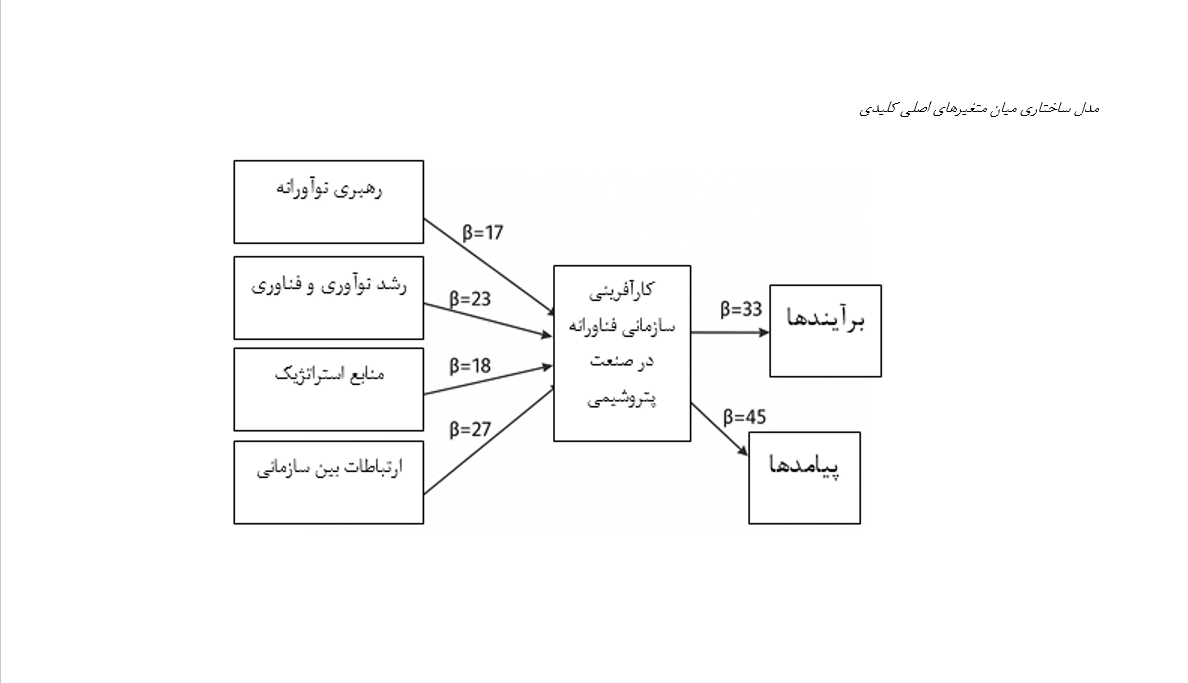
هدف پژوهش حاضر طراحی و اعتبارسنجی الگوی کارآفرینی سازمانی فناورانه در صنعت پتروشیمی با تأکید بر عوامل کلیدی مؤثر بر توسعه نوآوری و مزیت رقابتی سازمانی بود. این پژوهش از نظر هدف کاربردی و از نظر روش، آمیخته (کیفی–کمی) بود. در بخش کیفی، با استفاده از نظریه دادهبنیاد و مصاحبههای نیمهساختاریافته با 18 نفر از خبرگان دانشگاهی و صنعتی، مفاهیم و مؤلفههای اصلی استخراج شد. دادههای کیفی طی مراحل کدگذاری باز، محوری و انتخابی تحلیل گردید و در نهایت 10 مقوله محوری و 35 مفهوم شناسایی شد. در بخش کمی، جامعه آماری شامل مدیران و کارشناسان صنعت پتروشیمی بود که بر اساس فرمول کوکران، 291 نفر بهعنوان نمونه انتخاب شدند. ابزار گردآوری دادهها پرسشنامه محققساخته مبتنی بر طیف لیکرت پنجدرجهای بود. روایی پرسشنامه از طریق تحلیل عاملی تأییدی و پایایی آن با آلفای کرونباخ 0/89 تأیید شد. دادهها با استفاده از نرمافزارهای SPSS و SmartPLS و از طریق تحلیل عاملی تأییدی و مدلسازی معادلات ساختاری تحلیل شدند. نتایج تحلیل عاملی تأییدی نشان داد که تمامی مؤلفهها دارای بار عاملی بالاتر از 0/70، میانگین واریانس استخراجشده بیش از 0/50 و پایایی ترکیبی بالاتر از 0/80 بودند که بیانگر روایی و پایایی مناسب مدل است. نتایج مدلسازی معادلات ساختاری نشان داد که رهبری نوآورانه (β=0.17)، رشد نوآوری و فناوری (β=0.23)، منابع استراتژیک (β=0.18) و ارتباطات بینسازمانی (β=0.27) تأثیر مثبت و معناداری بر کارآفرینی سازمانی فناورانه دارند. همچنین کارآفرینی سازمانی فناورانه تأثیر معناداری بر برآیندهای سازمانی (β=0.33) و پیامدهای سازمانی (β=0.45) داشت. شاخصهای برازش مدل شامل CFI=0.96، RMSEA=0.042 و χ²/df=2.58 نیز برازش مطلوب مدل را تأیید کردند. یافتههای پژوهش نشان داد که توسعه کارآفرینی سازمانی فناورانه در صنعت پتروشیمی مستلزم تقویت رهبری نوآورانه، رشد فناوری، منابع استراتژیک و تعاملات بینسازمانی است. همچنین، این نوع کارآفرینی میتواند موجب بهبود عملکرد، افزایش نوآوری، ارتقای مزیت رقابتی و دستیابی به پایداری سازمانی شود. الگوی طراحیشده میتواند بهعنوان چارچوبی بومی و کاربردی برای سیاستگذاران و مدیران صنعت پتروشیمی در جهت توسعه زیستبوم نوآوری و کارآفرینی فناورانه مورد استفاده قرار گیرد.
دانلودها
مراجع
Abdullayeva, M., & N, A. S. (2022). Ways of Rational Use of Water Resources in the Oil Industry. World Science(5(77)). https://doi.org/10.31435/rsglobal_ws/30092022/7868
Alhassan, A. M., Yusuf, B. O., Hussain, I., Tanimu, A., Alhooshani, K., Ali, B. E., & Ganiyu, S. A. (2025). Crude‐to‐Chemical Revolution: Integrating Technologies, Economic Feasibility, and Policy Frameworks for Sustainable Light Olefin Production. The Chemical Record, 25(8). https://doi.org/10.1002/tcr.202500011
Bauer, F., Nielsen, T., Nilsson, L. J., Palm, E., Ericsson, K., Fråne, A., & Cullen, J. M. (2022). Plastics and Climate Change—Breaking Carbon Lock-Ins Through Three Mitigation Pathways. One Earth, 5(4), 361-376. https://doi.org/10.1016/j.oneear.2022.03.007
Bondarenko, T. G., Borodin, A., Zholamanova, М., Panaedova, G., Belyanchikova, T. V., & Gurieva, L. (2020). Investments to the Petrochemical Sector: The Value of the Competitiveness of Petrochemical Companies. Journal of Entrepreneurship and Sustainability Issues, 7(3), 2510-2525. https://doi.org/10.9770/jesi.2020.7.3(70)
Bostan, I., Roman, C., & Boariu, C. (2020). The Romanian Chemical Production Sector (SRPC): Economic Parameters and Some Recent Trends Within European Context. Revista De Chimie, 71(6), 145-153. https://doi.org/10.37358/rc.20.6.8179
Chakraborty, S., Kalhori, S. K., González, Y., Mendoza, J. M., & Galatro, D. (2024). Student Perception of Sustainability in Industry: A Case Study in an Undergraduate Petroleum Processing Course. Frontiers in Education, 9. https://doi.org/10.3389/feduc.2024.1396377
Du, C., Li, X., Liu, C., Song, C., & Lu, J. (2023). Online Corrosion Management Based on the Situation of Long-Cycle Operation of Oil Refining Chemical Plants. 1776-1784. https://doi.org/10.2991/978-2-38476-126-5_201
Feltrin, L., Mah, A., & Brown, D. (2022). Noxious Deindustrialization: Experiences of Precarity and Pollution in Scotland’s Petrochemical Capital. Environment and Planning C Politics and Space, 40(4), 950-969. https://doi.org/10.1177/23996544211056328
Götz, M., & Kruse, A. (2024). A Proposal for Evaluating the Economic Viability of Biorefineries Against Petrochemical Benchmarks. Chemie Ingenieur Technik, 96(3), 355-362. https://doi.org/10.1002/cite.202300124
Griffiths, S., Sovacool, B. K., Kim, J., Bazilian, M., & Uratani, J. M. (2022). Decarbonizing the Oil Refining Industry: A Systematic Review of Sociotechnical Systems, Technological Innovations, and Policy Options. Energy Research & Social Science, 89, 102542. https://doi.org/10.1016/j.erss.2022.102542
Kapsarc. (2021). The Future of the Petrochemicals Industry and Sino-Saudi Cooperation. https://doi.org/10.30573/ks--2020-wb12
Kumar, A. (2023). Challenges and Opportunities to Conduct a Smart Supply Chain Management in Oil and Gas Industry With a Sustainable Strategies. https://doi.org/10.52783/jier.v3i2.171
Kuyukina, M. S., Krivoruchko, A. V., & Ившина, И. Б. (2020). Advanced Bioreactor Treatments of Hydrocarbon-Containing Wastewater. Applied Sciences, 10(3), 831. https://doi.org/10.3390/app10030831
Larraz, R. (2021). A Brief History of Oil Refining. Substantia, 5(2), 129-152. https://doi.org/10.36253/substantia-1191
Marinina, O., Tsvetkova, A., Vasilev, Y., Komendantova, N., & Parfenova, A. (2022). Evaluating the Downstream Development Strategy of Oil Companies: The Case of Rosneft. Resources, 11(1), 4. https://doi.org/10.3390/resources11010004
Mathur, S. B., Gosnell, G., Sovacool, B. K., Dylan, D. F. D. R., Griffiths, S., Bazilian, M., & Kim, J. (2022). Industrial Decarbonization via Natural Gas: A Critical and Systematic Review of Developments, Socio-Technical Systems and Policy Options. Energy Research & Social Science, 90, 102638. https://doi.org/10.1016/j.erss.2022.102638
Meese, A. F., Wu, X., Le, L., Napier, C., Hernandez, M., Laroco, N., Linden, K. G., Cox, J., Kurup, P., McCall, J., Greene, D., Talmadge, M., Huang, Z., Macknick, J., Sitterley, K. A., Miara, A., Evans, A., Thirumaran, K., Malhotra, M., . . . Kim, J. H. (2021). Opportunities and Challenges for Industrial Water Treatment and Reuse. Acs Es&t Engineering, 2(3), 465-488. https://doi.org/10.1021/acsestengg.1c00282
Michael, A. O. (2022). 30,000 BPD Capacity Modified Modular Refinery Operations in Nigeria. Open Journal of Modelling and Simulation, 10(04), 340-348. https://doi.org/10.4236/ojmsi.2022.104020
Mofo, L. (2020). Future-Proofing the Plastics Value Chain in Southern Africa. https://doi.org/10.35188/unu-wider/2020/905-1
Norouzi, N. (2021). Post‐COVID ‐19 and Globalization of Oil and Natural Gas Trade: Challenges, Opportunities, Lessons, Regulations, and Strategies. International Journal of Energy Research, 45(10), 14338-14356. https://doi.org/10.1002/er.6762
Orazbayeva, K., Sadu, Z., Nurgaliyeva, Z., Akisheva, A., & Ussenbayev, T. (2023). Formation and Development of Petrochemical Production in Kazakhstan According to the Cluster Principle. Bio Web of Conferences, 65, 09001. https://doi.org/10.1051/bioconf/20236509001
Øverland, I., & Poussenkova, N. (2020a). LUKOIL: Patriotic Cosmopolite. https://doi.org/10.4337/9781788978019.00014
Øverland, I., & Poussenkova, N. (2020b). Tatneft: Genghis Can. https://doi.org/10.4337/9781788978019.00017
Pagliaro, M., & Meneguzzo, F. (2020). Oil Refining in Sicily: A Critical Perspective Looking to the Future. Energy Science & Engineering, 8(3), 566-573. https://doi.org/10.1002/ese3.604
Pattnaik, F., Patra, B. R., Nanda, S., Mohanty, M., Dalai, A. K., & Rawat, J. K. (2024). Drivers and Barriers in the Production and Utilization of Second-Generation Bioethanol in India. Recycling, 9(1), 19. https://doi.org/10.3390/recycling9010019
Prodanova, N., Gordova, M., & Parasotskaya, N. (2023). Industrial Ecology and Environmental Management: Reducing the Level of Systemic Risks. E3s Web of Conferences, 371, 05019. https://doi.org/10.1051/e3sconf/202337105019
Rahman, M., Munadi, S., Widarsono, B., & Caryana, Y. K. (2022). Technology Challenges in Indonesia Oil and Gas Development. Scientific Contributions Oil and Gas, 34(1), 11-17. https://doi.org/10.29017/scog.34.1.787
Randolph, N. (2021). Pipeline Logic and Culpability: Establishing a Continuum of Harm for Sacrifice Zones. Frontiers in Environmental Science, 9. https://doi.org/10.3389/fenvs.2021.652691
Steininger, B. (2021). Ammonia Synthesis on the Banks of the Mississippi: A Molecular-Planetary Technology. The Anthropocene Review, 8(3), 262-279. https://doi.org/10.1177/20530196211029676
Tullo, A. (2021). C&EN’s Global Top 50. C&en Global Enterprise, 99(27), 27-33. https://doi.org/10.1021/cen-09927-cover
Tullo, A. H. (2021). C&EN’s Global Top 50 for 2021. Chemical & Engineering News, 26-33. https://doi.org/10.47287/cen-09927-cover
Wegner, R. C., & Fernandes, M. P. (2021). Business and Development Strategies in China: Inferences Based on the Evolution of SINOPEC. Estudos Internacionais Revista De Relações Internacionais Da Puc Minas, 9(1), 70-93. https://doi.org/10.5752/p.2317-773x.2021v9n1p70-93
Yadav, V. G., Yadav, G. D., & Patankar, S. C. (2020). The Production of Fuels and Chemicals in the New World: Critical Analysis of the Choice Between Crude Oil and Biomass Vis-À-Vis Sustainability and the Environment. Clean Technologies and Environmental Policy, 22(9), 1757-1774. https://doi.org/10.1007/s10098-020-01945-5
Zastupov, A. V. (2020). Increasing Innovation, Technology and Digital Potential of Industrial Enterprises. 113-121. https://doi.org/10.15405/epsbs.2020.03.16
Журавлева, М. В., Valeeva, E., Klimentova, G., Гончарова, И. Н., & Тагашева, Р. Г. (2021). Interdisciplinary Engineering Education for Sustainable Development of Russian Petrochemical Cluster. 1485-1492. https://doi.org/10.15405/epsbs.2021.09.02.166
دانلودها
گاهشمار انتشار
- ارسال
- بازنگری
- پذیرش
شماره
نوع مقاله
مجوز
حق نشر 1405 Sina Faraji (Author); Bijan Rezaee; Sohrab Delangizan (Author)

این پروژه تحت مجوز بین المللی Creative Commons Attribution-NonCommercial 4.0 می باشد.