Explaining the Mechanisms of the Impact of Digital Supply Chain Resilience on Firms’ Financial and Non-Financial Performance: The Mediating Role of Organizational Agility and the Moderating Role of Environmental Uncertainty
Keywords:
Digital Supply Chain Resilience, Financial Performance, Non-Financial Performance, Organizational Agility, Environmental Uncertainty, Structural Equation ModelingAbstract
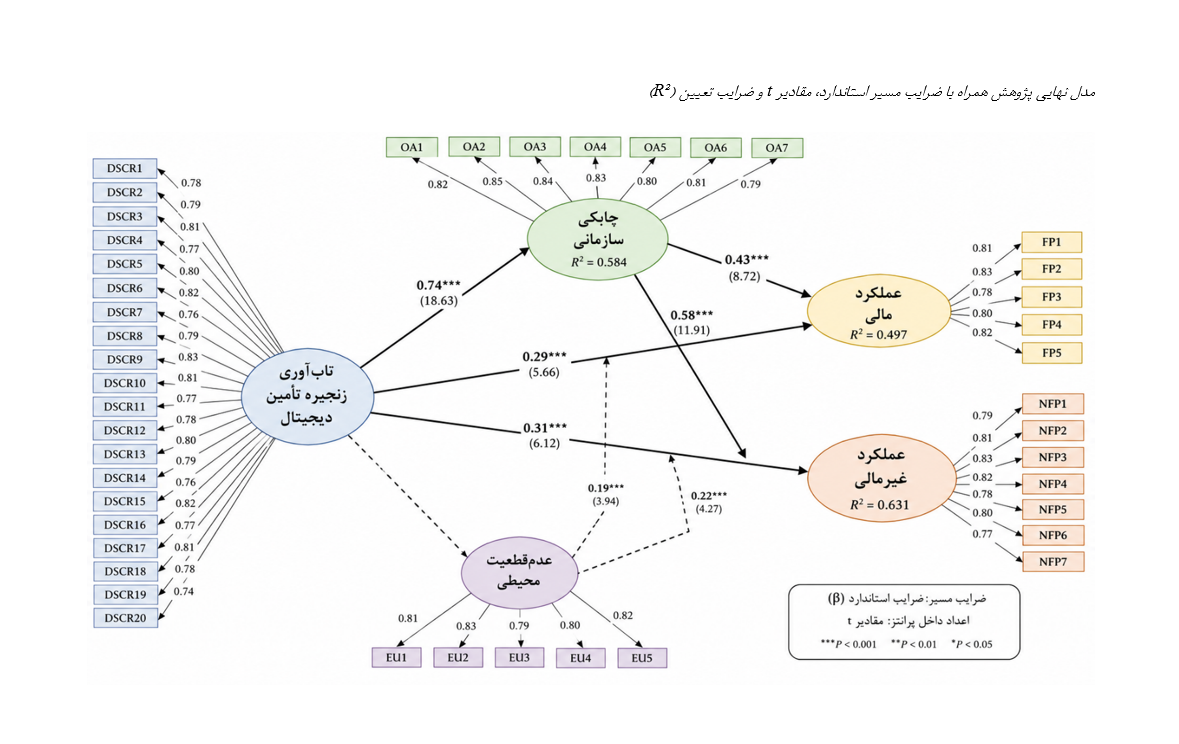
The present study aimed to explain the mechanisms through which digital supply chain resilience affects firms’ financial and non-financial performance by examining the mediating role of organizational agility and the moderating role of environmental uncertainty. This applied study employed a descriptive-correlational design based on structural equation modeling. The statistical population consisted of senior managers, supply chain managers, information technology managers, operations managers, and strategic planning experts working in medium-sized and large organizations in Tehran during 2026. Using Cochran’s formula, a sample size of 384 participants was determined, of which 372 valid questionnaires were retained for analysis. Data were collected through standardized instruments measuring digital supply chain resilience, organizational agility, financial and non-financial performance, and environmental uncertainty. Data analysis was conducted using SPSS version 27 and SmartPLS version 4. Structural equation modeling, mediation analysis, and moderation testing procedures were employed to evaluate the proposed conceptual model. The results revealed that digital supply chain resilience had a significant positive effect on organizational agility (β=0.74, t=18.63), financial performance (β=0.29, t=5.66), and non-financial performance (β=0.31, t=6.12). Organizational agility also demonstrated significant positive effects on financial performance (β=0.43, t=8.72) and non-financial performance (β=0.58, t=11.91). Bootstrapping analysis confirmed the mediating role of organizational agility in the relationship between digital supply chain resilience and financial performance (β=0.32, t=7.88), as well as non-financial performance (β=0.43, t=9.76). Furthermore, environmental uncertainty significantly moderated the relationships between digital supply chain resilience and financial performance (β=0.19, t=3.94) and non-financial performance (β=0.22, t=4.27). The findings indicate that digital supply chain resilience is a critical strategic capability that enhances both financial and non-financial organizational performance. Beyond its direct effects, resilience contributes to organizational success by strengthening organizational agility, while its positive influence becomes more pronounced under conditions of high environmental uncertainty. Therefore, investments in digital capabilities and agility development can serve as effective strategies for improving organizational performance and sustaining competitive advantage in turbulent and uncertain business environments.
Downloads
References
Abourokbah, S. H., Mashat, R. M., & Salam, M. A. (2023). Role of Absorptive Capacity, Digital Capability, Agility, and Resilience in Supply Chain Innovation Performance. Sustainability, 15(4), 3636. https://doi.org/10.3390/su15043636
Akbar, H. M., & Isfianadewi, D. (2023). The Role of Supply Chain Resilience to Relationships Supply Chain Risk Management Culture and Firm Performance During Disruption. International Journal of Research in Business and Social Science (2147-4478), 12(2), 643-652. https://doi.org/10.20525/ijrbs.v12i2.2392
Akhtar, P., Ghouri, A. M., Saha, M., Khan, M. R., Shamim, S., & Nallaluthan, K. (2024). Industrial Digitization, the Use of Real-Time Information, and Operational Agility: Digital and Information Perspectives for Supply Chain Resilience. Ieee Transactions on Engineering Management, 71, 10387-10397. https://doi.org/10.1109/tem.2022.3182479
Alakaş, E. Ö., Bölük, A. A., & Karadoğan, D. (2025). Resilient Logistics in Strategic Management: Going Beyond Low Cost and Sustainability. Business Strategy & Development, 8(3). https://doi.org/10.1002/bsd2.70197
Ali, E., & Gossaye, W. (2023). The Effects of Supply Chain Viability on Supply Chain Performance and Marketing Performance in Case of Large Manufacturing Firm in Ethiopia. Brazilian Journal of Operations & Production Management, 20(2), 1535. https://doi.org/10.14488/bjopm.1535.2023
Cabrera, B. D., Santa, R., Tegethoff, T., Morante, D., & Ferrer, M. (2023). Supply Chain Resilience in the Colombian Defense Sector Before and During the COVID-19 Pandemic: A Comparative Study. PLoS One, 18(3), e0282793. https://doi.org/10.1371/journal.pone.0282793
Cao, Q., Trimi, S., & Schniederjans, D. G. (2024). Ambidextrous Supply Chain Strategy: Roles and Consequences With Agile Manufacturing and Resilience. The International Journal of Logistics Management, 35(6), 1981-2011. https://doi.org/10.1108/ijlm-10-2023-0429
Ding, J., & Lee, E.-S. (2024). Improving the Maritime Supply Chain Resilience: The Role of Firms’ Dynamic Knowledge Management and Organizational Innovation. Journal of Organizational Change Management, 37(6), 1322-1339. https://doi.org/10.1108/jocm-01-2024-0006
Dubey, R., Bryde, D., Dwivedi, Y. K., Graham, G., Foropon, C., & Παπαδόπουλος, Θ. (2023). Dynamic Digital Capabilities and Supply Chain Resilience: The Role of Government Effectiveness. International Journal of Production Economics, 258, 108790. https://doi.org/10.1016/j.ijpe.2023.108790
Elnadi, M., Gheith, M. H., Troise, C., Abdallah, Y. O., & Abdelaziz, M. A. A. (2025). Digital Transformation and Sustainable Supply Chain Performance for Sustainable Development: The Mediating Role of Supply Chain Capabilities. Sustainable Development, 34(S1), 611-637. https://doi.org/10.1002/sd.70191
Gong, C., & Ribière, V. (2023). Understanding the Role of Organizational Agility in the Context of Digital Transformation: An Integrative Literature Review. VINE Journal of Information and Knowledge Management Systems, 55(2), 351-378. https://doi.org/10.1108/vjikms-09-2022-0312
Hsieh, C. C., Chen, S.-L., & Huang, C.-C. (2023). Investigating the Role of Supply Chain Environmental Risk in Shaping the Nexus of Supply Chain Agility, Resilience, and Performance. Sustainability, 15(20), 15003. https://doi.org/10.3390/su152015003
Kamar, M. A., Albadry, O. M., Sheikhelsouk, S., Al‐Abyadh, M. H. A., & Alsetoohy, O. (2023). Dynamic Capabilities Influence on the Operational Performance of Hotel Food Supply Chains: A Mediation-Moderation Model. Sustainability, 15(18), 13562. https://doi.org/10.3390/su151813562
Kang, T., Taylor, M., & Park, M. (2023). Agility Prevalence Across Industry Type: A Proposed Model. International Journal of Economics Business and Management Research, 07(09), 54-67. https://doi.org/10.51505/ijebmr.2023.7905
Mbamalu, E. I., Chike, N. K., Oguanobi, C. A., & Egbunike, C. F. (2023). Sustainable Supply Chain Management and Organisational Performance: Perception of Academics and Practitioners. Annals of Management and Organization Research, 5(1), 13-30. https://doi.org/10.35912/amor.v5i1.1758
Negi, P. (2025). Supply Chain Resilience, Organizational Effectiveness, and Firm Performance: A Systematic Review and Future Research Agenda. Sage Open, 15(4). https://doi.org/10.1177/21582440251393994
Pertheban, T. R., Marimuthu, A., Venkatachalam, K. R., Annamalah, S., Paraman, P., & Hoo, W. C. (2023). The Impact of Proactive Resilience Strategies on Organizational Performance: Role of Ambidextrous and Dynamic Capabilities of SMEs in Manufacturing Sector. Sustainability, 15(16), 12665. https://doi.org/10.3390/su151612665
Phadnis, S. S. (2023). A Review of Research on Supply Chain Adaptability: Opening the Black Box. Journal of Business Logistics, 45(1). https://doi.org/10.1111/jbl.12370
Piprani, A. Z., Khan, S. A. R., & Yu, Z. (2024). Driving Success Through Digital Transformation: Influence of Industry 4.0 on Lean, Agile, Resilient, Green Supply Chain Practices. Journal of Manufacturing Technology Management, 35(6), 1175-1198. https://doi.org/10.1108/jmtm-05-2023-0179
Qader, G., Rehman, J., Shamsi, M., & Abro, S. (2025). Examining the Impact of Dynamic Capabilities and Industry4.0 Technologies in Pharmaceutical Manufacturing Firms: A Sustainable Supply Chain Performance Framework. Business Strategy & Development, 8(3). https://doi.org/10.1002/bsd2.70205
Rahman, M. K., Piprani, A. Z., Mohiuddin, S., Nazir, S., & Shah, A. A. (2026). Unraveling the Impact of Organizational Ambidexterity: The Role of Integration and Agility in Enhancing Performance Amidst Supply Chain Disruptions. Global Business and Organizational Excellence. https://doi.org/10.1002/joe.70028
Rana, J., Daultani, Y., Goswami, M., & Kumar, S. (2025). Exploring the Impact of Supply Chain Digital Transformation on Supply Chain Performance: An Empirical Investigation. Business Strategy and the Environment, 34(3), 3497-3521. https://doi.org/10.1002/bse.4157
Roh, T., & Xiao, S. (2024). Extending the Research Agenda for Supply Chain Management in the Age of Disruption: The Multifaceted Role and Implications of Dynamic Capabilities. Journal of General Management, 50(1), 5-15. https://doi.org/10.1177/03063070241272373
Ruan, Z. (2025). Driving Supply Chain Agility Through Digitalization. Journal of Global Information Management, 33(1), 1-28. https://doi.org/10.4018/jgim.395354
Shafaghizadeh, S., & Sajadi, S. M. (2023). Ranking Agility Factors to Reliably Sustain a Green Industrial Supply Chain Using the Fuzzy Analytic Network Process and Ordinal Priority Approach. Sustainability, 15(22), 16005. https://doi.org/10.3390/su152216005
Sharma, M., Antony, R., Sharma, A., & Daim, T. (2024). Can Smart Supply Chain Bring Agility and Resilience for Enhanced Sustainable Business Performance? The International Journal of Logistics Management, 36(2), 501-555. https://doi.org/10.1108/ijlm-09-2023-0381
Soledispa-Cañarte, B. J., Pionce, M. S. P., Merchán-Ponce, N. P., Alvarez, D. M., Tovar-Quintero, J., Escobar-Molina, D., Cedeño-Ramírez, J. D., & Rincón-Guio, C. (2023). The Role of Logistics 4.0 in Agribusiness Sustainability and Competitiveness, a Bibliometric and Systematic Literature Review. Operations and Supply Chain Management an International Journal, 109-120. https://doi.org/10.31387/oscm0520376
Tripathi, S., & Roy, S. S. (2023). Linking Supply Chain Performance with Organizational Strategic Performance – A Review and Research Agenda. International Journal of Productivity and Performance Management, 73(7), 2037-2067. https://doi.org/10.1108/ijppm-09-2022-0461
Xu, H., Zheng, H., Sun, D., Wang, M., & Ye, C. (2024). An Integrated Framework for Enablers in Supply Chain Resilience: Model Development and Analysis. IEEE Access, 12, 42490-42508. https://doi.org/10.1109/access.2024.3379212
Xu, T., & Liu, X. (2023). Achieving Manufacturing Supply Chain Resilience: The Role of Paradoxical Leadership and Big Data Analytics Capability. Journal of Manufacturing Technology Management, 35(2), 205-225. https://doi.org/10.1108/jmtm-05-2023-0206
Ye, F., Ke, M., Ouyang, Y., Li, Y., Li, L., Zhan, Y., & Zhang, M. (2023). Impact of Digital Technology Usage on Firm Resilience: A Dynamic Capability Perspective. Supply Chain Management an International Journal, 29(1), 162-175. https://doi.org/10.1108/scm-12-2022-0480
Downloads
Publication Timeline
- Submitted
- Revised
- Accepted
Issue
Section
License
Copyright (c) 1404 Mohammad Hossein kachouei (Author)

This work is licensed under a Creative Commons Attribution-NonCommercial 4.0 International License.