Designing a Business Model for Iran’s Gift Gold and Jewelry Industry Using the Blue Ocean Transformation Approach
Keywords:
Blue Ocean Transformation, Business Model, Gift Gold and Jewelry, Value Innovation, Noncustomers, Strategy Canvas, Thematic AnalysisAbstract
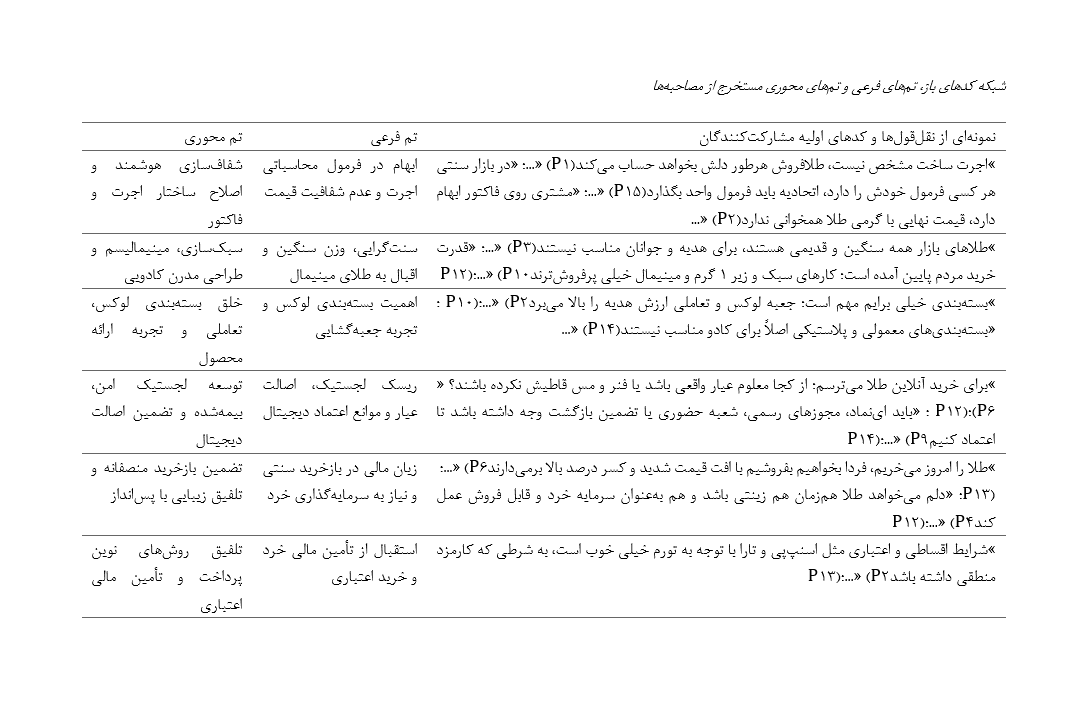
The present study aimed to design and validate an innovative business model for Iran’s gift gold and jewelry industry using the Blue Ocean Transformation approach, with emphasis on identifying customer and noncustomer pain points and reconstructing competitive market factors. This study employed a qualitative, interpretive, inductive, developmental, and exploratory-descriptive design. Participants were selected through purposive judgmental sampling and consisted of 15 customers, noncustomers, and experts from the gold and jewelry industry. Data were collected through in-depth semi-structured interviews and two focus-group sessions. Interviews continued until data saturation was achieved. The data were analyzed using a six-stage thematic analysis process. The extracted themes were then integrated with the Eliminate-Reduce-Raise-Create framework, the three tiers of noncustomers, the Strategy Canvas, and the Business Model Canvas. Cohen’s kappa was κ = 0.874, indicating a high level of inter-coder agreement. The analysis yielded 54 initial codes and 13 subthemes. The main transformation domains included pricing and making-charge transparency, lightweight and minimalist design, premium packaging and unboxing experience, digital trust and secure logistics, fair buyback and micro-investment value, and credit-based financing. Cohen’s kappa was 87.4%, indicating high inter-coder agreement. The Blue Ocean analysis showed that the proposed model should reduce reliance on costly physical decoration, opaque making-charge formulas, and traditional intermediaries, while increasing invoice transparency, sub-1-gram products, credit purchasing, premium packaging, insured delivery, and hybrid gift-investment products. The proposed model indicates that transformation of Iran’s gift gold and jewelry industry requires a shift from a traditional weight-centered and store-based logic toward a transparent, digital, experience-oriented, and value-centered ecosystem capable of serving both existing customers and previously untapped noncustomer demand.
Downloads
References
Christianto, V., & Smarandache, F. (2021). Remark on Neutrosophy Perspective on Blue Ocean Shift. Bio-Science Research Bulletin, 37(1), 1-3. https://doi.org/10.5958/2320-3161.2021.00001.8
Dsilva, J., & Subramanian, A. P. (2021). Blue Ocean Strategy: An Investigation on Food Industry in the UAE. Turkish Journal of Computer and Mathematics Education, 12(13), 2077-2086. https://doi.org/10.17762/turcomat.v12i13.8888
Fauzi, A., Widagdo, S., & Kusuma, D. W. (2023). Business Model Design with Blue Ocean Strategy Approach for CV. Dwipa Nusantara Tobacco.
Ghanbari, M., Sabzali Yameqani, A., Rabbani, Y., & Sabzali Yamaqani, K. (2024). Formulating a Blue Ocean Strategy in the Banking Services Industry: Enhancing Customer Satisfaction through Improved Demand Fulfillment and Presenting an Optimal Pattern. Journal of Business Management, 16(1), 87-113. https://doi.org/10.22059/JIBM.2023.353262.4517
Henaulu, A. K., Ardian, S., & Ely, A. J. (2021). Combination of Canvas Business Model and Blue Ocean Strategy in Developing SMEs Jus Pala Morella. IOP Conference Series: Earth and Environmental Science, 807, 022059.
Hokianto, H. F. (2023). Implementation of Blue Ocean Strategy: Review of Previous Cases. Sinergi International Journal of Management and Business, 1(2), 116-125. https://journal.sinergi.or.id/
Indrayani, R. (2022). Designing a Marketing Strategy with a Blue Ocean Strategy Approach at the Dstyle Bandung Online Store. Journal of Research in Business, Economics, and Education, 4(3), 1-9. https://doi.org/10.55683/jrbee.v4i3.402
Mas'ud, M. A., Prasetyowati, E., & Matsaini. (2023). Canvas Business Model and Blue Ocean Strategy for the Development of Rengginang Lorjuk Based on Quality Function Deployment. International Journal of Advanced Engineering and Management Research, 8(1). https://doi.org/10.51505/ijaemr.2022.8106
Massoudi, A. H., & Ahmed, M. E. (2021). The Adoption of Blue Ocean Strategy to Sustain Competitive Advantage in the Syrian Food Industry. Ukh Journal of Social Sciences, 5(2), 34-49. https://journals.ukh.edu.krd/index.php/ukhjss/article/view/344
Mutua, J. N., & Wangari, C. N. (2023). A Critique of Blue Ocean Strategies: Exploring the Limits of Creating Uncontested Markets. The International Journal Of Business & Management, 1-5.
Payne, A., Frow, P., Steinhoff, L., & Eggert, A. (2020). Toward a Comprehensive Framework of Value Proposition Development: From Strategy to Implementation. Industrial Marketing Management, 87(244), 255.
Rajabi Farjad, H., Tootian Isfahani, S., & Sabet, M. (2020). The Impact of Blue Ocean Strategy on the Competitive Advantage of Insurance Companies: Case Study of Novin Insurance Company. Iranian Journal of Insurance Research, 34(4), 79-100. https://doi.org/10.22056/jir.2020.149010.2368
Sakinah, I., Zahro, Z., & Andinia, A. (2023). Adaptation of Blue Ocean Strategy in Increasing Business Markets. Journal of Entrepreneurship and Business Innovation, 1-11.
Samrin, S., Hasibuan, H. A., Hidayat, R., & Rusiadi. (2022). Model of Blue Ocean Strategy Developing a Bamboo Small Business in Medan City. (Vol. 3, pp. 255-263): Universitas Pembangunan Panca Budi.
Statista. (2021). Global Gold Demand from 2010 to 2021, by Sector. https://www.statista.com/statistics/273645/global-gold-demand-by-industry-sector
Statista. (2022). Value of the Jewelry Market Worldwide from 2020 to 2026. https://www.statista.com/statistics/802082/global-jewelry-market-value
Statista. (2023). Global Gold Production from 2010 to 2023. https://www.statista.com/statistics/238414/global-mine-production-of-gold
Yohanes, H., Atmaji, G., Pramono, E. P., Astin, E. P., Setianto, W. B., Susanto, M., & Untoro, M. (2024). Blue Ocean Strategy Approach and Canvas Business Model for New Technology: Case Study of a Spouted Bed Coffee Roaster System.
Zafriana, L., & Prihono. (2023). Business Model Design Based on Blue Ocean Strategy for Eco-Friendly Sativa Mouthwash. Journal of Applied Industrial Engineering, 6(1), 44-57. https://doi.org/10.36456/tibuana.6.1.6497.44-57
Zahrani, I. A., & Prasetio, E. A. (2023). A Proposed Business Model Innovation Using Blue Ocean Strategy Approach for Kiumarket in the Post-Pandemic Era. International Journal of Current Science Research and Review, 6(12), 7696-7717. https://doi.org/10.47191/ijcsrr/V6-i12-26
Downloads
Publication Timeline
- Submitted
- Revised
- Accepted
Issue
Section
License
Copyright (c) 2026 Sepideh Arab (Author); Ali Divandari; Ali Namaki, Amir Khanlari (Author)

This work is licensed under a Creative Commons Attribution-NonCommercial 4.0 International License.