The Influence of Artificial Intelligence on Impulse Buying: The Mediating Role of Branding on Public Social Media Platforms
Keywords:
Artificial Intelligence, Consumer Behavior, Emotional Buying, Branding, Social NetworksAbstract
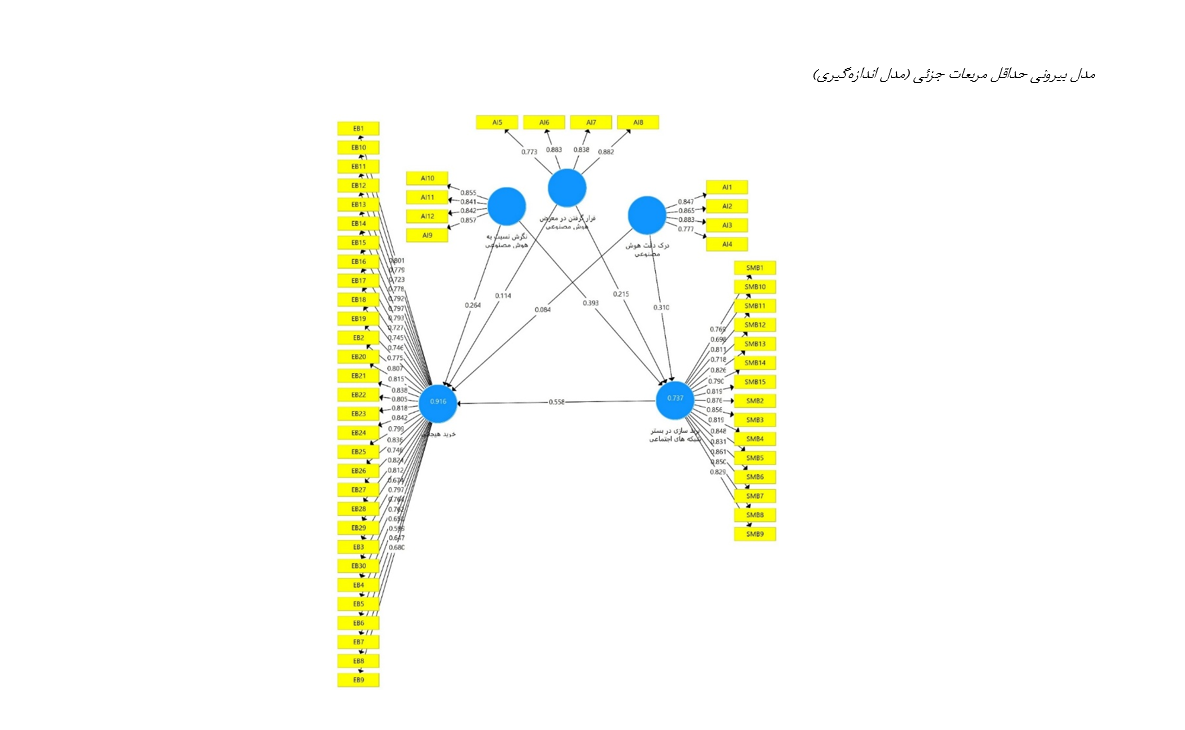
This study aimed to investigate the effect of artificial intelligence on customers’ impulse buying behavior, considering the mediating role of branding on public social media platforms. This applied study employed a descriptive-correlational survey design. The statistical population consisted of customers of Digikala, from whom 384 participants were selected using Cochran’s formula and stratified random sampling. Data were collected through standardized questionnaires measuring AI exposure, attitudes toward AI, perceived AI accuracy, impulse buying behavior, and social media branding. The hypotheses were tested using Structural Equation Modeling (SEM) based on the Partial Least Squares (PLS) approach through SmartPLS software. The results revealed that exposure to artificial intelligence had a positive and significant effect on impulse buying (β=0.114, t=3.357, p=0.001). Attitudes toward artificial intelligence (β=0.264, t=6.016, p<0.001), perceived AI accuracy (β=0.084, t=2.648, p=0.008), and branding on public social media platforms (β=0.558, t=16.973, p<0.001) also exerted significant positive effects on impulse buying behavior. Furthermore, Sobel test results confirmed that social media branding played a significant partial mediating role in the relationships between AI-related variables and impulse buying, with VAF values ranging from 0.453 to 0.673. The findings indicate that artificial intelligence can stimulate impulse buying through personalization, enhanced trust, and improved customer experiences. Branding on public social media platforms further strengthens these effects by fostering emotional engagement and reinforcing brand-consumer relationships. Consequently, the integration of AI technologies with effective social media branding strategies can increase customer engagement, enrich shopping experiences, and improve marketing outcomes for online retailers.
Downloads
References
Alizadeh, H., Nazarpour Kashani, H., Jalali Filshour, M., & Pourjabbari Khameneh, A. H. (2023). Evaluating the Prediction of Consumer Behavior Based on Artificial Intelligence-Based Marketing. National Conference on Management and Humanities Research in Iran,
Alsheibani, S., Cheung, Y., Messom, C., & Alhosni, M. (2020). Winning AI Strategy: Six-Steps to Create Value from Artificial Intelligence. Americas Conference on Information Systems, Online.
Azad, N., Soleimani, M. H., & Sedighi, S. (2022). The Effect of Trust and Perceived Value on Customer Intention as Well as Customer Reasons and Experience in Artificial Intelligence. National Conference on Management, Psychology and Behavioral Sciences,
Boozary, P. (2024). The Impact of Marketing Automation on Consumer Buying Behavior in the Digital Space via Artificial Intelligence. Power System Technology, 48(1), 1008-1021.
Buettner, R. (2020). The Impact of Trust in Consumer Protection on Internet Shopping Behavior: An Empirical Study Using a Large Official Dataset from the European Union. 2020 IEEE Sixth International Conference on Big Data Computing Service and Applications (Big Data Service),
Duan, F. L. (2023). Artificial Intelligence. In When AIAA Meets IEEE: Intelligent Aero-Engine and Electric Aircraft (pp. 23-45). Springer Nature Singapore.
Fahim, E., Poursalimi, M., Hosseinzadeh, A., & Ghasemi Namaghi, M. (2020). Designing a Social Branding Model in the Banking Industry on Social Networks. Brand Management, 7(23), 12-38.
Guerra-Tamez, C. R., Kraul Flores, K., Serna-Mendiburu, G. M., Chavelas Robles, D., & Ibarra Cortés, J. (2024). Decoding Gen Z: AI's Influence on Brand Trust and Purchasing Behavior. Frontiers in Artificial Intelligence, 7, 1323512.
Haleem, A., Javaid, M., Qadri, M. A., Singh, R. P., & Suman, R. (2022). Artificial Intelligence (AI) Applications for Marketing: A Literature-Based Study. International Journal of Intelligent Networks, 3, 119-132.
Khan, S. I. (2022). Impact of Artificial Intelligence on Consumer Buying Behaviors: Study about the Online Retail Purchase. International journal of health sciences(II), 8121-8129.
Mantello, P., Ho, M. T., Nguyen, M. H., & Vuong, Q. H. (2023). Bosses without a Heart: Socio-Demographic and Cross-Cultural Determinants of Attitude toward Emotional AI in the Workplace. Ai & Society, 38, 97-119. https://doi.org/10.1007/s00146-021-01290-1
McLean, G., Osei-Frimpong, K., & Barhorst, J. (2021). Alexa, Do Voice Assistants Influence Consumer Brand Engagement? Examining the Role of AI Powered Voice Assistants in Influencing Consumer Brand Engagement. Journal of Business Research, 124, 312-328. https://doi.org/10.1016/j.jbusres.2020.11.045
Meyer-Waarden, L., & Cloarec, J. (2021). Baby, You Can Drive My Car: Psychological Antecedents That Drive Consumers' Adoption of AI-Powered Autonomous Vehicles. Technovation, 109, 102348. https://doi.org/10.1016/j.technovation.2021.102348
Mikalef, P., & Gupta, M. (2021). Artificial Intelligence Capability: Conceptualization, Measurement Calibration, and Empirical Study on Its Impact on Organizational Creativity and Firm Performance. Information & Management. https://doi.org/10.1016/j.im.2021.103434
Mousavi, S. M. H., Hamdi, K., & Vazifehdoost, H. (2020). Presenting a Model for Measuring the Effects of Social Media and Emotional Intelligence on Consumer Purchase Decision-Making Behavior. Journal of Mashhad University of Medical Sciences, 63(6), 3095-3112.
Sajan, A., & Giri, P. (2025). Understanding artificial intelligence and its major role in branding Strategic Brand Management in the Age of AI and Disruption. IGI Global Scientific Publishing. https://doi.org/10.4018/979-8-3693-9461-8.ch006
Sakib, S. N. (2023). Artificial Intelligence Model for Analyzing the Buying Patterns of Customers. In Handbook of Research on AI and Machine Learning Applications in Customer Support and Analytics (pp. 37-55). IGI Global.
Shirmohammadi, Y., & Bostanmanesh Fard, A. (2022). Designing a Customer Purchase Model from Smart Stores during the Coronavirus Period with Emphasis on Artificial Intelligence. Smart Business Management Studies, 10(40), 233-263.
Shutaleva, A., Novgorodtseva, A. N., & Ryapalova, O. S. (2022). Self-Presentation in Instagram: Promotion of a Personal Brand in Social Networks.
Sicari, S., Rizzardi, A., & Porisini, A. C. (2020). 5G in the Internet of Things Era: An Overview on Security and Privacy. Computer Networks, 179, 107345. https://doi.org/10.1016/j.comnet.2020.107345
Talha, M. (2025). Optimizing Digital Marketing Campaigns Using Artificial Intelligence (AI) and Social Media Analytics: A Comparative Study of Machine Learning Algorithms. International Journal of Scientific Research in Engineering and Management, 9(3), 1-9. https://doi.org/10.55041/ijsrem42691
Teng, H. Y., Li, M. W., & Chen, C. Y. (2025). Does Smart Technology, Artificial Intelligence, Robotics, and Algorithm (STARA) Awareness Have a Double-Edged-Sword Influence on Proactive Customer Service Performance? Effects of Work Engagement and Employee Resilience. Journal of Hospitality Marketing & Management, 1-24. https://doi.org/10.1080/19368623.2025.2449853
Verma, R., Sonker, V., Singh, R. K., & Sharma, R. (2024). An Appraisal on Impact of Artificial Intelligence Driven Algorithms (Auto-Suggestions) in Determining Consumer's Buying Behavior across E-Commerce Platforms. Academy of Marketing Studies Journal, 28(1).
Wamba-Taguimdje, S. L., Wamba, S. F., Kamdjoug, J. R. K., & Wanko, C. E. T. (2020). Influence of Artificial Intelligence (AI) on Firm Performance: The Business Value of AI-Based Transformation Projects. Business Process Management Journal, 26(7), 1893-1924. https://doi.org/10.1108/BPMJ-10-2019-0411
Xu, Q. (2025). Artificial Intelligence Enabling Marketing in Africa: A Study of Precision Marketing Strategies and Economic Impact in Low-Income Markets. Highlights in Business Economics and Management, 56, 72-77. https://doi.org/10.54097/xephsz35
Downloads
Publication Timeline
- Submitted
- Revised
- Accepted
Issue
Section
License
Copyright (c) 2025 Leila Daneshvar; Amir Houshang Tajfar (Author)

This work is licensed under a Creative Commons Attribution-NonCommercial 4.0 International License.