Exploring the Indicators Shaping Brand Position in Iran’s Entrepreneurial Ecosystem
Keywords:
Brand positioning, entrepreneurship ecosystem, entrepreneurial branding, brand management, and brand legitimizationAbstract
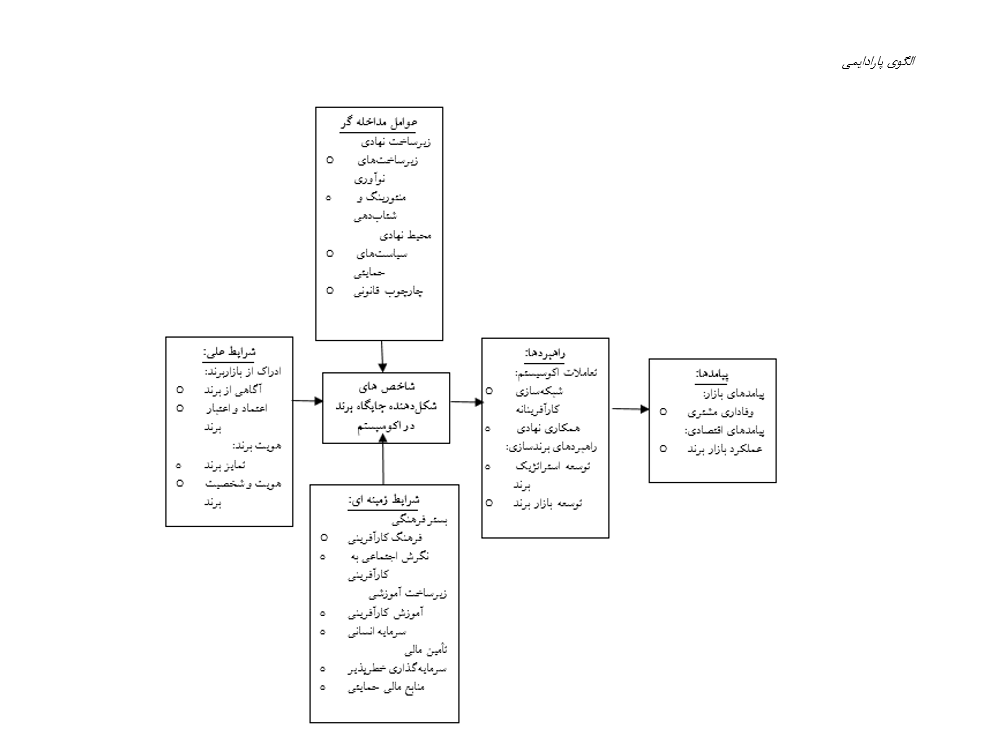
This study aimed to identify and explain the indicators shaping brand position in Iran’s entrepreneurial ecosystem and to develop an integrated model of the relationships among the factors contributing to the formation and enhancement of brand position. This applied study employed a qualitative-inductive approach within an interpretivist paradigm and used grounded theory based on the Strauss and Corbin framework. The study population comprised relevant scientific documents and literature as well as academic and executive experts in entrepreneurship and branding. Participants were selected through purposive sampling, and semi-structured interviews were conducted with 12 experts until theoretical saturation was reached. Data were analyzed using MAXQDA through open, axial, and selective coding. The trustworthiness of the qualitative findings was assessed through credibility, dependability, confirmability, and transferability criteria. Data analysis yielded 141 initial codes, 25 concepts, and 13 categories. The resulting paradigmatic model indicated that brand position in Iran’s entrepreneurial ecosystem emerges from multidimensional interactions among market perceptions of the brand, brand identity, brand management, cultural context, educational infrastructure, financing mechanisms, innovation infrastructure, and the institutional environment. Brand management emerged as the central phenomenon, while entrepreneurial networking, institutional collaboration, strategic brand development, and market development represented the principal strategies connecting ecosystem capacities to market and economic outcomes. The main consequences included enhanced customer loyalty, improved brand market performance, increased market share and sales, and ultimately a stronger brand position within the entrepreneurial ecosystem. The final position of the brand was therefore shaped by the dynamic interaction of causal, contextual, intervening, and strategic conditions. Brand position in Iran’s entrepreneurial ecosystem is a strategic, multidimensional, and ecosystem-based construct rather than merely an outcome of promotional or marketing activities. Establishing a strong brand position requires synergy among brand identity and management, institutional and cultural capacities, financial and educational resources, and network interactions. Accordingly, start-ups and small and medium-sized enterprises can strengthen their legitimacy, access to resources, market performance, and competitiveness through coherent brand management, stronger ecosystem relationships, and the creation of meaningful differentiation and market trust.
Downloads
References
Adinda, C., Syahira, R., Risde, K. R., & Rahayu, F. (2026). Analyzing Laptop Brand Positioning in Indonesia: A Perceptual Mapping Approach. Golden Ratio of Mapping Idea and Literature Format, 6(1), 1072-1085. https://doi.org/10.52970/grmilf.v6i1.1823
Alipour Harisi, M., Yadollahi Farsi, J., & Zali, M. R. (2021). Designing an Entrepreneurship Process Model Based on Branding: A Case Study of the Panter Brand in the Stationery Industry. Business Management Perspective, 20(48), 13-42.
Alms, J., & Tamásy, C. (2026). Social entrepreneurship ecosystems in the Baltic Sea region: searching for rural perspectives. Journal of Baltic Studies, 1-26. https://doi.org/10.1080/01629778.2026.2643849
Alsaaty, F. M., & Sawyer, G. (2019). Branding Entrepreneurial Start up Disruptive Innovation Ventures. Journal of Small Business and Entrepreneurship, 7(1), 71-81. https://doi.org/10.15640/jsbed.v7n1a6
Alzate, M., Arce-Urriza, M., & Cebollada, J. (2022). Mining the text of online consumer reviews to analyze brand image and brand positioning. Journal of Retailing and Consumer Services, 67, 102989. https://doi.org/10.1016/j.jretconser.2022.102989
Amani, M., Nasr Esfahani, A., Shaemi Barzoki, A., & Teymouri, H. (2019). Identifying the Antecedents and Consequences of Entrepreneurs' Personal Brands: A Case Study of Entrepreneurs in Isfahan. Journal of Executive Management, 11(22), 207-228.
Amolo, J., & Migiro, S. O. (2015). An entrepreneurial flair development: the role of an ecosystem. Problems and Perspectives in Management, 13(2), 494-505.
Bashir Khodaparasti, R., & Bagheri Gharah Bolagh, H. (2020). Exploring the Role of Brand Orientation and Entrepreneurial Orientation in Brand Performance among Green Food Manufacturing Companies. Entrepreneurship Strategies in Agriculture, 7(14), 11-20.
Bernarto, I., Berlianto, M. P., Meilani, Y. F., Masman, R. R., & Suryawan, I. N. (2020). The Influence of Brand Awareness, Brand Image, and Brand Trust on Brand Loyalty. Jurnal Manajemen, 24(3), 412-426. https://doi.org/10.24912/jm.v24i3.676
Dewi, L. G. P. S., Edyanto, N., & Siagian, H. (2020). The Effect of Brand Ambassador, Brand Image, and Brand Awareness on Purchase Decision of Pantene Shampoo in Surabaya, Indonesia SHS Web of Conferences, https://doi.org/10.1051/shsconf/20207601023
Emon, M. M. H. (2026). Purpose-Driven Intelligence in Green Marketing: Leveraging AI for CSR-Centric and Sustainable Brand Positioning. In Transforming Business Practices With AI-Powered Green Marketing (pp. 89-122). IGI Global Scientific Publishing. https://doi.org/10.4018/979-8-3373-3017-4.ch004
Eqbal Moghaddam, T., Mohammadkazemi, & Zabihi. (2023). Designing a City Branding Model Based on Digital Entrepreneurship in Creative Industries. Urban Economics and Planning, 4(1), 6-17.
Foroudi, P. (2019). Influence of brand signature, brand awareness, brand attitude, brand reputation on hotel industry's brand performance. International Journal of Hospitality Management, 76, 271-285. https://doi.org/10.1016/j.ijhm.2018.05.016
Hosseini Kahnouj, S. R., Sajasi Qeidari, H., Annabestani, A. A., & Shahdadi, A. (2021). Identifying Challenges Affecting the Development of the Tourism Business Ecosystem Using a Phenomenological Approach. Space Planning and Spatial Planning, 25(4), 71-112.
Hu, F., & Trivedi, R. H. (2020). Mapping hotel brand positioning and competitive landscapes by text-mining user-generated content. International Journal of Hospitality Management, 84, 102317. https://doi.org/10.1016/j.ijhm.2019.102317
Iyer, P., Davari, A., & Paswan, A. (2018). Determinants of brand performance: the role of internal branding. Journal of Brand Management, 25(3), 202-216. https://doi.org/10.1057/s41262-018-0097-1
Khajehpour Shirvan, N., Saketi, & Teymournejad, K. (2024). Presenting a Framework for Evaluating the Entrepreneurial Ecosystem of Science and Technology Parks in Iran. Strategic Management Studies, 15(57), 181-208.
Leicht, T., Giovanardi, M., Darler, W., & Kavaratzis, M. (2026). Co-creating and managing resident-place relationships in place marketing and branding: a place brand equity approach. European Journal of Marketing, 60(1), 1-31. https://doi.org/10.1108/EJM-03-2023-0154
Malekzadeh Oskouei, M., & Mohebbi, M. M. (2018). The Effect of Brand Orientation and Brand Entrepreneurship on Brand Performance: The Mediating Role of Brand Identification Second Scientific Research Conference on New Achievements in Management Sciences, Accounting, and Economics Studies in Iran, Ilam.
Plompen, B. E., & Wynants, M. (2021). Exploring the Entrepreneur's Mind-A Spectrum of Corporate Branding Mindsets Found in Start-ups.
Regele, M. D., & Neck, H. M. (2014). Entrepreneurship education sub-ecosystem in the United States: opportunities to increase entrepreneurial activity. (pp. 52-69): Babson College, USASBE.
Rezaei, B., Jalilian, N., & Badizadeh, A. (2021). The Effect of Entrepreneurial Ecosystem Formation Preconditions on Health Tourism Outcomes in Iran: A Case Study of Kermanshah Province. Entrepreneurship Knowledge, 1(1).
Sattari, B., Zia, B., Sokhdari, K., & Hosseini, S. R. (2020). Research Synthesis of Studies on the International Entrepreneurial Branding Model in the Health Tourism Industry. Tourism and Development, 9(2), 51-66.
Soukhtanlou, Rastegar, A., Sanaeipour, H., & Gorji. (2022). Designing a Technological Entrepreneurship Ecosystem Model in the Processing Industries of Golestan Province. Entrepreneurship Strategies in Agriculture, 9(17), 59-72.
Stam, E., & Van de Ven, A. (2021). Entrepreneurial ecosystem elements. Small Business Economics, 56(2), 809-832. https://doi.org/10.1007/s11187-019-00270-6
Thakshak. (2018). Analysing customer based airline brand equity: Perspective from Taiwan. Future Business Journal, 4(2), 233-245. https://doi.org/10.1016/j.fbj.2018.07.001
Wu, Y., Wu, J., & Cai, Y. (2025). Conform to local: how local vs global brand positioning increases consumer conformity. Journal of Product & Brand Management, 34(4), 500-515. https://doi.org/10.1108/JPBM-01-2024-4936
Yarahmadi, M., Almasifard, M. R., & Abdolmaleki, Z. (2021). Exploring Factors Affecting the Creation of a Sports Entrepreneurship Ecosystem in Kermanshah Province. Sport Management Journal, 13(3), 885-902.
Downloads
Publication Timeline
- Submitted
- Revised
- Accepted
Issue
Section
License
Copyright (c) 2025 Mahdiyeh Bazgir (Author); Seyyed Hassan Hataminasab; Shahnaz Nayebzadeh (Author)

This work is licensed under a Creative Commons Attribution-NonCommercial 4.0 International License.